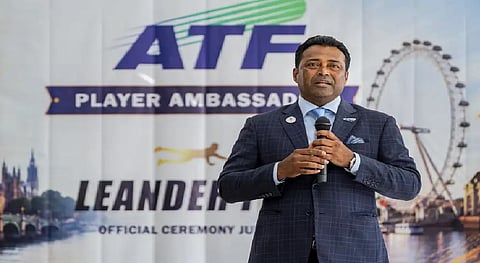

New Delhi | Indian tennis legend Leander Paes has entered the All India Tennis Association's (AITA) electoral fray with a clear agenda of cleaning up the system, restoring the organisation's image and ensuring accountability at every level, saying the association has suffered because some individuals misused their positions for personal gains.
The 53-year-old, who is contesting for the vice-president's post from the group led by interim president Chintan Parikh, said his decision to step into administration was driven by the need to bring change from within and build an organisation that puts players and tournaments first.
"I personally feel that my role here is to support the team to clean up the entire association. A year ago, the All India Tennis Association was not in good health. And it's been like that for many, many years," Paes told PTI in an interview.
Paes, who has won 20 Grand Slam titles across singles, doubles and mixed doubles and represented India in a record seven Olympics, said the priority was to make every individual and every state association accountable.
"I would love to see the All India Tennis Association as powerful as the BCCI. What I would love to see is every individual accountable, every state accountable," he said.
Without naming anyone, Paes referred to certain state associations, AITA Trust funds and individuals who, he alleged, had treated administrative positions as their birthright.
"I don't want to speak about muck. It has been very evident over many years about certain state associations, certain Trust funds that have been there. Certain individuals who believe that it is their birthright to be in a seat," he said.
The former world number one added that the alleged misuse of positions for personal gains had damaged AITA's reputation and made it difficult to attract corporate support.
"AITA has taken a hit by (due to) some past players, administrators and people who have shown AITA in poor light...who have misused the system for their personal gain. From what I see, there has been so much of tremendous personal gain of people misusing their seats. That saddens me," he said.
Paes said restoring confidence among state associations, the sporting fraternity and corporates would be central to his group's efforts.
Asked why he had chosen to contest for the vice-president's position when his stature as an Olympic medallist and seven-time Olympian could have helped him seek a more prominent role, or enter the electoral process through the Sportsperson of Merit (SOM) category, Paes said he believed in learning the administrative ropes rather than jumping into a leadership position.
"One has to be wise to focus on governance and not politics. One has to be wise to take steps and stepping stones to achieve what one can. I don't think one can just jump the gun just because I've played seven Olympics," he said.
Paes said he had complete faith in Parikh's leadership and believed that the AITA interim president had the administrative experience needed to clean up the system.
"I 100 per cent believe that Chintan Parikh is the right man for this job. Under his administration, under his leadership, there are also things that I can learn in administration. I can learn in politics. I can learn in how to deal with the system," he said.
Drawing parallels with his playing career, Paes said a successful team player must know when to lead and when to support others.
"Look at the partnerships I've had. Martina Navratilova, she led, I supported. Martina Hingis, she led, I supported. Mahesh Bhupathi, I led, he supported. Radek Stepanek, I led, he supported. In all of this, I think a true leader is also someone who understands when to lead and when to follow," he said.
Paes also acknowledged that his decision to step away from the SOM route was deliberate, though he declined to discuss the circumstances surrounding it.
"On the merit of being an Olympic champion, I was in Tier 1. On the merit of having played seven World Record Olympics, the Indian Olympic Association was an opportunity too. But I've chosen to follow a leadership and learn through a leadership of a man who's a little more experienced than me," he said.
The former tennis star said his long-term ambition was to build a strong grassroots and player-development structure, with state associations playing a central role in identifying and nurturing talent.
He outlined a pyramid-based model, beginning with grassroots development, followed by a properly structured domestic tournament calendar and culminating in more international events in the country.
"All the state associations need to be empowered to scout talent, nurture talent and build champions," he said.
He also wants India to host more ATP and WTA tournaments, giving domestic players opportunities to earn world ranking points without having to travel overseas extensively.
The former Davis Cup star said he would look to work closely with the Sports Authority of India and the Sports Ministry, while also seeking to involve former players such as Sania Mirza, Mahesh Bhupathi and Rohan Bopanna in developing the next generation.
Paes also proposed a more structured administrative system across five zones -- north, south, east, west and central -- with zone heads holding internal meetings and conducting quarterly evaluations.
"I would like to build a very corporate, clean structure where the legal system is empowered, where the financial system is empowered," he said.
Paes, who recalled the financial hardships he faced while pursuing professional tennis, said providing opportunities to talented children from smaller towns and economically weaker backgrounds would be a personal priority.
"I have had to sleep in locker rooms. Let's not forget, I got mugged in New York at Grand Central Station because I was taking trains everywhere," he said, recalling the struggles of his early career.
"The reason I have come in is for every young child in India, that if Leander can achieve it through all the trials and tribulations then I can do it too," he added.
Paes said the larger objective was to create a healthy tennis ecosystem in which administrators, former players, state associations and athletes worked together rather than against each other.
"This is not one group against the other. This is the right people for the right job to build a very healthy association that puts the players and the athletes and tournaments first," he said.
