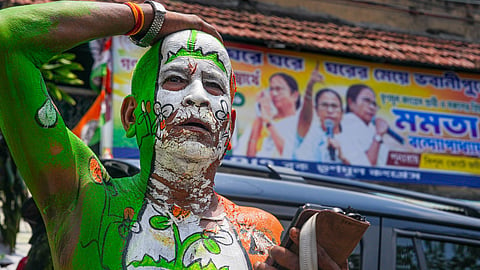

Kolkata | West Bengal's assembly poll verdict signals more than a change of government, it marks a structural rupture in the political order Mamata Banerjee built over the past decade and a half, with the Trinamool Congress (TMC) facing its most consequential moment of recalibration.
For a party that has defined Bengal’s political grammar since 2011, the loss is not merely electoral, it is systemic, evident by the BJP’s decisive breach in a system that rested on centralised authority, welfare delivery and a tightly controlled organisational pyramid.
"The TMC’s model was built on access to power. Once that axis shifts, the entire structure has to be reimagined," said political analyst Biswanath Chakraborty.
The numbers underline the depth of the churn. The BJP’s vote share rising to around 44.8 per cent from 38 per cent in the 2021 assembly polls marks both consolidation and expansion. Conversely, the TMC’s dip to nearly 41.7 per cent from 48 per cent during the same elections reflects a steady erosion of its social coalition — particularly in semi-urban belts and among segments that had anchored its 2021 sweep.
A key point appears to be the 177 constituencies where voter deletions exceeded past victory margins. In these seats, the BJP not only held ground where it was already strong but also made significant inroads into TMC-held territories, suggesting that what appeared to be a technical variable has translated into a political shift.
"This is not a wave in the conventional sense—it is a redistribution of political ground. The BJP has moved from being a challenger to a system-altering force," said another political commentator.
The TMC’s biggest strength -centralisation- has also emerged as its principal vulnerability. With authority concentrated at the top, the party has limited institutional buffers when that layer is weakened.
Also, unlike the Aam Aadmi Party, which expanded beyond Delhi to build governing footholds in Punjab and a growing presence in states like Goa, the All India Trinamool Congress remains overwhelmingly focused on Bengal. This geographic concentration now amplifies the scale of the setback, leaving the party without an alternative power base to cushion the loss.
Inside the TMC, the implications are immediate and potentially destabilising.
A party whose cohesion has long been tied to administrative control, patronage networks and electoral dominance now faces the challenge of holding its organisational structure together without those levers. In the absence of strong ideological cohesion, a section of leaders and elected representatives -many of whom aligned with the party through access to power- could become vulnerable to defections, including to the BJP.
This raises the prospect of an existential phase for the TMC.
For Banerjee, this election is perhaps the defining battle of her political life. After three successive terms and over a decade and a half at the helm, she was not just contesting to retain power but to defend the political ecosystem she had built.
Few leaders embody their party as completely as Banerjee does. The distinction between leader and organisation has, over time, blurred into near-complete overlap, making the current setback as much personal as political.
At 71, and after three terms in office, the road to a comeback appears steeper. While Banerjee has repeatedly demonstrated an ability to rebound from setbacks -from Singur to Nandigram- the current moment presents a different scale of challenge, where time, organisational fatigue and a resurgent opponent converge.
Yet, her politics has historically thrived in resistance. Stripped of power, she could seek to return to that idiom -recalibrating the party from a governance machine to an opposition force.
Setbacks have often served as points of recalibration.Yet, this moment is different. It punctures the aura of inevitability that had come to define her leadership and redraws the relationship between mandate and authority.
Nationally, the implications are layered. Losing Bengal weakens her immediate leverage within the opposition bloc, but does not erase her relevance. A combative Banerjee outside power could still shape opposition discourse -though from a diminished perch.
The spotlight is also likely to be on Abhishek Banerjee, whose organisational role may expand in the coming phase. But managing internal contradictions without the cushion of power could prove significantly more complex.
At the core of the TMC’s defeat also lies the accumulated weight of incumbency. Banerjee had, in previous elections, managed to convert anti-incumbency into electoral advantage. This time, however, the pressures of governance proved harder to deflect.
Corruption allegations, recruitment scams, bureaucratic fatigue and a more cohesive opposition campaign combined to narrow the party’s margin for manoeuvre. The narrative, once tightly controlled, began to slip.
For the BJP, the verdict marks a long-sought breakthrough. But it also brings the challenge of governing a politically charged state where its principal adversary remains intact, if momentarily weakened.
What is clear, however, is that Bengal has entered a new phase. The dominance is broken. The contest has reopened.
For the TMC, the immediate task is not reclaiming power but redefining itself without it.
The result marks the closing of a political arc that began with Banerjee dismantling the 34-year Left Front regime. What followed was a governance model driven by personality, welfare and constant political mobilisation -a system that now faces its first test without administrative control.

