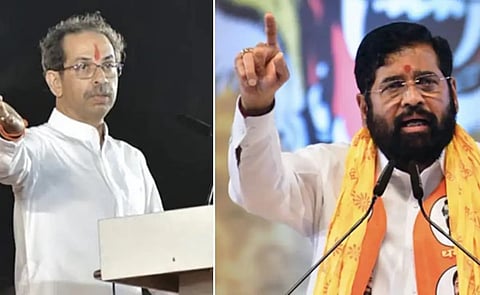

Mumbai | As both factions of the Shiv Sena celebrate 60 years on Friday, the one led by Uddhav Thackeray is facing an existential crisis, while the other, under Eknath Shinde, is battling for relevance in the era of a hegemonic BJP, according to experts.
The undivided Shiv Sena, once a steadfast ally of the BJP for 25 years, was virtually an "elder brother" in the coalition in Maharashtra, but the power dynamics have changed since 2014, after Narendra Modi took charge as the Prime Minister.
The alliance between the two parties broke just before the 2014 assembly polls. The two came together in less than four months, but the relations were never warm again, always simmering, waiting to explode.
The scene repeated itself in 2019 when the Shiv Sena walked out of the BJP-led National Democratic Alliance over the chief minister's post. The break-up later unleashed forces that divided the party into two factions.
It is not that the Shiv Sena was new to revolts. Right from stalwarts like Chhagan Bhujbal to Ganesh Naik to Narayan Rane to Raj Thackeray, it had faced many rebellions, but none matched the one led by Shinde in 2022 that split the Shiv Sena.
Shinde, who rose from the ranks of the Shiv Sena, had then walked away with 39 MLAs and 13 MPs. Subsequently, his group got the party's name and its bow-and-arrow symbol as well.
The Shiv Sena was formed in 1966 by firebrand orator Bal Keshav Thackeray, popularly known as Balasaheb, a cartoonist and son of social reformer Keshav (Prabhodhankar) Thackeray, who championed the cause of the 'Marathi manoos', or the Marathi-speaking population of Maharashtra.
Bal Thackeray made the Shiv Sena a force to reckon with in Maharashtra, particularly in Mumbai, with Shiv Sainiks earning a reputation as street-level activists who fiercely championed the party's causes.
In these 60 years, the undivided Shiv Sena had three chief ministers -- Manohar Joshi, Narayan Rane and Uddhav Thackeray. However, none of them could get an entire five-year tenure. Post the split in 2022, Shinde helmed the government for two and a half years.
Political analyst Hemant Desai said both factions, especially the Shiv Sena (UBT), headed by Uddhav Thackeray, confront a tougher challenge than Bal Thackeray faced in his lifetime. "Bal Thackeray did not live in the time of a hegemonic BJP, but both Sena factions are currently living in that era," he said.
However, the Uddhav Thackeray-led group is staring at a much bigger crisis, Desai said.
With only 20 MLAs, the Shiv Sena (UBT) may be the biggest party in the Opposition camp in the assembly, but the Shinde-led Sena has nearly three times as many legislators in the House.
The undivided Shiv Sena helmed by Thackeray controlled the cash-rich Brihanmumbai Municipal Corporation (BMC) for an uninterrupted 25 years, from 1997 to 2022. The party's hold over the civic body ended in 2022 when the tenure of corporators came to an end. In the next civic elections conducted in 2026, the BJP installed its mayor in the corporation.
The Sena (UBT) currently has only one mayor in the state -- at the Parbhani Municipal Corporation.
Desai also said that there is a silver lining in the crisis faced by the Uddhav-led faction. It can start afresh, though that would require tremendous efforts, especially from Uddhav's son and heir apparent Aaditya Thackeray.
Shinde has been in power since 2014, first in the Devendra Fadnavis government and then in the Uddhav Thackeray-led government, later as chief minister from 2022 to 2024, and as deputy chief minister since 2024. For the Shinde-led Shiv Sena, the challenge will begin once there tightening of noose over finance, Desai said.
Political analyst Sanjay Kumar, a professor at the Delhi-based Centre for Developing Studies and Societies, said the relevance of the two Sena factions needs to be viewed from the context of regional parties, especially in those where the power transfer can take place within the first family. Data indicates that the relevance of both factions has reduced in terms of vote share.
Referring to the split in the undivided Shiv Sena headed by Thackeray, Kumar said his group is staring at another split and did not seem to take its cue from the Trinamool Congress, whose Lok Sabha MPs formed a separate group and later merged with the Nationalist Congress Party of India (NCPI).
"Uddhav faction is more prone to getting into deeper trouble as it is not in power," Kumar said.
He further said that while the Sena (UBT) is set to lose six MPs, the sheer magnitude of loss in assembly elections has a direct impact in terms of the number of MPs a party sends to the Rajya Sabha. This also affects the party's share in national politics, he said.
Kumar said the Sena (UBT) not only faces issues with leadership, but also an ideological crisis as the BJP has "snatched" its Hindutva plank.
The Shinde-led Shiv Sena is likely to remain relevant for some time as the BJP still does not command a complete majority in the state elections, he said.
"Slowly and gradually, the Shinde-led Sena is moving towards losing relevance just like the JD(U) in Bihar," Kumar added

