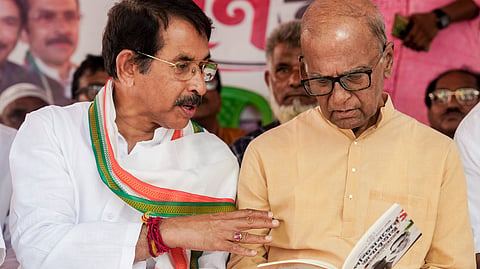

Kolkata | West Bengal Congress president Subhankar Sarkar on Tuesday invited TMC supremo Mamata Banerjee to the party's July 21 programme in Kolkata, saying she should acknowledge that leaving the Congress nearly three decades ago was a "mistake".
Speaking to reporters after reviewing preparations for the 'Martyrs' Day' programme at Shahid Minar, Sarkar said Banerjee should recognise the historical significance of the July 21, 1993 movement instead of "attempting to rewrite its legacy".
"If Mamata Banerjee really has the courage, she should not distort history. She should admit that she took a wrong political decision in the past. She is welcome to come to our programme at Shahid Minar and pay tribute to the martyrs," he said.
Sarkar asserted that the July 21, 1993 movement was organised under the banner of the Youth Congress and that its association with the Congress could not be erased.
"The movement of July 21, 1993 was held under the Youth Congress flag. That is a part of history, and there is no scope to deny it. A political leader who respects his or her own political past earns greater respect," he said.
The Congress leader said Banerjee's participation in the programme, coupled with an acknowledgement that quitting the Congress was a political error, would be a significant gesture.
"If she publicly says that leaving the Congress was a mistake and comes to the Shahid Minar stage to pay homage to the July 21 martyrs, it will be an important act of political atonement. It will at least show an effort to correct some of the mistakes of the past. The Congress stage is open to everyone, and she is free to come and pay her respects," Sarkar said.
On July 21, 1993, 13 people allegedly died in police firing on a Youth Congress rally led by Banerjee.
Banerjee, who left the Congress in December 1997 and formed the TMC, has been observing the day with mega rallies. The rallies had become a show of her party's organisational strength over the years, while the Congress continued to mark the day with comparatively low-key programmes.
With Banerjee losing power in the assembly polls, the situation has somewhat changed as her party fights rebellion on multiple fronts.
The rebel TMC faction led by Ritabrata Banerjee is organising a separate observance of the anniversary near the Mahatma Gandhi statue in Esplanade. On the other side, police have denied permission to the group loyal to the former CM to hold the programme in front of Victoria House, where it has been traditionally held, with the matter now pending in court.
Kolkata | Senior TMC MP Kalyan Banerjee on Tuesday renewed his blistering attack on party national general secretary Abhishek Banerjee, alleging that the "Camac Street ecosystem" built around him had hollowed out the organisation and played a key role in the party's collapse in the 2026 West Bengal Assembly polls.
Escalating his criticism amid the deepening split within the TMC, Banerjee alleged that leaders and workers who had operated through Abhishek's Camac Street office and political strategist I-PAC were now either joining the rebel camp or turning against the very leadership they once projected as unassailable.
"Camac Street has finished the party," Banerjee said, in one of his sharpest attacks yet on Abhishek Banerjee's political style and the organisational structure that evolved around his office on Camac Street.
He also levelled allegations against Abhishek Banerjee's aide Sumit Roy, claiming that several grassroots organisers who had coordinated party affairs through the Camac Street office were now facing police pressure and being coerced into joining the Ritabrata Banerjee-led rebel faction, an allegation that could not be independently verified.
According to Banerjee, many of those now spearheading the rebellion were the very leaders who had earlier benefited the most from their proximity to Abhishek Banerjee and I-PAC.
"They enjoyed every privilege, projected themselves as Abhishek's representatives and used that identity to exercise influence. Today, they are the ones attacking him the most," he said.
Banerjee also revived his long-running criticism of election consultancy firm I-PAC, accusing it of replacing the party's traditional organisational culture with a consultant-driven political model that ultimately weakened the TMC from within.
He alleged that the consultancy exercised disproportionate influence over candidate selection and organisational decisions, sidelining experienced party workers and encouraging a culture of patronage rather than political commitment.
Political parties, he said, could not be run through surveys, data analytics and external agencies but only through sustained engagement between workers and voters.
Banerjee further claimed that I-PAC had created unrealistic expectations among numerous aspirants by giving them hope of securing Assembly nominations.
When many of them were denied tickets, resentment spread across the organisation, contributing to internal sabotage during the assembly polls, he alleged.
Maintaining that his objections were not new, Banerjee said he had repeatedly cautioned the party leadership since 2022 against becoming excessively dependent on political consultants, but his warnings had gone unheeded.
His latest remarks come as the TMC faces its gravest internal crisis since its formation in 1998, with the organisation now split between the Mamata Banerjee-led faction and rebels led by former Rajya Sabha MP Ritabrata Banerjee.
The rebellion has been driven largely by opposition to Abhishek Banerjee's growing influence within the party and his emergence as Mamata Banerjee's political heir after the TMC's electoral setbacks.
For the first time since the party's inception, rival factions are preparing to observe the July 21 Martyrs' Day programme separately.
Last month, the Ritabrata Banerjee camp convened what it described as a special organisational session, elected senior MLA Arup Roy as its chairperson and announced a parallel organisational structure, removing founder chairperson Mamata Banerjee from the post.
The organisational rupture widened after 58 of the party's 80 MLAs backed Ritabrata Banerjee's claim to the post of Leader of the Opposition, rejecting the nominee supported by the Mamata Banerjee camp. The rebel faction now claims the support of around 65 legislators.
The split has also extended to Parliament, with 20 of the TMC's 28 Lok Sabha MPs breaking away, backing the BJP-led NDA after merging with the Nationalist Citizens Party of India (NCPI), while several other senior leaders have distanced themselves from the Mamata Banerjee camp.
Banerjee had also blamed Abhishek Banerjee soon after the change of government in the state, alleging that his "arrogance" and unwillingness to respect senior leaders had contributed significantly to the party's decline, saying the leadership had failed to draw lessons despite suffering a historic political setback.

