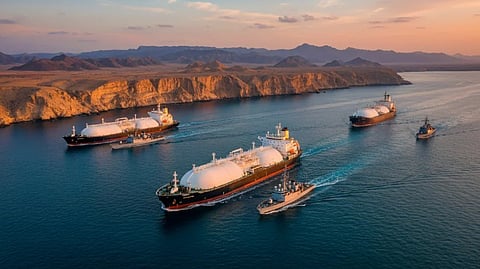

Washington | US President Donald Trump on Saturday urged nations affected by Tehran’s “attempted closure” of the Hormuz Strait to send ships to secure the narrow shipping lane crucial for global oil supplies as the war with Iran entered the third week.
In a post of Truth Social, Trump urged countries such as China, France, Japan, South Korea, the UK and others to send ships to the Hormuz Strait, asserting that the US will continue to bomb the shoreline and target Iranian ships and boats.
Starting February 28, the US and Israel have launched a massive joint attack on Iran and with Iran's retaliation, it has extended to the entire Gulf region. Iranian strikes in Hormuz have affected maritime traffic in the strait, which is crucial for global supply chains for crude and oil.
“Many countries, especially those who are affected by Iran’s attempted closure of the Hormuz Strait, will be sending war ships, in conjunction with the United States of America, to keep the Strait open and safe,” the US President said in his social media post.
However, it was not clear if there was any formal arrangement regarding this or it was the president who wanted it to happen.
Trump claimed that the US has already destroyed 100 per cent of Iran’s military capability, but it’s easy for them to send a drone or two, drop a mine, or deliver a close range missile somewhere along, or in, this waterway, no matter how badly defeated they are.
“Hopefully, China, France, Japan, South Korea, the UK, and others, that are affected by this artificial constraint, will send ships to the area so that the Hormuz Strait will no longer be a threat by a nation that has been totally decapitated,” he said.
“In the meantime, the United States will be bombing the hell out of the shoreline, and continually shooting Iranian Boats and Ships out of the water. One way or the other, we will soon get the Hormuz Strait OPEN, SAFE, and FREE,” Trump said.
Global oil and gas prices have surged after Iran has virtually blocked the Strait of Hormuz, a narrow shipping lane between the Persian Gulf and the Gulf of Oman, that handles roughly 20 per cent of global oil and LNG (Liquefied Natural Gas).
The region has been a major source of India's energy procurement.
In New Delhi, External Affairs Ministry Spokesperson Randhir Jaiswal said, two Indian ships Shivalik and Nanda Devi crossed the Strait of Hormuz and are now headed to ports in India, and added, several of India's ships remained in the Gulf region.
Meanwhile, the US on Friday issued an order to clear the decks for a company operating off the California coast to restart an oil pipeline that state officials have kept offline since 2015.
“Today, more than 60 per cent of the oil refined in California comes from overseas, with a significant share travelling through the Strait of Hormuz — presenting serious national security threats,” the Department of Energy announced.
Energy Secretary Chris Wright said in a statement that the move would “strengthen America’s oil supply and restore a pipeline system vital to our national security and defence, ensuring that West Coast military installations have the reliable energy critical to military readiness.”
The announcement drew sharp criticism from Democrat leader and California Governor Gavin Newsom, who accused Trump of using the Iran war to open California’s beaches for his oil industry friends.
“Donald Trump started a war, admitted it would spike gas prices nationwide, told Americans it was a small price to pay, and now he’s using this crisis of his own making to attempt what he’s wanted to do for years: open California’s coast for his oil industry friends so they can poison our beaches,” Newsom said in a statement.
The Democrat leader called the attempt to restart the pipeline as illegal and said that it “wouldn’t lower prices by a cent” due to the fact that oil prices are set on the global marketplace.
New Delhi | Two Indian ships carrying LPG from the Gulf countries crossed the Strait of Hormuz early on Saturday morning, raising the number of Indian vessels safely passing through the war-hit, narrow shipping lane to three.
The remaining 22 ships on the west side of the strait are on standby as the Indian government engages with governments in the region for ensuring their safe passage.
LPG carriers Shivalik and Nanda Devi are now headed to Mundra and Kandla ports in Gujarat, Rajesh Kumar Sinha, Special Secretary in Ministry of Shipping, told a media briefing.
The vessels are carrying 92,700 tonnes of LPG, he said adding Shivalik is likely to reach Mundra on March 16 and Nanda Devi is likely to dock at Kandla the next day.
Besides the safe passage being an important milestone for Indian diplomacy, the cargo they are carrying is considered critical as shipping constraints had impacted cooking gas LPG supplies.
India imports 60 per cent of its LPG needs, with 85-90 per cent of this being sourced from Gulf countries like Saudi Arabia and the UAE who use the Strait of Hormuz as transit for shipping oil and gas to users. The strait has been effectively closed since the first week of March.
The two ships were among the 24 stranded on the west side of the strait since the war broke out in the region.
Besides, four others were stranded on the east side. One of them, an India-flagged oil tanker, Jag Prakash, carrying gasoline from Oman to Africa, crossed the war-hit strait on Friday.
Sinha said of the 22 remaining Indian-flagged vessels on the west side, six are LPG vessels, one is a liquefied natural gas (LNG) carrier, four are crude oil tankers, one is carrying chemical products, three are container ships and two are bulk carriers. Of the remaining, one is a dredger and another is empty, holding no cargo. Three others are on dry docks, meaning on routine maintenance.
Hundreds of ships had been stranded in the narrow sea lane between Iran and Oman since the US and Israel launched attacks on Iran, and Tehran targeted the region in retaliation.
"Several of our ships remain on standby in the Gulf region. We propose to continue to remain in touch and coordinate with all the concerned countries to ensure a safe and unimpeded transit for them in our effort to ensure our energy security," MEA spokesperson Randhir Jaiswal said at the briefing.
Sinha said in all 28 Indian flags vessels were stuck - 24 on the west of the Strait of Hormuz and four on the east.
Jag Prakash was loaded with gasoline from Sohar port in Oman and headed to Tanga in Tanzania. It is due to reach Tanga on March 21.
"The remaining 22 vessels (on the west side) have 611 seafarers," he said adding Indian authorities including DG Shipping are closely monitoring the situation.
Three vessels remain stuck on the east side with 76 seafarers on board.
He said DG Shipping is coordinating with ship owners, RPSL agencies and Indian missions on the remaining vessels.
Sinha said port operations across India remain stable. SOPs have been issued for major ports and state maritime boards, according priority berthing to vessels carrying LPG, a fuel that is running short in the country.
Six vessels arrived from different parts of the world at Indian ports and were given safe anchorage, he added.
Ministry of Ports, Shipping and Waterways continues to closely monitor the maritime situation in the Persian Gulf, he added.

