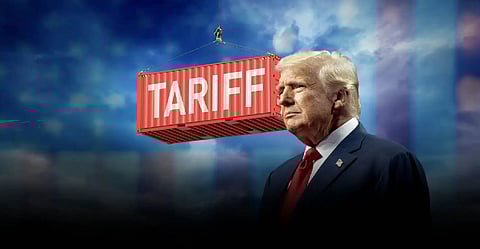

Washington/New Delhi | US President Donald Trump on Saturday announced hike in tariffs on all countries to 15 per cent from 10 per cent, which was imposed a day earlier.
Following a Supreme Court verdict against his earlier sweeping tariffs, Trump on Friday imposed a 10 per cent tariffs on all the countries, including India from February 24 for 150 days.
Commenting on the 10 per cent tariff, the Indian government on Saturday said it is studying these and their implications.
"Based on a thorough, detailed, and complete review of the ridiculous, poorly written, and extraordinarily anti-American decision on Tariffs issued yesterday, after MANY months of contemplation, by the United States Supreme Court, please let this statement serve to represent that I, as President of the United States of America, will be, effective immediately, raising the 10 per cent Worldwide Tariff on Countries, many of which have been "ripping" the U.S. off for decades, without retribution (until I came along!), to the fully allowed, and legally tested, 15 per cent level.
"During the next short number of months, the Trump Administration will determine and issue the new and legally permissible Tariffs, which will continue our extraordinarily successful process of Making America Great Again," he said in a social media post.
In a proclamation titled 'Imposing a Temporary Import Surcharge to Address Fundamental International Payments Problems' dated February 20, Trump said he is imposing, for a period of 150 days, a "temporary import surcharge of 10 per cent ad valorem" on articles imported into the US," effective February 24.
In a major setback to Trump's pivotal economic agenda in his second term, the US Supreme Court ruled that the tariffs imposed by Trump on nations around the world were illegal and that the president had exceeded his authority when he imposed the sweeping levies.
Further, a fact sheet issued by the White House said Trump is invoking his authority under Section 122 of the Trade Act of 1974, which empowers the President to address certain fundamental international payment problems through surcharges and other special import restrictions.
The fact sheet noted that some goods will not be subject to the temporary import duty because of the needs of the US economy.
The goods include certain critical minerals, metals used in currency and bullion, energy, and energy products; natural resources and fertilisers that cannot be grown, mined, or otherwise produced in the US; certain agricultural products, including beef, tomatoes, and oranges; pharmaceuticals; certain electronics; passenger vehicles, some light trucks, certain medium and heavy-duty vehicles, buses, and certain aerospace products.
Trump lashed out at the Supreme Court justices who ruled against him, calling them "fools and lapdogs".
"The Supreme Court's ruling on tariffs is deeply disappointing, and I'm ashamed of certain members of the Court, absolutely ashamed for not having the courage to do what's right for our country," he told reporters at the White House on Friday, just hours after the verdict came in.
The US President also said that "nothing" changes in the trade deal with India in the wake of this verdict, as he responded to the ruling by announcing an additional 10 per cent global levies on items imported into America.
"Nothing changes. They'll (India) be paying tariffs, and we will not be paying tariffs. So deal with India is they pay tariffs. This is a reversal for what it used to be... So we made a deal with India. It's a fair deal now, and we are not paying tariffs to them, and they are paying tariffs. We did a little flip," Trump said.
The Indian commerce ministry in a statement said the government is studying the developments on the US tariffs and their implications.
"We have noted the US Supreme Court judgement on tariffs yesterday (Friday). US President Donald Trump has also addressed a press conference in this regard. Some steps have been announced by the US administration. We are studying all these developments for their implications," it said.
The US had imposed a reciprocal tariff of 25 per cent on India in August.
Later, an additional 25 per cent was imposed for buying Russian crude oil, taking the total tariffs on India to 50 per cent.
Meanwhile, earlier this month, both countries agreed to finalise an interim trade deal, under which Washington agreed to cut down the tariffs to 18 per cent. So far, the punitive 25 per cent has been removed. The remaining 25 per cent exists.
After the proclamation, the tariffs on Indian goods will be 10 per cent from the existing 25 per cent. Now Trump has again announced hiking these tariffs to 15 per cent. This levy, if notified, will be over and above the existing MFN or import duties in the US.
For instance, if a product faces a 5 per cent MFN duty, an additional 15 per cent will be imposed, taking the effective duty to 20 per cent.
Earlier, this was 5 plus 25 per cent.
There is no clarity, however, about what the tariff imposed by the US will be on countries, such as India, after the 150-day period.
To finalise the legal text for the first phase of the bilateral trade agreement, the Indian team is scheduled to meet its counterparts in Washington from February 23-26, 2026.
Commerce Minister Piyush Goyal had said the deal may be signed in March and implemented in April.
Welcoming the 10 per cent tariff, apex exporters' body Federation of Indian Export Organisations (FIEO) said the move would boost competitiveness of labour-intensive sectors such as gems and jewellery and engineering.
"The reduction of the US reciprocal tariff on India improves competitiveness for key sectors such as pharmaceuticals, electronics, engineering goods, textiles, and gems and jewellery, particularly amid supply chain diversification," FIEO Director General Ajay Sahai said.
However, Section 232 tariffs on steel, aluminum, copper (50 per cent) and certain auto products (25 per cent) remain a constraint, he said, adding that India should leverage this improved position to expand market share while pursuing trade negotiations for greater stability and sectoral relief.
The extent of benefit of the lower tariffs for Indian exporters remains to be seen as India's competitors, too, will now need to pay the reduced rate of 10 per cent.
If India will look at renegotiating its trade deal with the US, he said India is unlikely to renegotiate out of compulsion.
"However, both sides may recalibrate negotiations in light of the changed tariff environment. The ruling creates an opportunity to pursue a more balanced and rules-based framework rather than one driven by unilateral tariff actions," Sahai said.
Think tank GTRI said India should reassess the deal.
"Taken together, the ruling and the temporary tariff response inject significant uncertainty into global trade relations and ongoing negotiations. Countries that made concessions to avoid higher US tariffs may now reassess the value of those agreements, while the legal fragility and short duration of the 10 per cent tariff complicate business planning and diplomatic strategy, the GTRI said.
The Congress on Saturday demanded that the government put the interim trade agreement on hold and renegotiate the terms of the deal.
Congress General Secretary Jairam Ramesh said the government must also ensure that the interests of Indian farmers are fully protected during renegotiations and asked the government to categorically state that it will not allow any import liberalisation to the American side.
During 2021-25, the US was India's largest trading partner in goods. The US accounts for about 18 per cent of India's total exports, 6.22 per cent in imports and 10.73 per cent in bilateral trade.
In 2024-25, the bilateral trade touched USD 186 billion (USD 86.5 billion exports and USD 45.3 billion imports).
