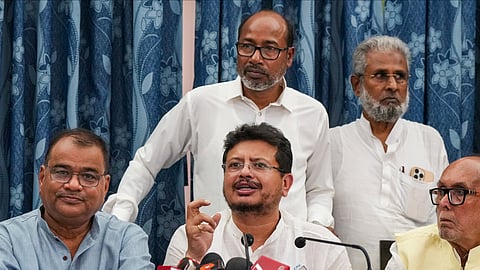

Kolkata | The TMC on Wednesday suffered its first split in its 28-year history as 58 rebel MLAs elected expelled leader Ritabrata Banerjee as Leader of Opposition, wresting control of its legislature party, and secured recognition from the Assembly Speaker, plunging Mamata Banerjee's outfit into its gravest internal crisis since its inception.
Within hours, a rattled TMC leadership dissolved all party committees and frontal organisations across West Bengal in what appeared to be an attempt to regain political control amid a fast-escalating power struggle.
The dramatic rebellion, unfolding within two months of the party's crushing defeat in the assembly elections, exposed a deep rupture between the organisation and its elected legislators, raising questions over leadership, succession and the future direction of the party that has dominated Bengal politics for more than a decade.
The rebel camp, led by Ritabrata Banerjee and fellow expelled MLA Sandipan Saha, submitted letters of support from 58 legislators before Speaker Rathindra Bose, comfortably crossing the two-thirds threshold required under the anti-defection law for recognition as a separate bloc.
"Our claim has been accepted by the Speaker," Ritabrata Banerjee told reporters after meeting the Speaker.
Claiming legitimacy through numbers, he asserted that the dissidents now represented the real Trinamool Congress in the Assembly.
"The TMC legislative party is a team of 58 MLAs who won on the TMC symbol. We are the real TMC now in the Assembly," he said.
The Speaker's acceptance effectively formalised the first organisational rupture in a party founded by Mamata Banerjee in 1998 after her break from the Congress.
The dissident camp unveiled a new leadership structure, naming Ritabrata Banerjee as LoP and Akhruzzaman as chief whip. Senior legislators and party old-timers Javed Ahmed Khan, Sandipan Saha, Sabina Yasmin and Shiuli Saha were appointed deputy leaders.
Several veteran TMC legislators joined the rebellion, including Samar Mukhopadhyay, Arup Roy, Rathin Ghosh, Javed Khan and Prasun Banerjee.
Yet, significantly, the rebels stopped short of directly challenging Mamata Banerjee's primacy.
In their communication to the Speaker, they continued to recognise her as chairperson of the Trinamool Congress while making it equally clear that they no longer accepted the authority of her nephew and party national general secretary Abhishek Banerjee in the functioning of the legislature party.
"We accept Mamata Banerjee as our leader but do not accept Abhishek Banerjee," a leader associated with the dissident camp said.
Seeking to soften the optics of the revolt, Ritabrata Banerjee even appealed to the former chief minister to guide the legislature party.
"We would request Mamata Banerjee to play the role of chief adviser to the legislative party," he said.
However, the Mamata Banerjee camp questioned the validity of the rebels' move, claiming that the communication to the Speaker was submitted on plain paper rather than the party's official letterhead. It maintained that only the party chairperson and national general secretary Abhishek Banerjee were empowered to convey such decisions to the Assembly.
Unfazed by the challenge, Ritabrata Banerjee asserted that every step had been taken in conformity with parliamentary conventions and legislative rules.
The rebellion traces its immediate origins to the controversy surrounding the selection of the Leader of Opposition after the elections.
The dispute erupted when a proposal sent to the Speaker seeking recognition of senior TMC MLA Sobhandeb Chattopadhyay allegedly contained forged signatures of several legislators. The allegations led to an FIR and a CID probe.
What began as a procedural dispute soon snowballed into a battle for control of the legislature party and eventually into the biggest challenge to Mamata Banerjee's authority since she founded the party.
Recognising the seriousness of the threat, the Mamata Banerjee-led faction moved swiftly on the organisational front, announcing a comprehensive review of its structure and functioning before reconstituting all organisational units.
"After careful consideration, it has been decided that all committees of the All India Trinamool Congress in West Bengal, as well as all its frontal organisations, shall stand dissolved with immediate effect," the party said in a statement.
Significantly, Ritabrata Banerjee was state president of the TMC’s trade union, whereas Abhishek Banerjee was the TMC national general secretary.
Political observers viewed the move as an acknowledgement that the crisis had gone beyond routine factionalism and entered the realm of a struggle for control of the party itself.
For many, the unfolding events carried unmistakable echoes of Maharashtra.
Like the Shiv Sena split engineered by Eknath Shinde in 2022 and the Nationalist Congress Party split led by Ajit Pawar in 2023, the Bengal rebellion has been built around numerical strength within the legislature party rather than control of the parent organisation.
But there remains one critical difference.
Unlike Shiv Sena founder Bal Thackeray, who was no longer alive when the Maharashtra split unfolded, Mamata Banerjee remains an active political force. That perhaps explains why even her rebels continue to publicly acknowledge her leadership while simultaneously dismantling her authority within the legislature party.
The parallels nevertheless remain striking. The architect of the rebellion is Ritabrata Banerjee, a former CPI(M) leader and Rajya Sabha member who once rose rapidly within the TMC after being expelled by the CPI(M).
The political beneficiary, many observers argue, is Chief Minister Suvendu Adhikari, himself once one of Mamata Banerjee's closest lieutenants before crossing over to the BJP and emerging as her fiercest rival.
The crisis also carries a layer of political irony that has not gone unnoticed by the opposition.
Both the CPI(M) and Congress said the TMC was now experiencing the same politics of defections that it had perfected after coming to power in 2011.
According to CPI(M) and Congress leaders, between 2011 and 2021, during the 16th and 17th Assemblies, at least 65 legislators from the Left and Congress camps crossed over to the Trinamool without any of them facing disqualification under the anti-defection law.
"History has come full circle," CPI(M) leader Sujan Chakraborty remarked.
Senior TMC leader Kunal Ghosh, however, accused the dissidents of betraying the party at a difficult moment.
"These differences could have been resolved within the party. This is backstabbing," he said.
The BJP wasted little time in exploiting the turmoil.
"Mamata Banerjee has lost control of her legislative party. This is only the beginning," BJP IT department head Amit Malviya said in a social media post.
For Mamata Banerjee, the challenge now extends far beyond retaining organisational control.
The rebellion threatens to create two competing centres of authority within the TMC -one controlling the party apparatus including symbol and funds and another claiming legitimacy through legislative numbers.
The battle ahead is likely to be fought not merely over posts and positions but over the ownership of the TMC's political legacy itself.
For a party that once appeared inseparable from the personality and authority of its founder, Wednesday's developments marked a historic rupture.
The first split in the TMC since its inception has arrived not from outside but from within, opening a new and uncertain chapter in Bengal politics and raising existential questions about the future of one of India's most formidable regional parties.
Kolkata | An "accidental" meeting in Delhi, a signature-forgery controversy, simmering resentment over the influence of TMC MP Abhishek Banerjee and a succession battle – developments that unfolded with breathtaking speed over just 13 days leading to the first split in the 28-year-old party.
What began with an apparently chance encounter between rebel TMC MLA Ritabrata Banerjee and Chief Minister Suvendu Adhikari at Banga Bhavan on May 22 ended on Wednesday with 58 MLAs wresting control of the party's legislature wing, electing Ritabrata as their leader and securing recognition from the Assembly Speaker.
The rebellion formally fractured a party founded by Mamata Banerjee on January 1, 1998, after breaking away from the Congress.
Yet the seeds of the revolt had been sown much earlier.
Soon after the Assembly poll defeat on May 4 at the hands of the BJP, unease began surfacing within sections of the party over what some legislators perceived as the growing concentration of authority around Abhishek Banerjee, the nephew of the party chief.
At a meeting of newly elected MLAs on May 6, Mamata Banerjee reportedly asked legislators to rise and applaud Abhishek for his role in the campaign. While intended as recognition of his contribution, the gesture triggered murmurs among a section of legislators who felt the party was increasingly revolving around one family.
The first public signs of dissent emerged on May 19. At another meeting, Ritabrata Banerjee and Entally MLA Sandipan Saha questioned why Falta MLA Jahangir Khan had not been expelled despite publicly announcing his withdrawal from the repoll. Since Jahangir was regarded as being close to Abhishek, the criticism was widely interpreted as a challenge to the TMC national general secretary.
Veteran MLA Kunal Ghosh also voiced similar concerns, though he would later distance himself from the rebel camp.
The turning point came three days later. On May 22, Ritabrata, who was in Delhi to complete post-Rajya Sabha formalities following the end of his tenure, visited Banga Bhavan for lunch. There he bumped into Chief Minister Suvendu Adhikari.
Afterwards, he publicly welcomed Adhikari's decision to invite opposition legislators and MPs to administrative review meetings, describing the move as a healthy democratic practice. The remarks immediately drew attention in political circles.
Within days, however, a separate controversy engulfed the TMC. On May 25, allegations surfaced that signatures of several legislators had been forged on documents submitted to the Speaker regarding the leadership structure of the legislature party.
The dispute acquired a legal dimension on May 27 when Ritabrata and Sandipan formally complained to the Speaker, alleging forgery. The Assembly secretariat subsequently approached the police, triggering a CID investigation.
As investigators began questioning legislators over the next two days, the controversy transformed from a procedural issue into a political dispute.
The signature row became a rallying point for disgruntled MLAs, triggering intense lobbying, strategy meetings and behind-the-scenes mobilisation across the state.
The crisis deepened further on May 30 when Abhishek Banerjee came under a mob attack during a visit to Sonarpur.
While political parties condemned the incident, several TMC leaders privately noted the muted response from sections of the organisation and the legislature party, seeing it as evidence of a widening disconnect between the leadership and a section of elected representatives.
By May 31, the erosion of authority had become visible. A meeting of newly elected MLAs convened by Mamata Banerjee at her Kalighat residence reportedly witnessed poor attendance, depriving the leadership of the show of unity it had hoped to project.
The decisive rupture came on June 1. Hours after Adhikari publicly disclosed that the CID probe had been initiated based on complaints filed by Ritabrata and Sandipan, the TMC expelled both leaders from the party.
Instead of containing the crisis, the move accelerated the rebellion.
The expelled leaders sharpened their attack on Abhishek Banerjee, accusing him of centralising power within the organisation. Within rebel circles, the campaign soon acquired a name -- "Operation Crown Prince".
Even as the party attempted to regain control by sending fresh communications to the Speaker on June 2 regarding the legislature party leadership, support continued shifting towards the dissidents.
The denouement arrived on Wednesday. A group of 58 MLAs submitted a letter to the Speaker, electing Ritabrata Banerjee as leader of the legislature party and nominating a new leadership team.
The Speaker accepted the claim, effectively recognising the rebel faction as the official legislature wing of the TMC. Minutes later, many of the same legislators attended a government review meeting convened by Adhikari at the state secretariat Nabanna.
For a rebellion that began in Delhi and gathered momentum through allegations of forged signatures, organisational resentment and a battle over succession, the final act played out inside the Assembly itself.
In just 13 days, a party built around Mamata Banerjee's personality and political dominance witnessed the biggest rupture in its existence.
The irony of the moment was hard to miss. Not long ago, Ritabrata frequently invoked Vladimir Lenin while explaining Mamata Banerjee's political appeal, arguing that he understood the Bolshevik leader's theories on mass politics by watching the TMC supremo work among ordinary people.
On Wednesday, the former CPI(M) leader found himself at the head of what supporters described as a "legislative revolution" against the very leader he once compared to Lenin.
American journalist John Reed immortalised the Bolshevik Revolution in his classic account, "Ten Days That Shook the World".
Between May 22 and June 3, Bengal witnessed a political upheaval of its own: 13 turbulent days that shook TMC, reshaped the state's principal opposition party and altered the course of its politics.
Kolkata | The Enforcement Directorate served a summons to Trinamool Congress MP Abhishek Banerjee on Wednesday, asking him to appear before it on June 15 in connection with the primary school recruitment irregularities case, officials said.
A team of ED officers visited Banerjee's Kalighat Road residence in south Kolkata in the evening, and delivered the summons to a member of his staff as he was not present, they said.
The Diamond Harbour MP, who is the nephew of former CM Mamata Banerjee, was directed to appear before the agency at its CGO Complex office in Salt Lake, they added.
The ED has been probing the primary teacher recruitment scam since 2022. The agency has conducted multiple raids at properties linked to TMC leaders in connection with the case, and arrested several heavyweights, including former state education minister Partha Chatterjee.
Over the past year, the ED questioned several officials and attached assets worth crores of rupees, as the investigators suspect a wider conspiracy involving fraudulent appointments, tampered merit lists, and intermediaries who facilitated illegal teacher postings in state-run schools.
Besides the ED, which is assessing the trail of the proceeds of crime, the CBI is investigating other aspects of the case. The two agencies have been filing charge sheets in phases as evidence is consolidated.
The ED is probing the role of Abhishek Banerjee-linked Leaps and Bounds Pvt Ltd in connection with the case after detecting suspicious transactions linked to accused middlemen, officials said.
The company has been raided and its assets attached in connection with the money-laundering probe, while Banerjee has firmly denied any wrongdoing.

