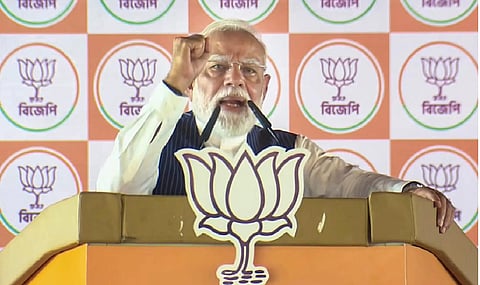

Kolkata | Prime Minister Narendra Modi on Friday mounted an aggressive twin-pronged attack on the ruling TMC, declaring that the first phase of West Bengal’s assembly elections had sealed a “wave of change” in favour of the BJP and signalled the beginning of the end of the Mamata Banerjee-led government’s “maha jungle raj”.
Addressing back-to-back rallies in Dum Dum’s Panihati and Baruipur in the Jadavpur Lok Sabha segment, Modi framed the nearly 92 per cent turnout in Thursday’s first phase of polling as an endorsement of the BJP’s call for regime change and a rejection of what he described as TMC’s “dictatorship”, corruption and syndicate rule.
“The wave of change that had been visible in Bengal for a long time — yesterday’s first phase of voting has put its seal on it. The support shown in favour of the BJP has sounded the conch shell of the BJP’s victory,” he said.
Seeking to convert the high turnout into a larger political narrative, Modi said the people of Bengal had begun reclaiming democracy through the ballot after years of political intimidation.
“In Bengal, where TMC had crushed the temple of democracy, where it had shattered democracy with its dictatorship, people in the first phase have reconstructed that temple. In the second phase, you have to unfurl the victory flag over this temple,” he said.
The TMC was rattled by Thursday’s turnout, Modi claimed, saying, “This is why throughout last night, the TMC was empowering its goons to take to the field.”
Escalating the attack, he said, “Yesterday’s first phase of voting has declared the end of TMC’s reign of jungle raj. On May 4, after the results are declared, TMC goons will have no place to hide. No one will be able to protect them.”
At the Baruipur rally, Modi sharpened the pitch, claiming the TMC might “not even be able to open its account” if the momentum seen in phase one continued.
“Now you must ensure a decisive defeat for TMC and a clear victory for the BJP,” he told the gathering.
The PM sought to present the BJP as the preferred choice of people cutting across classes and professions, saying support for the saffron party was visible everywhere in Bengal.
“Since Independence, the nation has never witnessed anything like what the people of Bengal have demonstrated this time. Everywhere, the talk is about how much massive support the BJP has received in Bengal,” he said.
Modi cast the election as a larger ideological battle to restore Bengal’s pride, invoking Netaji Subhas Chandra Bose and saying the state needed a “new revolution”, this time through the vote.
“Netaji Subhas Chandra Bose had called upon the nation to break the chains of slavery: 'give me blood and I will give you freedom'. This is the time for a new revolution in Bengal. This revolution will happen with your one vote,” he said.
The PM said the BJP’s promise was to deliver Bengal from “years of hardship” by ensuring freedom from fear, corruption, syndicate rule, atrocities against women, unemployment, forced migration and what he called the growing pressure of infiltration.
“To restore Bengal’s pride once again, to make Bengal the land of opportunities again, this freedom is absolutely essential. TMC has destroyed Bengal’s identity. Infiltrators are being settled here. They are encroaching on land and taking away people’s livelihoods,” Modi alleged.
On one side, there is TMC’s corruption and on the other, the pressure of infiltration, he said, adding that as a result, many Bengalis are being forced to leave their homes in search of opportunities.
Modi accused the ruling party of institutionalising corruption across sectors and protecting criminal networks.
“In the last 15 years, TMC has only worked to loot Bengal. There is no sector left untouched by corruption,” he said, listing alleged recruitment irregularities, chit fund frauds, coal and sand mining scams, ration distribution irregularities and the “cut money” culture.
Turning to Bengal’s industrial decline, Modi said the TMC had “ruined” the state’s economy in its 15 years in power.
“People once came to Kolkata for employment. Today, migration of youth has become the biggest challenge here,” he said, alleging that industries, MSMEs and industrial hubs such as Dum Dum had weakened under “syndicate raj”.
At Jadavpur, he linked the same charge to local grievances, alleging that syndicates controlled construction material supply and residents were forced to pay “protection money” even to build homes on their own land.
He also attacked the TMC over frequent unrest at Jadavpur University, saying the premier institution had become a symbol of disorder and political intimidation.
“Jadavpur University was once spoken of with great respect. The foundation of the campus was built on nationalism. But today, people are being threatened and students are being forced to protest. We do not want anarchy; we want a healthy academic environment,” he said.
Women’s safety and representation also figured prominently in Modi’s campaign pitch as he described the TMC as an “anti-women party” and projected the BJP’s “women-led development model”.
Referring to BJP’s Panihati candidate Ratna Debnath, mother of the RG Kar hospital's rape-murder victim, Modi sought to turn the high-profile case into a political indictment of the ruling dispensation.
“The mother who helped her daughter become a doctor, and whose daughter was taken away by TMC’s maha jungle raj. BJP has made that mother its candidate,” Modi said while campaigning for Ratna Debnath in Panihati.
He said the BJP had given similar political representation to women who had faced injustice, including a survivor from Sandeshkhali, while accusing the TMC of protecting the accused and silencing victims.
“When the women of Bengal ask for justice, TMC tells them not to step out of their homes,” he alleged.

