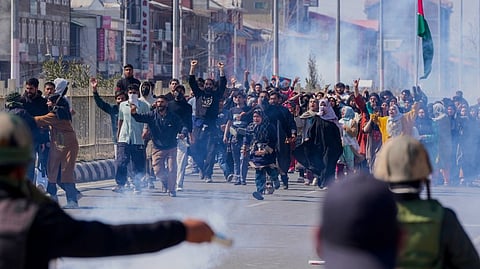

Srinagar | At least 14 people, including six security personnel, were injured on the second day of protests that erupted in Jammu and Kashmir following the killing of Iran's Supreme Leader Ayatollah Ali Khamenei in a joint US-Israeli attack, officials said.
Authorities have imposed restrictions to curb people's movement, shut down education institutes and throttled mobile internet speeds in the Union territory as precautionary measures.
Officials said that 75 rallies were held at various places in the Kashmir Valley, while a few demonstrations were held in the Jammu region as well. Security forces had to use mild force to disperse the protesters in some areas.
Protests broke out in Bemina, Gund Hassibhat, Saidakadal, Nigeen, Foreshore Road and Jehangir Chowk areas of Srinagar city, in the Pulwama town of south Kashmir, and Budgam in central Kashmir -- all of which have a large Shia population, as agitators marched through the streets, raising anti-US and anti-Israel slogans.
While most of the protests were by and large peaceful, clashes erupted at a few places, forcing the security forces personnel to use mild force to disperse the protestors, the officials said.
They said 14 persons -- eight protestors and six security forces personnel -- were injured during these clashes in the Kashmir valley.
Severe restrictions had been placed on the movement of people in parts of Kashmir. The curbs were imposed against the backdrop of a call for a one-day strike given by Mutahida Majlis-e-Ulama (MMU) chairman Mirwaiz Umar Farooq.
He had urged people to observe the strike "with unity, dignity, and in peace".
The authorities had sealed Ghanta Ghar at Lal Chowk with barricades erected all around it, while a large number of police and paramilitary CRPF personnel were deployed across the city to prevent gatherings of protestors, officials said.
They added that concertina wires and barricades were placed at important intersections leading into the city while asserting that these were precautionary measures imposed to maintain law and order.
The authorities also closed all educational institutions for two days, as a precautionary measure for the safety of students and to maintain law and order. Similar curbs were imposed in Shia-dominated areas in other districts of the Kashmir valley. Mobile internet speeds were also throttled across Kashmir.
The MMU's strike call was supported by several political parties, including PDP president Mehbooba Mufti.
"Extending our full support and solidarity with the shutdown call of Mirwaiz Umar Farooq on the martyrdom of Iran's supreme leader. This is a day of mourning to remind the world that injustice anywhere wounds the entire Muslim Ummah and all who stand for truth," she said.
Police issued an advisory urging all media organisations and news platforms to exercise the highest level of responsibility and professionalism in their reporting.
"Please refrain from publishing unverified information, speculation, or rumours; ensure that all reports are confirmed through credible and authoritative sources before dissemination; and avoid sensational headlines that may create unnecessary panic," the advisory read.
In the Jammu region, a partial strike was observed in Kishtwar and Doda districts of the Chenab valley region, with groups of people holding peaceful protests to condemn the killing of Iran's supreme leader.
The law and order situation across the region remained peaceful by and large, with no untoward incident reported from anywhere, the officials said.
Most of the shops and business establishments remained closed in both Kishtwar and Doda district headquarters and in other major towns in response to separate bandh calls given by religious leaders to protest the alleged aggression of the US and Israel.
The Imam of Jamia Masjid Kishtwar, Moulvi Farooq Ahmad Kachloo, also led a protest rally from the place of worship to the nearby bus stand, the officials said, adding that the protesters chanted slogans against the US and Israel before dispersing peacefully.
Reports of protests were also received from Bounjwa, Drabshall and Chatroo in Kishtwar, Gandoh and Bhaderwah in Doda, they said.
In Ramban district, which also falls in the Chenab Valley region, Shia mourners organised special prayers at Chanderkote for the second day to pay homage to Khamenei and others who lost their lives in the US-Israel attacks.
The Muslim community also held protests at different places in the Rajouri and Poonch districts. Several Muslim organisations have called for a Rajouri bandh on Tuesday after a joint meeting at the local Jamia masjid.
The president of the Islamic Welfare Organisation, Rajouri, Shafqat Mir, said the present situation is quite worrisome and the US, as well as Israel, have crossed all limits of humanity by directly targeting Iran and killing the supreme leader.
Protests and mourning assemblies for Khamenei were also held in the Kargil district of the Union Territory of Ladakh. A large number of Shia mourners assembled at the Hussaini Park in Kargil to take part in the protest.
Aligarh (UP) | Members of the Muslim community held a funeral prayer for Iran's supreme leader Ayatollah Khamenei at the lawns of the Aligarh Muslim University Students Union compound here amid tight security, with speakers urging the Indian government to offer condolences to the cleric's family, instead of remaining silent.
The 'Ghaibaana Namaaz-e-Janazza' (funeral prayer in absentia) was attended by several people, including students of the university.
The prayer was preceded by slogans of Shia-Sunni unity and addresses to the gathering, where several speakers asserted that Ayatollah Khamenei, in his death, attained "martyrdom and aroused a wave of sympathy beyond the borders of his own country".
A number of speakers urged the Government of India to offer condolences to the family of the departed cleric, instead of remaining silent.
Addressing the prayer meeting, former president of the AMU Students Union Salman Imtiaz said that Khamenei, in his death, "became the voice of all those downtrodden people of the world who speak for humanity against the imperialist forces of the world" and brought Shias and Sunnis on the same platform.
"Ayatollah Khamenei was an old friend of India, and had stood by India even at the cost of its relationship with Pakistan," Imtiaz said.
The prayer meeting was held under tight security arrangements, and the participants were advised to disperse after the meeting instead of taking out any procession, police sources said.
Several opposition parties on Sunday condemned the killing of Khamenei in US-Israel strikes and questioned the Centre's "silence" over the development, with the Congress saying that it shows the Narendra Modi government's "abdication of moral leadership".
Opposition leaders also criticised the Centre's foreign policy and said the government's response to the war unleashed on "friend" Iran has been a "betrayal" of India's values, principles and interests.
Prime Minister Narendra Modi on Monday spoke to the King of Bahrain, Hamad Bin Isa Al Khalifa, and the Crown Prince and Prime Minister of Saudi Arabia, Mohammed Bin Salman, and condemned the recent attacks on the two countries in violation of their sovereignty and territorial integrity.
During his telephonic conversations with the two leaders, Prime Minister Modi said that the earliest restoration of regional peace and stability is of utmost importance and thanked them for looking after the well-being of the Indian community living there in these difficult times.
