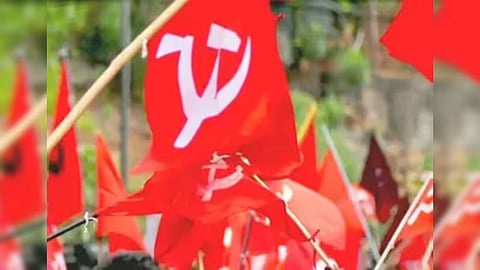

New Delhi | The defeat of the LDF in Kerala has left parties of the left front without power in any state for the first time in decades, underscoring a broader national decline in their political influence.
This also marks a sharp shift from their earlier position as both a governing force in key states and a significant bloc in national politics.
The Left will be without control of any state for the first time in almost five decades, marking a significant shift from its earlier position as both a governing force in states and an influential bloc in national politics.
The Congress-led United Democratic Front (UDF) won 102 seats, while the LDF won in 35 out of the 140 constituencies. In a limited sign of presence elsewhere, a lone Left candidate, Md. Mostafijur Rahaman of CPI(M) won from Domkal in West Bengal, while another AISF candidate Md Nawsad Siddique got elected from Bhangar.
CPI(M) general secretary MA Baby described the latest round of assembly election results as a "serious setback" for the Left, particularly in Kerala, while warning that the growing footprint of the BJP across states poses a wider challenge to secular politics and the opposition's INDIA bloc.
He said the results underline "two major features" - the defeat of the Left Democratic Front (LDF) in Kerala after 10 years in power and the BJP's strengthening position in states like West Bengal, Assam and Puducherry.
On West Bengal, he said, "Even in such a polarised situation, the Left has marginally improved its performance. In over 30 constituencies, our position has improved, though we expected a far better outcome".
Kerala, governed by the LDF since 2016, has been the last remaining state where Left parties exercised executive authority. Earlier strongholds slipped away over the past decade, with the Left Front losing power in West Bengal in 2011 after 34 uninterrupted years, followed by the fall of its government in Tripura in 2018.
Since then, Kerala has served as the only base of state power for Communist parties.
The state occupies a distinct place in political history. In 1957, it elected the world's first democratically chosen Communist government under EMS Namboodiripad, lending global visibility to parliamentary communism.
It remained in power until 1959, when it was dismissed by the Centre.
Following the 1964 split in the Communist movement, Namboodiripad returned as Chief Minister in 1967'1969, this time representing the Communist Party of India (Marxist) and heading a broad coalition. This was followed by governments led by C Achutha Menon of the CPI from 1969 to 1970 and again from 1970 to 1977, the latter with Congress support.
The Left later consolidated under the LDF, formally constituted in 1980, under which Left governments have since been formed in 1980, 1987, 1996, 2006, 2016, and 2021.
Over the decades, Kerala evolved into a key centre of Left politics, with power alternating between the LDF and the UDF in a largely stable bipolar system.
While Left governments appeared intermittently in the decades following Independence, their presence was not continuous. The turning point came in 1977, when the Left Front assumed office in West Bengal, beginning an uninterrupted phase of governance that lasted over three decades. Alongside periodic governments in Tripura and Kerala, this ensured that Left parties were almost always in power in at least one state.
At the national level, the Left once occupied a far more influential position. In the years following Independence, the Communist Party of India (CPI) emerged as the largest opposition party in Parliament.
Through the 1990s and 2000s, Left parties remained a significant parliamentary bloc in Lok Sabha, often playing a key role in coalition politics.
In the 1990s, the combined strength of Left parties in the Lok Sabha fluctuated but remained substantial - standing at about 52 MPs in 1991, rising to around 60 in 1996, and then settling at around 45 in 1998 and about 43 in 1999. Their influence peaked in 2004, when they won 61 seats and extended outside support to the Congress-led UPA government, exercising considerable leverage over policy decisions, particularly on welfare and economic issues.
They even came close to having a prime minister from the CPI(M) when the United Front government was formed in 1996, and Jyoti Basu was offered the prime ministerial position.
It is said it was the "Kerala lobby" in CPI(M) that had taken a stand against it, and Basu had turned down the post. The same lobby was also said to be responsible for withdrawing support from the Manmohan Singh government in 2007.
The decline of Left also coincided with structural changes in the economy and polity.
Economic liberalisation and the expansion of the informal sector weakened traditional labour bases, while the rise of identity-driven politics reshaped electoral alignments. In states where the Left governed for extended periods, anti-incumbency and organisational fatigue also contributed to electoral setbacks.
Electoral setbacks in traditional strongholds, especially West Bengal and Tripura, sharply reduced their parliamentary presence. In recent Lok Sabha terms, the Left's tally has fallen to single digits. In the 18th Lok Sabha, the CPI(M) has four MPs, CPI and CPI(ML) Liberation have two MPs each.
Observers say the loss in Kerala would further accentuate this decline by removing the Left's last platform of state governance. State power has traditionally provided organisational support, visibility and a base for cadre mobilisation, which in turn fed into national influence.
In Kerala, the LDF had managed to retain support longer than elsewhere, aided by welfare-oriented policies and relatively strong social indicators.
Its re-election in 2021 had broken the state's pattern of alternating governments. However, recent electoral trends pointed to growing challenges.

