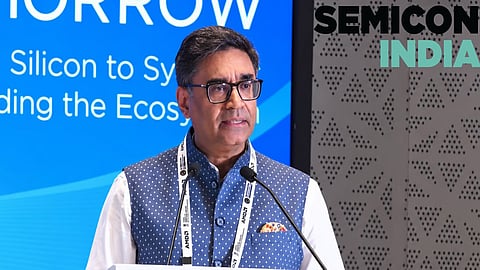

New Delhi | India's mission to become self-reliant is not to build everything within its borders but to know about capabilities and build sovereign capacities with trusted partners, a top government official said on Friday.
Speaking at Semicon India 2026, Foreign Secretary Vikram Misri said that as India looks to build its technology ecosystem, it is not to compete for dominance in this industry but to partner with companies and remain open to the world.
"Self-reliance does not mean building everything within our own borders. No nation on earth does that. And no nation should try. The attempt would mean higher costs, slower innovation, and a lonelier industrial revolution," he said.
The government has been coming out with a series of policies to become Atmanirbhar (self-reliant) and reduce dependence on imports, especially in the technology space.
"Properly understood, self-reliance means knowing exactly where our capabilities and our capacities must be sovereign, and building it with discipline. And where a trusted partnership serves us better, and pursuing that with equanimity," Misri said.
He said India is investing genuine indigenous strength in design, packaging, and specific manufacturing steps while also inviting the world's leading equipment makers, materials developers, and design houses to build alongside.
Under the Indian Semicon Mission 1.0, the government approved 12 semiconductor plants, of which three units have already started production.
The government has come up with Semicon 2.0, which mainly focuses on design and creating intellectual property in the semiconductor industry space, along with attracting manufacturing units.
At the inauguration of Semicon India 2026, Prime Minister Narendra Modi said the government has already started working on the next scheme for the sector.
"We still depend on imported equipment and imported materials, and must build fluency across regulatory environments. Above all, we must sustain consistency. Policy held steady over years, not showcased for a season. Trust is built on accurate expectations, not on enthusiasm," Misri said.
He asked industry to look for complementarity, not duplication, while forming any alliance or collaboration in the semiconductor industry.
Misri said partnerships built on genuine complementarity tend to outlast partnerships built merely on convenience, costs or bottom lines. He suggested weighing predictability in collaborations as heavily as price.
"A slightly higher cost with a steady, predictable partner often beats the cheapest option today. Where a facility can take years to build, and decades to pay off, the ability to plan confidently is itself valid," he said.
Misri said that the strongest industrial partnerships, the ones that survive a difficult year or a change in government, are built years earlier through joint research, shared training and people who have worked together before.
"Trust, once earned, is among the most durable assets a company can hold. India's ambition in this spirit is not to compete for dominance in this industry. It is to be a partner, to partner with companies actively that they want to build with. Reliable and honest about its gaps and genuinely open to the world," he said.
The foreign secretary said the trust is built not through policy documents alone, but through handshakes, discussions, and events like Semicon India.

