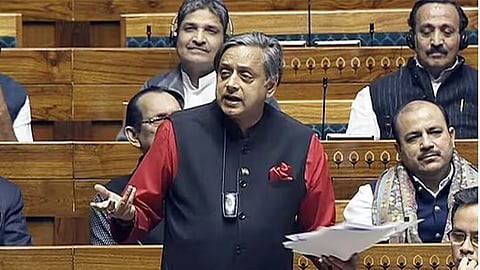

New Delhi | Congress MP Shashi Tharoor took a sharp dig at the BJP-led Centre on Tuesday while opposing the VB-G RAM G Bill in the Lok Sabha, recalling the 1971 hit Bollywood number -- "Dekho o deewano (tum) ye kaam na karo, Ram ka naam badnaam na karo".
The MP from Kerala's Thiruvananthapuram asserted that the bill is not merely an administrative tweak but an "assault on the very spirit and philosophical foundation of this crucial programme".
The Viksit Bharat Guarantee for Rozgar and Ajeevika Mission (Gramin) (VB-G RAM G) Bill, 2025, that seeks to replace the existing rural employment law Mahatma Gandhi National Rural Employment Guarantee Act (MGNREGA), was introduced in the Lok Sabha on Tuesday amid strong objections from the opposition over the "removal" of Gandhi's name from it.
Introducing the bill, Union minister Shivraj Singh Chouhan said the Centre not only believes in Gandhi but also follows his principles. "The (Narendra) Modi government has done more for rural development than previous governments," he said.
Opposition members opposed the proposed legislation at the introduction stage and pressed for sending the bill to a parliamentary panel for greater scrutiny. The MPs, including Priyanka Gandhi Vadra of the Congress, strongly objected to the "removal" of Gandhi's name.
Tharoor said the VB-G RAM G Bill represents a "deeply regrettable and retrograde step" for the country and for its commitment to the welfare of its most vulnerable citizens.
"My first objection, as with others, is the ill-advised decision to remove the name of the Father of the Nation, for the reasons already stated, which I will not repeat. But this is not merely an administrative tweak, it is an assault on the very spirit and philosophical foundation of this crucial programme," he said.
Asserting that Gandhi's vision of Ram Rajya was never a purely political project, the former Union minister said it was a socio-economic blueprint rooted in the empowerment of villages, and his unwavering faith in Gram Swaraj was part of his vision of Ram Rajya.
"The original Act, by bearing his name, acknowledged this profound connection -- that true employment guarantee and upliftment must flow from the grassroots, embodying his principle of the last person first. To remove the name of Mahatma Gandhi is to strip the bill of its moral compass and historical legitimacy," Tharoor said.
"Then to have two languages in the title just to make the acronym G RAM G is not just a violation of Article 348, as pointed out in the previous discussion, but it also reminds me of a song from my childhood -- 'Dekho o deewano (tum) ye kaam na karo, Ram ka naam badnaam na karo'," he added.
The Congress leader also called for seriously questioning the intent behind the financial restructuring proposed in the bill.
"The proposal to impose 40 per cent of the financial burden directly on state governments is not merely fiscally irresponsible, it is a measure that threatens to make the entire programme unviable," he said.
This sudden and massive shift in liability will inevitably make implementation impossible for poorer states, he pointed out.
"It will lead to delays in wage payments, a reduction in the number of workdays and ultimately, the destruction of the scheme itself. This is a clear violation of fiscal federalism, which is why I believe we lack the legislative competence to undertake such a change," Tharoor asserted.
Finally, the bill makes the scheme contingent upon executive notification, allowing the Union to decide when and where it will operate, he said.
This fundamentally alters the very nature of the programme, he asserted.
Later, the opposition members also trooped to the Well of the House, holding up photographs of Gandhi and expressing their disapproval of the "removal" of the name of the Father of the Nation from the proposed legislation.
According to a copy of the bill, it will provide a statutory guarantee of 125 days of wage employment in a financial year to every rural household whose adult members volunteer to undertake unskilled manual work.
Within six months from the date of commencement of the VB-G RAM G Act, states will have to make a scheme consistent with the provisions of the new law.
In a statement, the rural development ministry has said the proposed legislation will establish a modern statutory framework aligned with the goal of "Viksit Bharat 2047".
It has added that the bill aims at creating both employment and durable rural infrastructure through four priority verticals -- water security through water-related works, core rural infrastructure, livelihood-related infrastructure and special works to mitigate extreme weather events.
