
New Delhi | Placing health at the centre of climate action makes it practical for people, governments and local bodies to act on, since climate change, biodiversity loss and pollution undermine human and ecological health alike, posing an existential threat to humanity, a former top official of a UN body said.
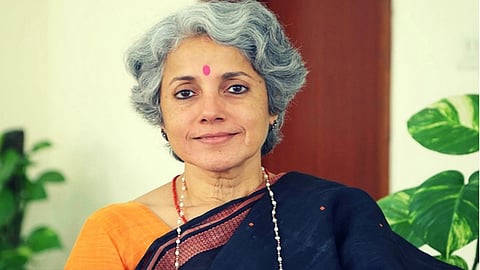
Speaking to PTI Videos on the United Nation's Asia-Pacific synergies report, its co-author Soumya Swaminathan said that heat, waterborne and vector-borne diseases, displacement, rising gender-based violence, and impacts on nutrition affect health first, adding that the report places health firmly at the centre of the actions it encourages countries to take.
The report, released on Tuesday by the UN Economic and Social Commission for Asia and the Pacific (ESCAP), examined how countries like India and China are using health-centred approaches, from sustainable cooling initiatives to sacred grove restoration, to advance climate, biodiversity and SDG goals together.
"If you take extreme heat as an example, we see that not just in India or the developing countries, but around the world, even in high-income countries. And who's suffering? It's the most vulnerable, again... People who already have very fragile livelihoods, incomes," Swaminathan told PTI.
Highlighting its economic impact, she noted that institutions like the World Bank estimate GDP losses from heat alone run into trillions of dollars, with air pollution similarly affecting a significant share of GDP.
"Health impacts need to be considered from the very beginning, and importantly, monitored and documented, because doing so reveals benefits that go far beyond the initial investment, say, in a cooling system or energy efficiency," Swaminathan, the former chief scientist at the World Health Organization, told PTI.
She noted that measuring and documenting health impacts is where the synergy lies, and that the end result is greater than what would be expected from an investment assessed against a few narrow outcomes.
Asked how the success of health-centred climate initiatives can be measured on the ground, Swaminathan said the answer lies in integrated city-level dashboards that bring together environmental data, such as air and water quality, with health data from local clinics and hospitals.
She explained that such dashboards could reveal patterns like spikes in hospital admissions during heat hotspots or disease outbreaks in flood-prone areas, allowing policymakers to direct resources where they have the most impact and ensuring climate action remains equitable for the most vulnerable.
"I've seen some examples of cities and countries in other parts of the world which have been able to do this, such as New Zealand and Wales. And what they've essentially done is building a dashboard, where policymakers can see environmental, health and other variables," Swaminathan told PTI.
She added that the approach targets people who are most impacted rather than making improvements in areas of the city that are already well protected.
"Equity has to be at the heart of our climate action because we know that the people who are most vulnerable, have poor housing, fragile livelihoods and daily wage earners, they are the most impacted.
"Local urban bodies must be empowered, have more financing, tools and knowledge to deliver. Citizens too need to get more involved," she said.
According to Swaminathan, while India is investing heavily in energy efficiency, these efforts remain decoupled from health impacts.
Bringing the two together could unlock the synergistic benefits of such interventions, she said.
Asked whether putting health at the centre of climate policy could get the issue taken more seriously, rather than discussing it only in terms of emissions and temperature, Swaminathan said abstract metrics like "melting polar ice caps" or "tonnes of carbon dioxide reduced" are difficult for people to relate to, whereas heat, extreme weather events and forest fires are impacts that affect families, neighbourhoods and jobs directly.
Citing her work with fishermen at the MS Swaminathan Research Foundation, she highlighted that warming seas and declining fish stocks were affecting both their health and livelihoods, and that when people can relate to an impact and then see governments act to mitigate it, they recognise and appreciate the benefits, making health-centred climate action politically meaningful as well.
"Putting health indicators into our nationally determined contributions and national adaptation plans will make a big difference because people at the senior most level are looking at that data to assess where our health trends are going, and which actions are actually having an impact," the co-author of the UN report told PTI.
Speaking about the biggest challenge to synergistic finance, Swaminathan said the share of finances allocated to panchayats and local urban bodies has not risen significantly over the last decade.
"It's the way that finances are allocated, and they are allocated through ministries, departments and specified for programmes. In India, we see that at the third level of governance, that is the panchayats and the local urban bodies, the share of finances has not gone up very significantly over the last decade or two," she said.
"And I think that is an issue because with climate change and other challenges, the actions have to be taken actually at the local level," she added.
Swaminathan highlighted that problems vary from district to district, and that it is "insufficient" to have policy and implementation only at the national and state level.
Citing Kerala as an example, she noted that local bodies and panchayats are empowered there, and several programmes are more successful due to community involvement.
She said one way to achieve synergistic finance is devolving it to local levels, where convergence happens naturally as panchayats tackle local problems, and it requires giving local bodies finances, capacity-building support and digital tools, after which private investment and citizen participation can follow.

