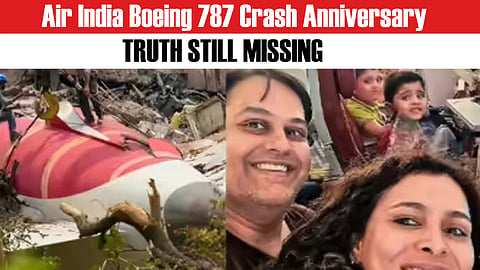

New Delhi | One year after an Air India Boeing 787 Dreamliner crashed shortly after takeoff from Ahmedabad, killing 260 people in one of the world's deadliest aviation disasters in a decade, families of the victims are still waiting for a definitive explanation of what brought down the aircraft and the investigation to reach its conclusion.
Flight AI171, bound for London's Gatwick Airport, crashed on June 12, 2025, less than a minute after takeoff from Ahmedabad, killing 241 of the 242 people on board and 19 people on the ground when the aircraft slammed into a medical college hostel. The accident marked the first fatal crash involving a Boeing 787 Dreamliner.
The anniversary comes with India's Aircraft Accident Investigation Bureau (AAIB) yet to issue a final report, which investigators had been expected to complete around the first anniversary of the crash.
Instead, the probe has been delayed as authorities continue examining critical evidence linked to the aircraft's GE Aerospace engines and associated control systems. Investigators are expected to issue a status update or interim report, with a final report now likely within the next three months, according to people familiar with the matter.
The preliminary report released last year found that both engine fuel control switches moved almost simultaneously from "RUN" to "CUTOFF" seconds after takeoff, starving the engines of fuel and causing a catastrophic loss of thrust.
The report, however, stopped short of assigning blame or identifying the cause of the switch movement, and Indian authorities have repeatedly cautioned against drawing conclusions before the investigation is completed.
The prolonged investigation has fuelled speculation and competing theories ranging from technical malfunction to human action. The Federation of Indian Pilots this week renewed its demand for a judicial inquiry and opposed the release of any interim report, arguing that partial findings could lead to confusion and misinterpretation before the investigation is complete.
For Air India, the disaster became the biggest crisis since the airline's acquisition by the Tata Group and threatened to overshadow efforts to rebuild its reputation through an ambitious fleet renewal and transformation programme.
Over the past year, Air India and Tata Group companies have focused on compensation, family assistance and support for the survivor and victims' relatives.
Air India said it has paid interim compensation of Rs 25 lakh to 96 per cent of affected families, while Tata Sons, through the AI171 Memorial and Welfare Trust, has provided ex gratia assistance of Rs 1 crore to more than 90 per cent of eligible families. Combined disbursements have reached nearly Rs 300 crore.
The airline has also begun the process of final compensation settlements and the return of personal belongings recovered from the crash site.
Yet for many families, compensation has not brought closure. Some relatives continue to press for a permanent memorial at the crash site in Ahmedabad, while others say meaningful closure can come only after investigators determine exactly what caused the disaster.
The crash remains one of the most consequential aviation accidents in recent years, drawing participation from international investigators, including experts from the United States, as authorities scrutinise aircraft systems, engine controls and cockpit data.
The final report is expected to carry significant implications not only for Air India and Boeing but also for the global aviation industry, given the previously unblemished fatal accident record of the 787 Dreamliner.
A year after the tragedy, however, the central question remains unanswered: why the aircraft lost power moments after takeoff and whether the sequence that led to the crash was caused by human action, mechanical failure or a combination of factors. Until investigators provide a definitive answer, families and the aviation industry remain without closure on the cause of the crash.

