
#Ajayan
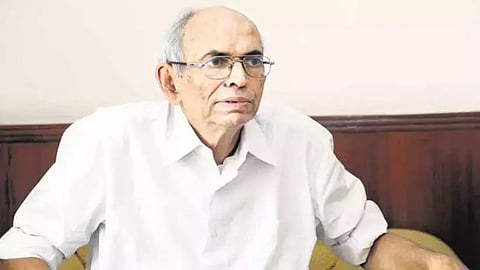
Madhav Gadgil remained one of Kerala’s most reviled and revered figures; quoted when convenient, cursed when costly and sadly respected only in hindsight. Political parties, clinging to the arithmetic of vote banks, bristled at his warnings on the Western Ghats and quietly buried his report. But every time floods rose or hillsides gave way, the price of that burial surfaced. By sidelining what he foresaw, catastrophe in Kerala is a recurring resident; a tiny strip of land trapped between an eroding mountain range and an encroaching sea.
After the 2018 floods, Gadgil came to Kochi and tore through the official alibi: Kerala was not drowned by rain, but by human folly. What the authorities owed was an apology. What they offered instead was arrogance, blaming the skies while absolving their own recklessness. Those familiar with the Gadgil report knew better: official sanction had enabled rampant quarrying in the hills, wetlands were reclaimed by diluting laws and quietly blessing land-grabbers and dams were thrown open at the peak of the deluge without coordination. The floods, as Gadgil said, were not natural at all; they were meticulously “man-made”.
In that quiet personal conversation sat another dissenter, the late Congress leader PT Thomas, whose support for the Gadgil report earned him fury from left, right and centre, his party included, and the Church, which opposed the report to protect its settler shepherds and hillside farms. Not because the report had been read, as it was rigorously pro-people, but because convenience, once again, triumphed over both reason and environment.
Gadgil’s tryst with Kerala began in the 1970s, amid the uproar over a proposed hydel project in Silent Valley. Poets, writers, environmentalists and scientists, Gadgil among them, joined an agitation that prevailed, planting the first green seeds of ecological resistance. That victory did more than save a forest; it pushed environmental consciousness from elite debate into the grassroots, making Gadgil a name familiar with even the common man.
In 2010, the Congress-led UPA government appointed Gadgil to head the Western Ghats Ecology Expert Panel. Credit is due to the then Environment and Forest Minister, Jairam Ramesh, for constituting the panel and entrusting it to Gadgil. In Jairam’s own tribute: “Nation builders come in different forms and varieties. Madhav Gadgil was definitely one of them. Above all he had the hallmark of a true scholar, he was gentle, unassuming and exuded empathy and humility behind which was a vast ocean of knowledge and learning.”
As the Church and political parties joined forces to raise a din over the Gadgil report, fuelled by calculated misinformation, the Centre capitulated, appointing a Kasturirangan-led panel to dilute it. Even that watered-down version, a pale apology to Gadgil’s original vision, was never implemented in Kerala. By then, Jairam Ramesh, the crusader whose stand against Bt brinjal had set him apart, was out of the Environment and Forest Ministry.
An ecologist, academic and tireless field researcher who walked the length of the Western Ghats, Gadgil was also a true democrat—so rooted in people that his report insisted development be decided by gramsabhas, not distant bureaucracies. His mid-1980s intervention to protect the Bastar forests was another defining act. Beyond the field, he reshaped two venerable institutions—the Botanical Survey of India and the Zoological Survey of India—giving them a new ecological and democratic spine.
Yet, for all this, his call to repeal the Wildlife Protection Act of 1972, advocating the culling of so-called vermin and the consumption of that meat, would have lent moral and intellectual ballast to Kerala’s proposed Bill on killing wild animals.
As with the defeated Silent Valley dam, another victory bore Gadgil’s imprint. Kerala owes much to his counsel during the agitation against the Athirappilly dam. Gadgil urged the tribal communities to anchor their resistance in the Forest Rights Act, 2006, securing their status as custodians of the forest. The strategy worked. One tribeswoman, in the forefront of the agitation, would later say that getting FRA implemented on Gadgil’s advice was “akin to attaining independence”.
