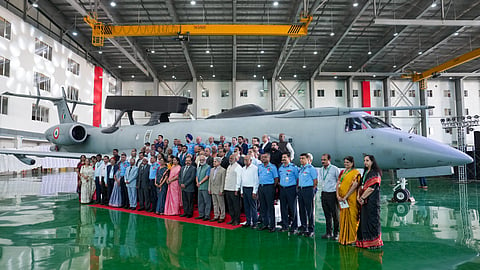

Bengaluru | Indigenous Netra Airborne Early Warning and Control (AEW&C) System, was on Thursday accorded Final Operational Clearance, marking a major milestone by paving the way for its operational exploitation by the IAF.
According to the DRDO, the AEW&C System consists of sensors mounted on an aircraft, for locating and providing early warning of airborne and sea surface targets and hostile emissions. It also provides comprehensive information to the controllers on-board of the aircraft as well as to the ground stations
The system is equipped with a comprehensive suite-- radar, electronic warfare systems, secure communication and self-protection.
Air Marshal Awadhesh Kumar Bharti, Deputy Chief of the Air Staff, formally declared the Final Operational Clearance (FOC) of the Netra AEW&C system in a ceremony held at the Centre for Airborne Systems here.
At the event here, the indigenous Netra (AEW&C) System and the FOC certificate were also unveiled.
Speaking on the occasion, Air Marshal Bharti said, "It is indeed a proud moment to declare the AEW&C's Final Operational Clearance."
"This is not merely the culmination of an indigenous technology programme, but a celebration of the unique partnership between the Indian Air Force and the scientific community in fulfilling India's quest for Atmanirbharta (self-sufficiency)."
Noting that the journey of the AEW&C has been extraordinary, he also said that it came with challenges, as is the norm for any new system.
"We had to do a lot of innovation, it had to see a lot of perseverance, and above all, collaboration. From every individual, every entity that was involved," he said.
Bharti said that right from the very inception of the programme, the IAF was not just a customer waiting for delivery of the product, but it was an active partner in design, development, integration, testing, and operationalisation.
"DRDO, CABS (Centre for Airborne Systems) in particular, and I have worked hand in hand in defining the operational requirements, participating in developmental and user trials, conducting continuous evaluation and providing timely and constructive feedback," he said.
According to him, every mission flown, every operational exercise undertaken, and every lesson learned was shared and analysed tightly and then translated into improvements, making the system progressively more capable and operationally important.
"Perhaps the greatest testimony to the faith that the Indian Air Force had in this indigenous programme was our decision to induct the platform operationally even before the final operational clearance. And this was not mere act of optimism. This was an expression of confidence in the capabilities of our scientists, and in the immense potential of our indigenous industry," he added.
He spoke about the operational utilisation and reliability of the system during Operation Sindoor and Balakot strikes.
Speaking at the event, K Rajalakshmi Menon, Director General (AERO) at DRDO recalled the January 11, 1999 crash of India's first Airborne Surveillance Platform aircraft and dedicated the FOC to the eight personnel who died in the incident.
"I salute the personnel who were on board and made the supreme sacrifice, and today we have shown that their sacrifice has not gone in vain. Their names have now been written in Golden Words, and this FOC is dedicated to them, she said."
Later, speaking to reporters, Menon said the indigenous system is equipped with a comprehensive suite: radar, electronic warfare systems, secure communication, self-protection and it provides excellent situational awareness.
Along with the airborne segment, the system also has ground elements.
"This includes operator training stations and mission planning stations. So, it is a fully operational capability that we have provided to the Indian Air Force. This capability is already being used operationally. It is a very capable system," she added.
In a video message, Air Marshal Ashutosh Dixit, Chief of Integrated Defence Staff, said that the national objective of achieving full operational capability for the Netra AEW&C system is particularly significant in the rapidly evolving geopolitical scenario.
Recalling the project's journey from the Cabinet Committee on Security's sanction in October 2004 to the FOC achieved today, he lauded the efforts of DRDO, the IAF and industry partners in delivering the indigenous airborne early warning and control system at its full operational potential.
"DRDO's innovative research and development expertise, support from certification and quality assurance agencies, the efficiency and agility of Indian industry, and the operational insights of the services have emerged as a critical pillar in strengthening our national defence capabilities and achieving self-reliance in defence technologies," Dixit said.
He also welcomed the planned expansion of the Netra programme to six more aircraft, expressing confidence that the upcoming projects would be equally successful.
Asked about the six aircraft that will be developed by the DRDO under the programme, Menon added that, "the new system will incorporate all the lessons we have learned. It will have enhanced features. The current NETRA was developed during the 2004 era and beyond. For the new system, we are using today's technologies. It will be significantly better than what has already been delivered."
Addressing media later, the Deputy Chief of the Air Staff said, "Since it has been built indigenously, it is entirely ours. All the software, source codes, interface control documents (ICDs), and everything related to the system are with us. This allows us to keep our capabilities confidential."
"We can also modify and enhance the system according to our future requirements." Bharti observed that this flexibility is not available with systems procured from abroad.
"In such cases, we always have to go back to the original manufacturer if any capability enhancement is required. That is the biggest advantage of an indigenous programme, and that is what we are seeing with the AEW&C Netra," he added.

