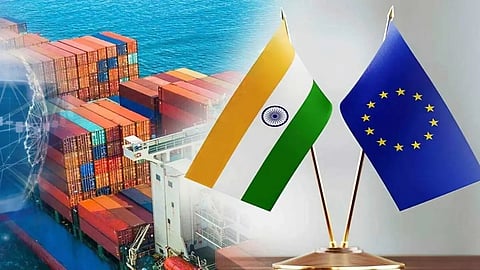

New Delhi | The proposed trade deal between India and the European Union will send a strong signal to global businesses that New Delhi believes in openness and fair trade as it will provide for certainty and rule-based order, people familiar with the matter said on Tuesday.
The top leaders of India and the 27-nation bloc are set to shortly announce the conclusion of the negotiations for the mega deal that would create a market comprising two billion people.
The India-EU free trade agreement is aimed at an open, fair, stable and rule based trading order as it sends a strong signal among global businesses that New Delhi believes in openness and fair trade, the people cited above said.
Prime Minister Narendra Modi hosted European Commission President Ursula von der Leyen and European Council President Antonio Costa for summit talks on Tuesday against the backdrop of increasing disruptions in global trade caused by Washington's policies on trade and tariffs.
India and the EU are the fourth and second largest economies, comprising 25 per cent of the global GDP and more than one third of global trade.
Integration of the two large diverse and complementary economies will create unprecedented trade and investment opportunities, the people said.
The EU-India FTA will also complement New Delhi's trade deals with the United Kingdom and the EFTA (European Free Trade Association) nations comprising Iceland, Liechtenstein, Norway and Switzerland.
For India, the EU is the second largest export market after the US and the FTA is likely to yield substantial net gains for India particularly for industries which are labour intensive such as textiles, clothing, gems and jewellery, leather and footwear where EU tariffs are high, the people said.
For the EU, India is a large and fast growing market with relatively higher tariffs giving EU a significant advantage vis-a-vis its competitors.
The people said core agricultural elements such as dairy, cereals, meat and certain fruits and vegetables are excluded from the deal respecting sensitivities on both sides. In the auto sector, the people said the calibrated and carefully crafted auto liberalisation package will not only allow the EU auto makers to introduce their models in India in higher price bands but also open the possibilities for Make in India and exports from India in future.
Indian consumers benefit from high tech products and greater competition, they said.
There is indication that both the EU and India will continue to discuss issues relating to CBAM ( Carbon Border Adjustment Mechanism), which is a framework for tariffs on carbon-intensive products such as steel and cement.
It is a very sensitive and complex issue and the FTA opens the way for constructive engagement through most favourable treatment, technical dialogue and support from EU to India in future to tackle climate change, the people said.
The EU and India had first launched negotiations for the free trade agreement in 2007, before the talks were suspended in 2013 due to a gap in ambition. The negotiations were relaunched in June 2022.
The EU, as a bloc, is India's largest trading partner in goods. For the financial year 2024-25, India's total trade in goods with the EU was worth about USD 136 billion, with exports around USD 76 billion and imports at USD 60 billion.
