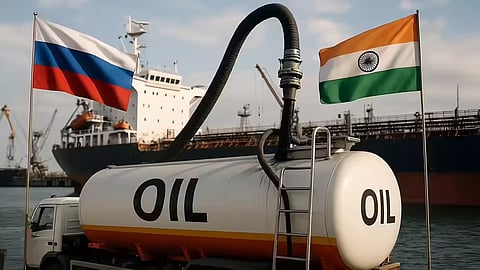

New Delhi | Indian refiners have begun buying some of the over 15 million barrels of Russian crude currently floating on tankers near the country, as they move to offset supply concerns arising from disruptions in the Middle East.
Sources said refiners stepped up purchases after the US Treasury Department issued a 30-day licence allowing India to buy Russian oil cargoes currently stuck at sea.
India, which was among the top buyers of Russian oil, curtailed purchases after US pressured New Delhi to avoid buying Russian barrels in an effort to reduce money flowing to Moscow's war effort in Ukraine.
India's imports of Russian crude in February fell to 1.04 million barrels per day - the lowest since November 2022. The US had made cuts to tariffs on Indian goods contingent on New Delhi reducing its purchases of Russian crude.
This left several ship loads of Russian oil stranded on high-sea, sources said.
India, which had turned to buying discounted Russian crude following Western sanctions in February 2022, is now adjusting its purchases amid disruptions in Middle East supplies.
The country had previously imported record volumes of Russian oil when cargoes were available at deep discounts, helping refiners offset rising global crude prices. Russian cargoes hit a peak of 2.15 million barrels in May 2023.
However, with the widening West Asia conflict blocking shipments through the Strait of Hormuz and raising concerns over oil and LNG supplies from the Middle East, Indian refiners are now balancing purchases from both Russian cargoes at sea and other sources to ensure an uninterrupted domestic fuel supply.
"President Trump's energy agenda has resulted in oil and gas production reaching the highest levels ever recorded," US Treasury Secretary Scott Bessent said. "To enable oil to keep flowing into the global market, the Treasury Department is issuing a temporary 30-day waiver to allow Indian refiners to purchase Russian oil." Calling the move a stopgap measure, he said Washington expects India to eventually buy more US oil.
"India is an essential partner of the United States, and we fully anticipate that New Delhi will ramp up purchases of US oil. This stop-gap measure will alleviate pressure caused by Iran's attempt to take global energy hostage," Bessent said in a post on X.
The short-term measure will not provide significant financial benefit to the Russian government as it only authorises transactions involving oil already stranded at sea, ​he added.
India, which has inventories to cover for 25 days of demand for crude (raw material for making fuels like petrol and diesel), sources 40-50 per cent of its crude oil needs from the Middle East through the Strait of Hormuz. The escalating conflict in West Asia has effectively shut the strait.
Sources said Indian refiners are now buying the Russian oil to build inventories.
There are more than a dozen tankers with Russian oil in the Arabian Sea and the Bay of Bengal, sources said, adding that another eight vessels are idling off Singapore and could reach India within days. Beyond that, ships laden with Russian oil are also in the Mediterranean Sea and the Suez canal which would also reach India in under a month.
"With nearly 50 per cent of India's crude imports transiting the Strait of Hormuz, the country remains highly exposed to potential supply disruptions," said Sumit Ritolia, an analyst at the data intelligence firm Kpler. "The US waiver allowing additional purchases of Russian crude over base load offers short-term relief, though competition from Chinese buyers for the same barrels could limit the extent of India's benefit."
Indian refiners had already been importing around 1 million barrels per day of Russian crude in recent months, meaning the waiver effectively acts as a green signal to lift volumes above this base load, he said.
"As of early March, around 130 million barrels of Russian crude remain on the water, including significant volumes across the Indian Ocean, Red Sea/Suez routes, and around Singapore, which could potentially be redirected toward Indian ports if commercial deals are finalised.
"With the waiver now in place, refiners could quickly resume purchases, potentially pushing Russian inflows around 1.6 to 2 million barrels per day in the near term," he said.
While this provides a short-term logistical buffer, it cannot fully offset India's 2.6 million barrels per day exposure to Middle Eastern crude, and competition from Chinese buyers for the same Russian barrels will limit the upside.
"For Indian refiners, renewed access to Russian crude would support feedstock security and margins. However, there has been no official indication of product export curbs from the Indian government.
In the near term, refiners are likely to prioritise domestic fuel availability and comfortable stock levels, meaning the increase in crude availability may not immediately translate into higher product exports. Export flows would likely rise only once domestic requirements are satisfied," he said.

