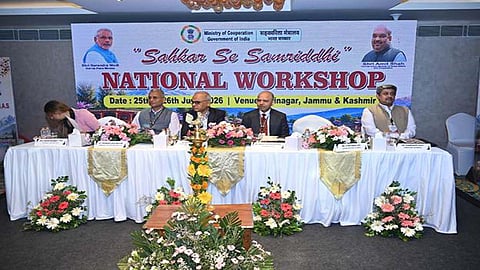

Srinagar |Ground-level insights and realities shaped deliberations on the future vision and roadmap of India’s cooperative sector at the 8th National Conference on theme of ‘Sahkar se Samriddhi — From Vision to Ground Reality’, inaugurated today in Srinagar, Jammu & Kashmir. Guided by Prime Minister Shri Narendra Modi’s vision of ‘Sahkar se Samriddhi’ and under the leadership of Union Home Minister and Minister of Cooperation Shri Amit Shah, the Conference focused on translating the transformational initiatives of the last five years into measurable outcomes at the grassroots level.
The National Review Conference brought together senior officers from States/UTs, Registrars of Cooperative Societies, national federations, cooperative institutions and key stakeholders of the cooperative ecosystem. The deliberations are aimed at reviewing progress, identifying ground-level challenges, sharing successful models and preparing a sharper roadmap for the next phase of cooperative development.
Addressing the Conference, Secretary Ministry of Cooperation, Government of India Dr. Ashish Kumar Bhutani said that the creation of a separate Ministry of Cooperation marked a defining moment in the history of India’s cooperative movement. He said that the Ministry has moved from a largely regulatory framework to a development-oriented and delivery-focused approach, with the objective of strengthening cooperatives as effective institutions of rural prosperity, inclusive growth and last-mile delivery.
Dr. Bhutani said that during the last five years, the Ministry has worked to strengthen the foundation of the cooperative sector, particularly at the level of Primary Agricultural Credit Societies. He highlighted major initiatives such as computerisation of PACS, adoption of model bye-laws, formation of new multipurpose PACS, dairy and fishery cooperatives, business diversification of PACS, and creation of national-level cooperatives in the areas of exports, organic products and seeds.
Secretary, Ministry of Cooperation said that the time has now come to move beyond numbers and focus on quality, accountability, professional management and visible ground-level impact in cooperatives. He said that while significant progress has been made in creating policy frameworks and institutional support systems, the next phase must be centred on implementation, measurable outcomes and effective delivery at the grassroots level.
Putting strong emphasis on technology adoption, data-driven governance and future-ready cooperative institutions, Dr. Bhutani said that in the era of UPI and digital financial services, cooperative banks must adopt modern technology platforms to remain relevant and competitive. He emphasised that rural and urban cooperative banks need common technology solutions, stronger governance systems, improved service delivery and better financial discipline.
Dr. Bhutani also highlighted the need for sustainability and circularity initiatives in the cooperative sector, particularly in areas such as dairy, compressed biogas and sugar by-products. He said that cooperatives can play a major role in converting rural waste into value, supporting clean energy, improving organic manure availability and creating additional income opportunities for members.
Dr. Bhutani urged States and UTs to accelerate the formation of these institutions and said that PACS are the backbone of the cooperative structure. He emphasised that their strengthening through technology, model bye-laws, business diversification and better governance will be critical for realising the vision of ‘Sahkar se Samriddhi’.
Highlighting the importance of data-driven governance, Dr. Bhutani said that National Cooperative Database 2.0 will further strengthen planning, monitoring and decision-making in the cooperative sector. He said that the upgraded platform will enable cooperatives to update and validate data directly, thereby improving the quality of information available for policy support, implementation and monitoring.
Referring to the World’s Largest Grain Storage Plan in the cooperative sector, Dr. Bhutani asked States to strengthen infrastructure creation under the scheme and work towards reducing post-harvest gaps. He said that the initiative has the potential to transform agri-infrastructure at the grassroots level by bringing storage facilities closer to farmers and strengthening the role of cooperatives in agricultural value chains.
A key feature of the Conference was its State-led format. States and UTs led the deliberations and shared best practices, successful models, innovations and ground-level challenges. This approach enabled exchange of practical experiences and helped identify actionable areas for faster implementation.
During the Conference, detailed deliberations were held on cooperative development in the North Eastern States and pathways for inclusive growth. States from the North Eastern region shared their experiences, progress, opportunities and specific challenges in strengthening the cooperative ecosystem. The discussions highlighted the need for region-specific approaches, improved institutional support and greater market linkages for cooperatives in the North East.
During the Conference deliberations were also held on the role of national institutions/federations in strengthening India’s cooperative ecosystem. Institutions such as NABARD, NDDB, IFFCO, KRIBHCO, NAFED, NCCF and NCDC shared their perspectives on financing, capacity building, market support, institutional development and sectoral transformation through cooperatives.
State-led discussions focused on expanding India’s cooperative base through formation of new multipurpose PACS, dairy and fishery cooperatives in uncovered Panchayats. The conference also witnessed focused deliberations on the role of cooperatives in building agri-infrastructure. Another important area of discussion was empowering PACS through business diversification. States shared models developed by PACS for undertaking multiple business activities, case studies of successful PACS and new opportunities for diversification. The deliberations underlined that diversified, professionally managed and technology-enabled PACS can become vibrant economic institutions in rural areas.
The Conference focuses on future-oriented thinking on building national value chains through new-age national cooperatives such as NCEL, NCOL and BBSSL. The Conference stresses to strengthen cooperative-led models in exports, organic products and seeds, while improving linkages between producers, institutions, markets and consumers.
Digital transformation, data-driven decision-making and the use of emerging technologies, including AI, are also important focus areas of the Conference. The Conference emphasises enabling cooperatives to move from computerisation to intelligent, transparent and responsive systems that can support better governance, service delivery and planning.
During the Conference, national federations were asked to prepare State-specific plans for various schemes and closely monitor their implementation. The emphasis was on ensuring that national-level institutions and federations work closely with States/UTs to support execution, resolve field-level challenges and improve outcomes across sectors.
The Conference drew actionable points for faster implementation and next six-month targets across States/UTs. The deliberations will contribute towards realising the vision of ‘Sahkar se Samriddhi’ and further strengthen the cooperative movement across the country.

