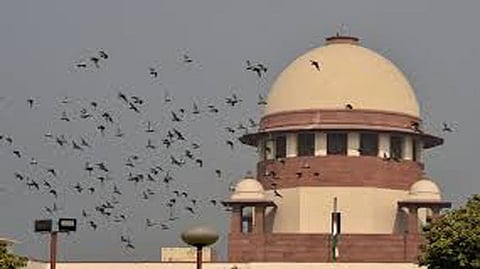

New Delhi | The Centre has told the Supreme Court that the principle of creamy layer was not applicable to reservation for Scheduled Castes (SCs) and Scheduled Tribes (STs).
The government has opposed PILs seeking implementation of the "creamy layer" principle in reservation for SCs and STs, and also the direction to the Centre to frame policies for a more equitable system of reservation in government employment.
The government said the PILs do not disclose any infringement of the fundamental rights under the Constitution.
"It has nowhere specifically been held that the principle of creamy layer is applicable to SCs and STs. The reference made to the concept of creamy layer…appears to be the general observation with regard to reservation in respect of OBCs (Other Backward Classes)/ SEBCs (Socially and Educationally Backward Classes).
"This has been clarified by a Constitution bench of this court in the case of Ashoka Kumar Thakur versus Union of India… that for the purpose of reservation, the principles of creamy layer are not applicable to SCs and STs," the government said in its affidavit to the Supreme Court.
The creamy layer principle was first devised by the Supreme Court in its famous Mandal case verdict of 1992 by which certain affluent people belonging to the Backward Classes were excluded from reservation in government jobs and admissions in educational institutions.
The government in its affidavit said, "That modification of reservation policy, particularly to introduce income-based preferences within reserved categories, should be preceded by a holistic review and thorough empirical study, including socio-economic data of reserved category beneficiaries."
It added that no direction can be issued to the executive to frame policy in a particular manner, which is beyond the judicial domain.
The Centre's affidavit sought dismissal of PILs filed by petitioners Ramashankar Prajapati and others, and advocate Ashwini Upadhyay, saying they were not maintainable under the law.
It said these petitions neither raise any question of law pertaining to the Constitution and which need interpretation of this court nor disclose the infringement of the fundamental rights under the Constitution and, therefore, were not maintainable under Article 32 and hence, deserve to be dismissed with exemplary cost.
The affidavit emphasised that fundamental rights guaranteed to the subject or subjects under Part III of the Constitution were negative in character and positive in sancțion.
"In other words, the subject/s cannot enforce his fundamental right by way of filing a writ petition under Article 32 of the Constitution, unless and until it is infringed by the state," it said.
The affidavit filed by the social justice and empowerment ministry said the present petition has been filed in ignorance of the law laid down by this court in a catena of judgments in which this court has elaborately dealt with the scope and ambit of Articles 341 and 342 of the Constitution.
"This Court has held that a notification issued under Clause (1) of Articles 341 and 342, specifying SCs and STs, can be amended only by law to be made by the Parliament.
"In other words, any caste tribe or part of or group within any caste/tribe can be included or excluded from the list of SCs or STs issued under Clause (1) of Articles 341 and 342 only by the Parliament by law and by no other authority and it is not open to State Governments or courts or tribunals or any other authority to modify, amend or alter the list of SCs or STs specified in the notification issued under Clause (1) of Article 341 or 342," it said.
Terming the petition as "a misconceived one", the government said that now similar provisions have been made for SEBCs vide the Constitution (One Hundred and Second Amendment) Act, 2018.
The Centre further said that in the majority of schemes for welfare and development of SCs, STs and SEBCs, excepting reservation in educational institutions and services under the state, there is a means test which ensures that benefits of schemes percolate to those who actually deserve them.
It said the reliefs sought are vague and generalised, and lack any material or documentary proof, and the petitioners have failed to specify which government schemes should be extended or how these would benefit the below poverty line (BPL) persons of all communities.
"In view of the above submissions, the writ petition lacks legal merit and is liable to be dismissed on the grounds of maintainability and non-justiciability. The court should refrain from directing the executive to frame policies on reservation or income-based preferences without empirical data or a legislative mandate, keeping in view the separation of powers and judicial precedents," it said.
On August 11, last year, the top court issued notice on the PIL filed by Prajapati and others which sought direction to implement and adopt the income-based preferences within each reserved category to ensure equitable distribution of benefits among economically weaker candidates belonging to SC, ST, OBC and Economically Weaker Sections (EWS).
On January 12, the top court issued notice to the Centre and all state governments on a PIL by Upadhyay which sought the implementation of the "creamy layer" principle in reservation for SCs and STs.
Upadhyay contended that in cases where a member of an SC or ST family has already attained a constitutional or senior government position, the children of such a person should not be allowed to avail of reservation benefits.

