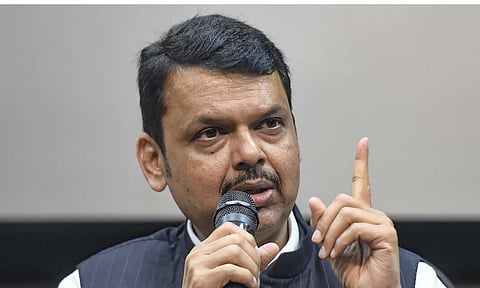

Mumbai | Maharashtra is putting in place the architecture of the Maharashtra Digitization and Exchange of Land Token Asset-The DELTA Act-to create a legal framework for blockchain based tokenization of land and other immovable assets, said Shri Devendra Fadnavis, Hon'ble Chief Minister of Maharashtra, at the Global Fintech Fest (GFF) 2026, being held from September 8–11, at Jio World Centre, Mumbai.
GFF 2026 is organised by the Payments Council of India (PCI), the National Payments Corporation of India (NPCI) and the Fintech Convergence Council (FCC).
The conference is supported by the Ministry of Electronics and Information Technology (MeitY); the Department of Financial Services, Ministry of Finance; the New, Emerging and Strategic Technology (NEST) Division, the Ministry of External Affairs; Niti Aayog; the Reserve Bank of India (RBI); the Securities and Exchanges Board of India (SEBI); the International Financial Services Centres Authority (IFSCA), and the Pension Fund Regulatory and Development Authority (PFRDA).
Addressing a session titled "Potential to Impact – Agentic AI, Tokenisation and Quantum," Shri Fadnavis spoke about how tokenisation and next-generation fintech could democratise ownership, capital and opportunity by unlocking dormant assets and making finance more transparent, liquid and accessible.
"For us, tokenization is not about speculation, it is about unlocking productive capital, bringing transparency, improving liquidity, and converting dormant wealth into economic opportunity," he said.
This vision extends beyond capital creation to making finance more accessible, inclusive and empowering for all. "UPI democratized transactions. The next generation of fintech must democratize credit, intelligence, ownership, and opportunity," he added.
Mr. Kris Gopalakrishnan, Chair, GFF 2026, Founder, Infosys, and Chairman, Axilor Ventures, remarked, "This year's inaugural session brings together three technology themes that will defi ne the next decade of finance: agentic AI, tokenization, and quantum computing."
"UPI succeeded not because the technology was clever, but because it was built as public infrastructure-open, interoperable, low cost, and designed from day one for inclusion," he said.
"If we keep inclusion, responsible adoption, security, and trusted systems at the center, India is exceptionally placed to lead," he added.
Also speaking at the session, Ms. Sohini Rajola, Executive Director, Growth, NPCI, said, “Over the years, GFF has grown alongside the Indian fintech ecosystem. It has evolved from a conference into a global platform where policymakers, regulators, central bankers, financial institutions, fintechs, technology companies, investors and academia engage with the structural questions shaping the future of finance. GFF has created a space where policy meet implementation, where innovators test ideas against institutional and regulatory realities, where global experience interact with India’s population-scale capabilities, and where conversations lead to tangible action.”
GFF 2026 is organised by the Payments Council of India (PCI), the National Payments Corporation of India (NPCI) and the Fintech Convergence Council (FCC).
The conference is supported by the Ministry of Electronics and Information Technology (MeitY); the Department of Financial Services, Ministry of Finance; the New, Emerging and Strategic Technology (NEST) Division, the Ministry of External Affairs; Niti Aayog; the Reserve Bank of India (RBI); the Securities and Exchanges Board of India (SEBI); the International Financial Services Centres Authority (IFSCA), and the Pension Fund Regulatory and Development Authority (PFRDA).
About Payments Council of India (PCI)
The Payments Council of India (PCI) was formed under the aegis of the Internet and Mobile Association of India (PCI) in the year 2013 catering to the needs of the digital payment industry. The Council was formed inter-alia to represent the various non-banking payment industry players, and to address and help resolve various industry-level issues and barriers that require discussion and action.
The council works with its 220+ members, encompassing over 90% of the industry to promote payments industry growth and to support our national goals of 'Cashless Society' and ‘Growth of Financial Inclusion’ which is also the Vision Shared by the RBI and the Government of India. PCI represents the complete digital payments ecosystem of India through its various committees representing different sectors.
About National Payments Corporation of India (NPCI)
National Payments Corporation of India (NPCI) is the umbrella entity responsible for operating retail payments and settlement systems in India. It is established by the Reserve Bank of India (RBI) and the Indian Banks’ Association (IBA). The Company is focused on bringing innovations in the retail payment systems by using technology for achieving greater efficiency in operations and widening the reach of payment systems. NPCI is committed to harnessing the transformative potential of deep tech, creating an ecosystem that fosters collaboration to work on breakthrough technologies. Underlining its commitment to service, NPCI has been incorporated as a “Not for Profit” Company to provide infrastructure to the entire Banking system in India for physical as well as electronic payment and settlement systems.
NPCI has made a profound impact on India's retail payment landscape, focusing on creating robust, efficient, and inclusive payment and settlement solutions. NPCI has been instrumental in introducing a range of products that have revolutionised retail payment systems. These include Unified Payments Interface (UPI), RuPay, National Automated Clearing House (NACH), Immediate Payment Service (IMPS), National Electronic Toll Collection (NETC), Aadhaar Enabled Payment System (AePS), e-RUPI and more. Each of these products has contributed significantly to enhance the efficiency and accessibility of payment systems in India, ultimately propelling financial inclusion.
NPCI has played a fundamental role in establishing the foundation for India’s rapidly growing digital payments ecosystem, projecting the country onto the global stage.
NPCI has four wholly owned subsidiaries – NPCI International Payments Limited (NIPL) and NPCI Bharat BillPay Limited (NBBL), NPCI BHIM Services Limited (NBSL) and NPCI Tech Solutions Limited (NTSL), established in pursuance of NPCI Board & RBI approval.
For more information visit: https://www.npci.org.in/
About Fintech Convergence Council (FCC)
Established in 2018, the Fintech Convergence Council (FCC) is an industry body representing the collective voice of fintech companies in India. Since its inception, the FCC has evolved into a leading platform with a diverse membership of over 280 fintech entities across key segments including digital lending, wealth, insurance, RegTech, and credit bureaus. The FCC’s core mission is to address sector-specific challenges and provide a unified platform for dialogue within the broader BFSI (Banking, Financial Services, and Insurance) ecosystem.
The council actively engages with regulators and policymakers to help shape progressive policy frameworks and promote a balanced approach to innovation and compliance. In addition to policy advocacy, the FCC also focuses on knowledge sharing, strengthening consumer education, and promoting responsible finance through awareness-building initiatives on customer protection, digital literacy, and best practices in fintech.
To learn more, please visit https://fintechcouncil.in

