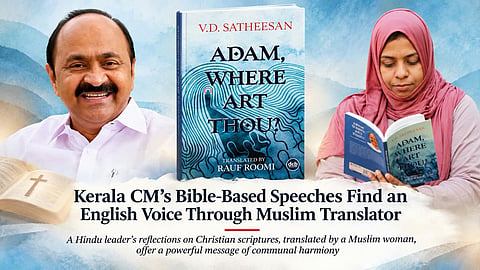

Thiruvananthapuram | A Hindu politician's Bible-inspired speeches found their way into English through the hands of a Muslim woman.
While Chief Minister V D Satheesan says such things are possible in Keralam, Rauf Rumi, who brought his book into English, says the experience went beyond words and language.
Speaking to PTI on Thursday, 38-year-old Rumi said that although she comes from a different faith, she was deeply moved by the Christian teachings and the thoughts expressed in the book, Adam, Where Art Thou? The experience also strengthened her belief that one does not have to belong to a particular religion to respect its teachings and scriptures.
"I am a Hindu who delivered speeches on the Bible and later compiled them into a book. A Muslim woman translated it into English. Such things are possible in Keralam," Satheesan recently remarked while speaking at a church programme in Changanassery, highlighting the religious inclusiveness that characterises the state's social life.
For Kannur-born Rumi, the assignment turned out to be much more than a translation project.
It was a journey of discovering another faith, exploring unfamiliar stories and finding common messages of compassion and humanity across religious traditions.
"I belong to the Islamic faith, which teaches us to respect all religions and their scriptures. This work gave me an opportunity to understand Christian beliefs and Biblical teachings more closely," said Rumi, a writer and translator.
The English edition of 'Adam, Where Art Thou?', translated from the Malayalam original 'Adam Nee Evide Aakunnu?', was released by DC Books on November 5.
Rumi said she had undertaken several translation assignments for DC Books when the publisher approached her with Satheesan's book.
She was already curious about the Malayalam edition, having found it unusual for a political leader to bring out a collection of speeches inspired by the Bible.
"I wanted to read the book even before they approached me. When DC Books contacted me, I was happy to take up the assignment. It was an interesting experience, and every speech of the chief minister offered something different," she said.
Although she was not a regular reader of the Bible, Rumi said her academic background in English literature had given her a basic familiarity with Biblical references.
Her friendships with members of the Christian community have also helped her understand their religious traditions and the different versions of the Bible followed by various church denominations.
She immersed herself in extensive reading and reference work to understand the context of the speeches and ensure that the original thoughts and emotions were not lost in translation.
An observation made by Satheesan in the prelude to the book particularly caught her attention. The chief minister has described himself as an idol-worshipping Hindu who nevertheless held the Bible in great reverence.
"For me, that was significant. Here is a Hindu who deeply respects Christian teachings. Similarly, I am a Muslim, but I could engage with and translate a book rooted in Christian beliefs. We do not have to belong to a particular religion to appreciate its teachings or respect its scriptures," she said.
Among the passages that stayed with her was Satheesan's observation in one of his speeches that people who pray are the strength of a society and that the prayers of all communities have significance.
"That portion touched me deeply while translating the book," Rumi said.
The experience also made her reflect on the similarities between the Quran and the Bible. Although the scriptures differ in their narratives and manner of presentation, both ultimately emphasise love for humanity, she said.
The book offered her discoveries beyond religious teachings as well. It introduced her to lesser-known historical episodes, incidents and interesting anecdotes, while helping her learn about the contributions of Christian priests to society across community boundaries.
Rumi said the secular atmosphere in Keralam had helped people develop a basic awareness of religions other than their own, making such cultural and intellectual exchanges possible.
The translation also brought an unexpected moment of personal appreciation. A few days after the English edition was released, Satheesan telephoned her to express his satisfaction with the work.
"He said he liked the translation very much and that the essence of the original Malayalam book had been retained. I was extremely happy to hear that," she said.
The original Malayalam publication is a compilation of 32 speeches Satheesan delivered at programmes hosted by various Christian organisations across Keralam, reflecting on Biblical stories and the teachings of Jesus Christ in the context of contemporary society.
All 32 chapters have been carried forward into the 197-page English edition, published by DC Books.
A native of Kannur, Rumi is a postgraduate in English language and literature and has qualified for the UGC National Eligibility Test (NET).
Having taught at colleges in Keralam and Punjab, she is currently taking a career break to pursue her interests in writing and translation.
Her translation credits include Dhariba Lyndhem's Name Place Animal Things and Sudha Murty's Gopi Diaries series for children, among other works.
