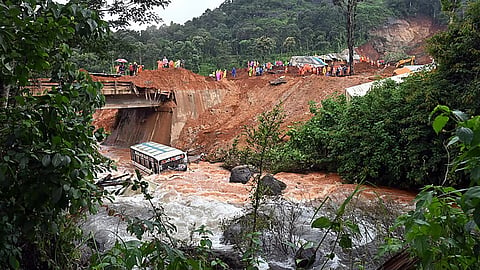


# Ajayan | Four days after the July 7 landslide disaster, the State Government constituted an expert committee to probe what happened, and whether blasting for the hurriedly pursued inauguration of the Anakkampoyil–Kalladi–Meppadi twin-tunnel project triggered the disaster. Yet, two months on, the deadline already over, there appears to be no light at the end of this investigative tunnel and only time has passed through it.
The committee’s one-month deadline has now stretched past two months, with little to show for it. Indications are that it has not even formally met, while its report, whenever, or if ever, submitted, may carry little beyond a recommendatory weight. Like many such reports before it, it could simply gather dust - officially received, effectively rejected - until the next disaster jolts the State into remembering the last one.
Apart from two technically fortified members - internationally acclaimed geologist CP Rajendran and environmental scientist Vishnudas – the committee was largely a bureaucratic assemblage. Two weeks later, hydrologist Sharmisha Singh and geotechnical engineer Sreevalsa Kolathayar were added, bringing some technical heft. An online meeting was followed by a site visit which included Keralam Chief Wildlife Warden P Pukazhendi. And then, apparently, nothing.
The bureaucratic merry-go-round continued. A transfer displaced one official; LSGD Principal Secretary Tinku Biswal stepped in to head the committee, followed by the co-option of yet another Disaster Management official. The committee thus gained members, shuffled chairs; and, so far, seemingly little else.
With the deadline already past, some members pressed for a collective discussion and a joint submission based on the site visit. A meeting was convened, though its outcome remains unclear. Meanwhile, a section of the bureaucracy is learnt to have bluntly conveyed that the recommendations would carry little weight in implementation. The official line, reportedly, was even blunter: let the work continue; recommendations must not become impediments.
Some committee members have continuously flagged serious lapses by the project company and warned that they warranted stringent action. The warning, however, seems to have vanished into official silence. The Government must now break the silence and force out the report, without further delay. But given the way things are going, it is a remote possibility that a corrective initiative will come.
After the gory of the Puthumala landslide in 2019 and the catastrophic Mundakkai disaster in 2024, the one at the tunnel opening was the latest warning. The mudslip that occurred at the very mouth of the controversial twin-tunnel project was not because of the mound of earth removed as part of construction work. The hill rolled down and with it went the mound.
The project was rushed to inauguration by then Chief Minister Pinarayi Vijayan with an eye on the elections. The then Opposition Leader, and now Chief Minister VD Satheesan had questioned its environmental clearance, given the tunnel’s alignment through an ecologically sensitive region and dangerously close to sites of earlier Wayanad disasters. Experts and green activists who sounded the alarm were intimidated and branded “anti-development”. Yet it takes no rocket science to understand that blasting can trigger subsurface rock piping and weaken slope stability. But science and ecology counted for little. The project rolled on and so did the disaster.
The Government’s deadly silence and dismissive handling of the expert committee are a dangerous invitation to disaster. It must stop the tunnel work, heed the committee, especially those with technical know-how, and await its full report before a single blast resumes. Anything less is not caution, it is gambling with the hills and the lives below them. Let science, and only science, prevail.
