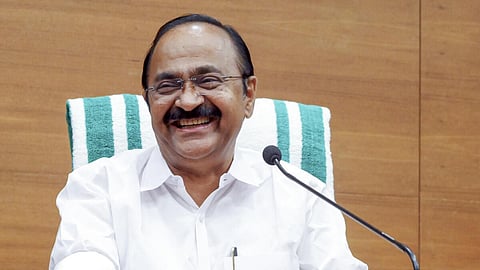

Thiruvananthapuram | Kerala Chief Minister V D Satheesan on Wednesday said the UDF government had not taken a final decision on permitting low-alcohol beverages in Kerala and would formulate its liquor policy only after consultations within the coalition and with stakeholders.
Replying to the three-day debate on the Budget in the state Assembly, Satheesan rejected allegations that the government had offered undue benefits to liquor companies through tax changes.
"As for the liquor policy itself, that is a political decision. The UDF will discuss it internally, prepare a draft, consult all stakeholders and parties, and then arrive at a policy," he said.
The chief minister clarified that the tax rates announced in the Budget did not, by themselves, imply that low-alcohol beverages would be sold in the state.
"If, after those discussions, the UDF decides that low-alcohol beverages should be sold in Kerala, these would be the applicable tax rates. If the UDF decides they should not be sold, then they will not be sold. That is ultimately a political decision," he said.
Satheesan defended the process followed in preparing tax proposals, saying departments routinely submit their recommendations to the Finance Department before the Budget is finalised.
Responding to allegations that the issue had not been discussed within the ruling front, he drew a distinction between administrative matters and political decisions.
Taking a dig at the CPI(M), he said, "Routine administrative files are not taken to the party office." "When it comes to major policy decisions, I will go to the KPCC office, discuss the matter with the party president, request the convening of the relevant committee, and formulate policy after consultations," he said.
The chief minister added that his government would not move official files outside the normal administrative process.
"What we will not do is take day-to-day government files to the party office or secretly move files there for approval without the knowledge of the CM. That is not how this government functions," he said.
The chief minister said the government did not propose to reduce taxes, as alleged.
"Instead, it fixed a 175 per cent tax rate for beverages containing between 10 and 20 per cent alcohol, describing it as one of the highest such rates among Indian states," he added.
"We did not adopt a rate between 86 per cent and 116 per cent as suggested. Instead, for beverages containing between 10 per cent and 20 per cent alcohol, we fixed the tax at 175 per cent," he said.
Satheesan said claims that his government had favoured liquor manufacturers were politically motivated and ignored decisions taken by the previous administration.
"People ask, 'How much did you receive?' Let me explain from the beginning," the chief minister said, in an apparent reference to the corruption allegations levelled by the opposition LDF.
He argued that discussions on permitting low-alcohol beverages had begun under the previous LDF government, noting that applications from liquor companies were taken up during its tenure.
"So I ask: Who first held discussions with liquor companies? Who initiated those talks?" he said.
Satheesan also said the LDF government's 2022–23 liquor policy, based on the recommendations of the Udayabhanu Commission, had proposed promoting beverages with an alcohol content of up to 20 per cent.
Accusing the previous CPI(M)-led LDF government of facilitating a sharp increase in the number of bars, he claimed that the figure had risen from 28 in 2016, when the Pinarayi Vijayan government assumed office, to more than 900 at present.
"The very government that now claims low-alcohol drinks are dangerous had a liquor policy promoting them," he said.
Satheesan questioned the tax decisions taken by the previous government on imported foreign liquor.
"Was that lower tax granted because someone accepted favours from imported foreign liquor brands? That is the question being raised," he said.
The chief minister maintained that the decision to create a separate category for low-alcohol beverages had been taken by the previous government and that his administration had merely determined the applicable tax structure

