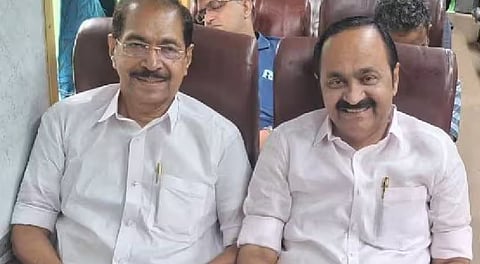

Kannur (Keralam) | Keralam Electricity Minister Sunny Joseph on Friday said there were no differences between him and Chief Minister V D Satheesan over power procurement and that the government was continuing efforts to secure electricity through long-term agreements to meet the state's growing demand.
Responding to reporters' queries here, Joseph said there was no immediate power crisis, but the government could not ignore the increasing demand, particularly during the summer months.
He also clarified that the state had not entered into any agreement with private power procurement platform GNA and that there were no immediate plans to proceed with such a deal.
Earlier, CM Satheesan had claimed that the state is looking to procure electricity from General Network Access (GNA) at a lower price. However, he later clarified that no agreement was made.
When asked about any difference with Satheesan over electricity procurement from GNA, Joseph denied it.
"There was no decision at that time. The media reported it incorrectly. Everything has been resolved through discussion," he said.
Regarding the proposed GNA arrangement, Joseph said the government had examined the advantages and practical difficulties of procuring power through the private platform.
Though the quoted rate appeared lower than the offer from other sources, the arrangement involved certain practical considerations, including the requirement to procure power during both daytime and nighttime, he said.
"The chief minister has been informed about the differences and practical difficulties involved. As of now, there will be no agreement with GNA," he said.
He also dismissed allegations that the Kerala State Electricity Board (KSEB) had exaggerated the possibility of a power crisis to push through the proposed agreement, saying the department had only highlighted the growing electricity requirement.
Joseph said the state needed to plan for its future power requirements rather than wait for an acute shortage to emerge.
He said the power situation had improved temporarily following rainfall in the state, cooler weather in northern India and the Deepavali holidays, which had reduced demand.
"However, that does not mean the electricity crisis has been resolved. We are continuing our efforts to procure more power, particularly to meet our long-term requirements during the summer," he said.
The minister said the state had recently secured an additional 540 MW of electricity from NTPC through discussions held in New Delhi about a month ago involving the chief minister, himself and the company's chairman.
"Following those discussions, NTPC has agreed to provide us 270 MW plus another 270 MW. This will help us get electricity at a comparatively lower price," he said.
Joseph said the arrangement would provide some relief but stressed that the state needed additional long-term power procurement agreements to meet summer demand.
He said Keralam's electricity requirement had been increasing steadily, with demand rising by around 1,000 MW compared with the previous year and more than doubling over the past decade. However, power generation within the state had not kept pace with the increase, he said.
"Over the last 10 years, our electricity demand has increased by around 2,500 MW, but generation has increased by only 150 MW," he said, pointing out that Keralam depended largely on hydropower projects for electricity generation.
The minister also explained that the increase in rooftop solar generation could not be considered a complete solution to the state's power requirements.
Solar power generated by households and supplied to the grid was largely available during the daytime, while Keralam's demand remained high during the night, he said.
"We need electricity particularly during night hours. We cannot depend entirely on solar power generated during the day. We need battery storage facilities to preserve the solar energy generated during the daytime and use it at night," he said.
Joseph said the government was planning to promote decentralised battery storage projects with the participation of local self-government institutions and cooperative organisations.
The state government had earmarked Rs 100 crore in the Budget for the initiative, but additional funds would be required to expand it, he said.
"We are considering providing subsidies for such projects and will also hold discussions with banks to facilitate loans," he said.
Asked about UDF convenor Adoor Prakash's criticism of the lack of coordination among ministers in the government, Joseph denied it.
"If anyone had any doubts, they were cleared. There is collective responsibility among the ministers," he said.v
