
#Ajayan
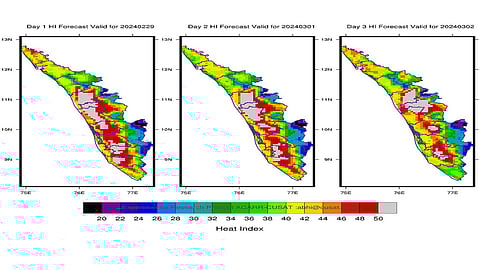
Kochi | Amidst the balmy days and sultry nights poised to linger over Kerala in the days ahead, it is a rare phenomenon of the midlands also caught in the heat impact. Several parts of Kerala have experienced temperatures soaring nearly four degrees above the normal range, despite the late-night dew, which, according to old-timers, will vanish after Sivaratri next week.
The rising temperatures in the midlands, now rivaling or even surpassing those of Palakkad or Malappuram, can be attributed to the urban heat island effect. Unlike forested areas or plains, such as in Palakkad which witness highest temperatures during summer, the midlands of Kerala have experienced significant construction activity, including the development of buildings and roadways. In these areas, the concrete structures absorb rather than reflect sunlight, leading to heat retention and making these urban areas hotter. With summer approaching its peak, the situation is expected to worsen.
The signs of an impending summer, anticipated to arrive by mid-March, have become unmistakable, with scorching days and stifling nights prevailing since mid-February. Such extreme temperatures were typically reserved for April, but the impact of climate change has brought them forward to February this year. With the onset of summer, the direct influence of the sun will be significantly intensified.
In Kerala, the peak of summer falls between mid-March and mid-April, when the sun's rays are at their most direct angle. This vertical angle means that the ultraviolet index will be high, as the rays travel shorter distances through the atmosphere compared to other times when they are more slanted.

El Nino effect
Climatologists attribute this phenomenon to the El Nino effect, which is characterized by the warming of the ocean surface in the central and eastern tropical Pacific Ocean, disrupting normal weather patterns globally. Abhilash S, Director of the CUSAT Advanced Centre for Atmospheric Radar Research, told Metro Vaartha that the El Nino effect is severe. Globally, 2023 was the hottest year in the last 100 years and this trend is expected to be reflected in this year's temperatures as well, he adds.
The ocean temperature in the Atlantic has risen by around 2-3 degrees, while on the eastern side of the Indian peninsula too, temperatures have risen similarly. A 1-2.5 degree rise in temperature due to El Nino is reflected in the circulation pattern, creating high pressure in the Indian peninsular region. This high pressure hinders cloud convection, creating a heat dome that persists for a longer duration. Consequently, there is limited mixing of air with the sea breeze, resulting in poor cooling, he adds.
