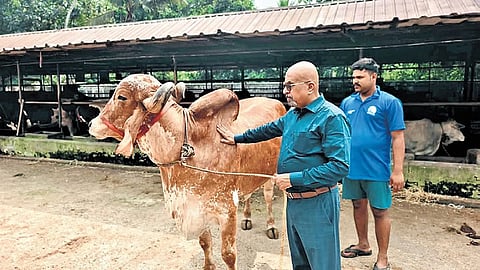

Kottayam (Keralam) | What began as a search for milk and panchgavya for his wife's treatment slowly turned into a farm with nearly 600 cattle.
For Muraleedharan Nair of Vaikom in Keralam, dairy farming was not initially about building a business empire.
It began as a personal need that grew into a venture demanding years of investment, patience, and hard work.
Now, his journey has earned him the first prize in the Central Government's National Gopal Ratna Puraskar 2026 for Best Dairy Farmer rearing indigenous cattle/buffalo breeds.
"I started with just seven cattle," says Muraleedharan Nair, recalling how he began the dairy venture in 2018 at Arattukulangara in Vaikom in Kottayam district.
What started on a small scale soon grew beyond his initial plans.
He bought cattle from Gujarat in three phases, bringing in around 50 to 60 animals, and gradually expanded the business.
Today, his dairy operations at Arattukulangara in Vaikom and Elanji in Ernakulam district have nearly 550 to 600 cattle.
The farms have indigenous breeds such as Gir and Vechur, along with crossbred cattle.
Holstein Friesian cattle are also part of his breeding programme to develop a new Gir variety.
The farms produce around 6,000 litres of milk a day.
The milk is sold directly through markets and online platforms, while the company also makes and markets various milk products.
The growth, however, has not come with quick profits.
"Right now, we are just breaking even. I expect it to become profitable in another two years," he told PTI.
For Nair, dairy farming is not a business one can enter expecting returns within a short period.
It requires investment, planning and the ability to sustain the farm through different stages of cattle breeding and milk production.
"Just starting and running a farm for two, four or even ten years does not mean it will become a permanent business," he says, explaining why he believes newcomers should approach dairy farming with a long-term plan.
He has a practical suggestion for those who want to enter the field.
"In my opinion, someone starting a dairy farm should have at least 50 cattle. Only then can you supply milk regularly. There are cattle that become pregnant and go through periods when they do not produce milk. So, you need a scientific plan to make the farm sustainable," he said.
The advice comes from a man who has spent decades building businesses outside Keralam, too.
Nair has been an expatriate for 32 years and runs businesses in Dubai. He is involved in logistics, shipping and other sectors through the Amro Group, which he started in 2004.
He also runs a flight academy in the UAE, training students from different countries to become pilots.
The dairy farm, however, is an effort to bring something back to his home State.
His aim is to make A2 milk and milk products available in Keralam while encouraging the rearing of indigenous cattle.
There is more in the pipeline. The Elanji farm, spread across 20 acres, is set for further expansion.
The farm is near a hill called Koorumala, a location that already attracts visitors.
His work in dairy farming has now brought him national recognition.
He will receive the National Gopal Ratna Puraskar in Patna, Bihar, on November 26.
The award carries a cash prize of Rs 5 lakh and a citation. He has won the first prize, making him the first Keralite to receive the top award, according to the details provided.
"There is a lot of pride in receiving this award. For the first time, a Malayali is getting the first prize," he says.
Officials from the National Dairy Development Board's Keralam office visited the farm and collected reports as part of the assessment.
The award-related information highlights his efforts to promote indigenous cattle breeds and scientific methods of dairy farming.
Nair is cautious about saying that an award alone will persuade young people to take up dairy farming.
But he believes it is a recognition of the work done by farmers in Keralam.
For a man who began with seven cattle, the farm today is a much larger undertaking.
There are more cattle, more milk, plans for more land and a business that is still waiting to turn the corner financially.
But the journey, he believes, is not one that can be measured only in profit. It is also about building something that lasts.
