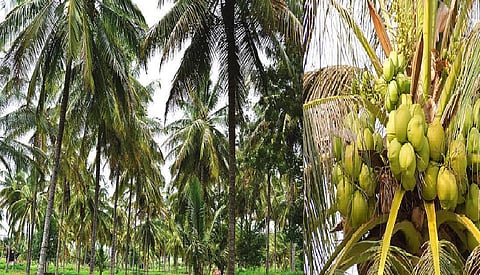

Kochi | For decades, coconut has shaped the landscape and livelihoods of millions of farming families in Kerala and other coastal states.
Now, the Coconut Development Board (CDB) is trying to take the crop beyond its traditional heartland by offering higher financial assistance to farmers willing to plant new coconut gardens and establish nurseries that can supply quality seedlings.
The Board has substantially increased the financial assistance available under its New Coconut Planting Scheme, replacing the earlier subsidy of around Rs 40 per seedling with support that now works out to nearly Rs 350 per seedling under the revised programme introduced last financial year.
"The revised scheme came into effect from the last financial year under the Area Expansion Programme," a senior Coconut Development Board official told PTI.
Under the revised guidelines, farmers planting coconut on one hectare of land are eligible for financial assistance of Rs 56,000, released in two equal annual instalments of Rs 28,000 each. Assistance is available for up to two hectares.
"On an average, around 160 to 170 coconut seedlings can be planted on one hectare, depending on the recommended spacing. The subsidy works out to roughly Rs 350 per seedling," the official said.
Farmers with at least 20 cents of land who plant a minimum of 10 coconut seedlings can also receive proportionate financial assistance. However, the scheme does not cover gap filling or replanting within existing coconut plantations.
The revised programme has already seen encouraging responses. During its first year, the Board provided financial assistance to 5,430 farmers covering 2,271 hectares across the country.
"Some applications reached us late, so we could not extend financial assistance to all eligible applicants during the last financial year. But this is a continuing scheme and farmers can apply every year," the official said.
Applications are invited annually in the prescribed format.
In Kerala, farmers can submit applications through their local Krishi Bhavan, while in other states they must apply through the respective Agriculture or Horticulture Departments.
The Board conducts random field inspections before releasing the subsidy, which is credited directly to the farmer's bank account through the Direct Benefit Transfer (DBT) system.
"The follow-up also continues in the second year. We send reminders to farmers on their mobile phones when they become eligible for the second instalment. We even send application forms individually so that beneficiaries can apply on time," the official said.
The Board has set an ambitious target of bringing around 8,000 hectares under new coconut cultivation during the current financial year.
"The programme is being implemented across all states, including traditional and non-traditional coconut-growing areas. The same scheme is also being extended to the northeastern states," the official said.
Alongside new planting, the Board is focusing on producing enough quality seedlings to meet growing demand.
One of the biggest challenges in non-traditional coconut-growing regions is the shortage of good planting material. To address this, the Board is promoting Coconut Nursery Schemes with financial assistance for entrepreneurs and farmers who establish certified nurseries.
"The nursery scheme supports the new planting programme. If quality seedlings are produced locally through the Board-assisted nurseries, farmers will have easier access to planting material and we can expand coconut cultivation in non-traditional areas much faster," the official said.
The initiative is already gaining ground in states such as West Bengal, where authorised nurseries collect seed nuts from approved mother palms and raise seedlings locally.
Under the scheme, a nursery in a traditional coconut-growing area can be established on 25 cents of land by sowing 10,000 seed nuts and producing about 6,250 seedlings. In non-traditional areas, however, the minimum production requirement has been reduced to 3,125 seedlings.
"We have relaxed the norms in non-traditional regions to encourage more nurseries. Similar concessions have also been provided under the new planting scheme," the official said.
The concessions extend to farmers as well. While growers in traditional coconut-producing states such as Kerala must plant at least 10 seedlings on a minimum of 0.08 hectare, or about 20 cents of land, to qualify for assistance, farmers in states such as West Bengal, Bihar, Jharkhand and the northeastern region need to plant only five seedlings. One cent of land equals about 0.01 acre.
Under the nursery scheme, the Board provides financial assistance of Rs 45 per seedling, released in two equal instalments of Rs 22.50 each after verification.
"The subsidy is based on about 50 per cent of the estimated production cost of each seedling. It covers components such as transportation of seed nuts, nursery establishment, polybags, shade-net structures and other essential infrastructure," the official said.
Before financial assistance is released, every nursery is inspected by a joint committee comprising officials of the Coconut Development Board and the concerned state department to ensure that it meets the prescribed standards.
Board officials say the twin focus on expanding coconut cultivation and strengthening the supply of quality seedlings is expected to help increase coconut acreage in both traditional and emerging growing regions, while giving more farmers an opportunity to diversify their income through a crop that remains one of India's most important plantation commodities.

