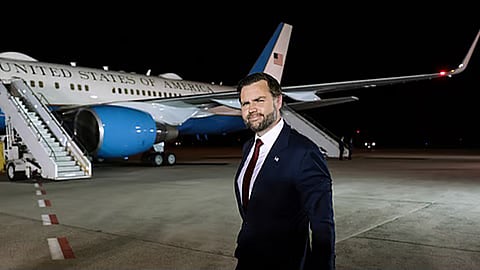

Islamabad | US Vice President JD Vance landed in Pakistan on Saturday to hold high-stakes talks with Iran with an aim to reach a permanent peace agreement to end the war in West Asia that has crippled global energy supplies and caused widespread economic disruptions.
Vance, accompanied by several top American officials, including special envoy Steve Witkoff and President Donald Trump's son-in-law Jared Kushner, arrived in Islamabad hours after an Iranian delegation led by Parliament Speaker Mohammad Bagher Ghalibaf, reached the Pakistani capital city.
The US Vice President was received at the airport by Pakistan Deputy Prime Minister Ishaq Dar and Army Chief Field Marshal Asim Munir at the Nur Khan airbase.
Welcoming the US Vice President, Dar commended the US's commitment to achieving lasting regional and global peace and stability, according to the Pakistan Foreign Office.
Dar, who is also the foreign minister, expressed the hope that "parties would engage constructively, and reiterated Pakistan's desire to continue facilitating the parties towards reaching lasting and durable solution to the conflict." The Pakistan-mediated peace talks are taking place, days after Iran and the US announced a two-week ceasefire.
The Iranian and American delegations are set to hold separate meetings with Pakistan Prime Minister Shehbaz Sharif before the commencement of any potential peace negotiations, Iran's semi-official Tasnim news agency reported.
It will be the first high-level negotiations between Iran and the US after the war began on February 28, following joint strikes on Iranian targets by the US and Israel.
US President Donald Trump has already cautioned that the US will resume its military action against Iran if the talks do not produce a peace deal.
Before departing for Pakistan, Vance said he was looking forward to the negotiations and hoped that it would be "positive".
As the US president said, if the Iranians are willing to negotiate in "good faith", we're certainly willing to extend the "open hand", Vance said.
"If they're going to try to play us, then they're going to find that the negotiating team is not that receptive," he added.
The Iranian delegation also comprised Foreign Minister Abbas Araghchi.
A thick security blanket covered Islamabad, which was on 'red alert' for the talks.
More than 10,000 police and security personnel have been deployed to ensure multi-layered security for the visiting delegates, officials said.
The Red Zone, housing key buildings, is being protected by the army and the Rangers, and only authorised officials and residents are allowed to go through it.
The upcoming negotiations are being closely watched globally, as their success or failure could have far-reaching implications for West Asia's security, global energy markets, and international diplomacy.

