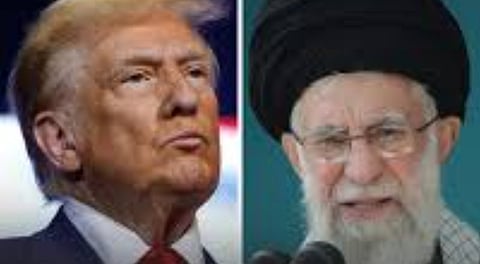

Washington | President Donald Trump said Tuesday the US knows where Iran's Supreme Leader Ayatollah Ali Khamenei is hiding during the Israel-Iran conflict but doesn't want him killed “for now.”
Trump urged, in a social media posting, Iran's “UNCONDITIONAL SURRENDER” as the five-day conflict continues to escalate.
“We know exactly where the so-called Supreme Leader' is hiding,” Trump added. “He is an easy target, but is safe there - We are not going to take him out (kill!), at least not for now. But we don't want missiles shot at civilians, or American soldiers. Our patience is wearing thin.”
Trump's increasingly muscular comments towards Tehran come after urging Tehran's 9.5 million residents to flee for their lives as he cut short his visit to an international summit to return to Washington for urgent talks with his national security team.
Trump arrived at the White House early Tuesday at a moment of choosing in his presidency. Israel, with five days of missile strikes, has done considerable damage to Iran and believes it can now deal a permanent blow to Tehran's nuclear programme — particularly if it gets a little more help from the Republican president.
But deepening American involvement, perhaps by providing the Israelis with bunker-busting bombs to penetrate Iranian nuclear sites built deep underground or offering other direct US military support, comes with enormous political risk for Trump.
Trump, as he made his way back to Washington, expressed frustration with Iranian leaders for failing to reach an agreement. He said he was now looking for “a real end” to the conflict and a “complete give-up” of Tehran's nuclear programme.
“They should have done the deal. I told them, Do the deal,'” Trump told reporters on Air Force One. “So I don't know. I'm not too much in the mood to negotiate.”
Iran has insisted that its nuclear programme is for peaceful purposes only, and US intelligence agencies have assessed that Tehran is not actively pursuing a bomb.
Trump, who planned to meet with advisers in the Situation Room, appears to be gradually building the public case for a more direct American role in the conflict. His shift in tone comes as the US has repositioned warships and military aircraft in the region to respond if the conflict between Israel and Iran further escalates.
Trump made an early departure from G7
The White House announced Monday, while Trump was at the Group of Seven summit in the Canadian Rockies, that he would cut his trip short.
“Simply stated, IRAN CAN NOT HAVE A NUCLEAR WEAPON,” he wrote on social media. “I said it over and over again! Everyone should immediately evacuate Tehran!”
Asked about his evacuation comment aboard Air Force One, Trump told reporters: “I just want people to be safe.”
“We're looking at better than a ceasefire. We're not looking for a ceasefire,” Trump said.
Trump said he wasn't ruling out a diplomatic option and he could send Vice President JD Vance and special envoy Steve Witkoff to meet with the Iranians.
He also dismissed congressional testimony from National Intelligence Director Tulsi Gabbard, who told lawmakers in March that US spy agencies did not believe Iran was building a nuclear weapon.
“I don't care what she said,” Trump said. “I think they were very close to having it.”
Speculation grows that Trump may be tilting toward more direct involvement
The Israelis say their offensive has eviscerated Iran's air defences and they can now strike targets across the country at will. Israeli Prime Minister Benjamin Netanyahu says the Israeli bombardment will continue until Iran's nuclear programme and ballistic missiles are destroyed.
So far, Israel has targeted multiple Iranian nuclear programme sites but has not been able to destroy Iran's Fordo uranium enrichment facility.
The site is buried deep underground — and to eliminate it, Israel may need the 30,000-pound GBU-57 Massive Ordnance Penetrator, which uses its weight and sheer kinetic force to reach deeply buried targets and then explode.
But Israel does not have the munition or the bomber needed to deliver it — the penetrator is currently delivered by the B-2 stealth bomber.
Israel's own defences remain largely intact in the face of Iran's retaliatory strikes, but some of Tehran's missiles are getting through and having deadly impact.
The White House dispatched Defence Secretary Pete Hegseth for a prime-time TV appearance as speculation grows about whether Trump could be tilting toward more direct US involvement.
Hegseth told Fox News Channel that “of course” Trump wanted to see a deal made to curb Iran's nuclear programme.
“His position has not changed,” Hegseth said. “What you're watching in real time is peace through strength and America first. Our job is to be strong. We are postured defensively in the region to be strong in pursuit of a peace deal. And we certainly hope that's what happens here.”
Trump continues to push Iran to negotiate on its nuclear programme
Trump, meanwhile, during an exchange with reporters on the sidelines of the G7, declined to say what it would take for the US to get more directly involved. Instead, he continued to press Iran on negotiations over its nuclear programme.
“They should talk, and they should talk immediately,” Trump said during a bilateral meeting with Canadian Prime Minister Mark Carney. He added, “I'd say Iran is not winning this war.”
To be certain, Trump in the days-old conflict has sought to restrain Netanyahu. He rejected a plan presented by Israel to the US to kill Iran's Supreme Leader Ayatollah Ali Khamenei, according to a US official familiar with the matter, who was not authorised to comment on the sensitive matter and spoke on the condition of anonymity.
The Israelis had informed the Trump administration in recent days that they had developed a credible plan to kill Khamenei.
A widening schism over Iran among Trump's MAGA supporters
Trump bristled when asked about some of his MAGA faithful, including conservative pundit Tucker Carlson, who have suggested that further US involvement would be a betrayal to supporters who were drawn to his promise to end US involvement in expensive and endless wars.
“Somebody please explain to kooky Tucker Carlson that,' IRAN CAN NOT HAVE A NUCLEAR WEAPON!'” the president wrote on social media.
Other prominent Trump supporters have also raised concerns about how far the president should go in backing Israel.
Rep Marjorie Taylor Greene of Georgia and Turning Point USA founder Charlie Kirk are among prominent Trump World allies who have noted that voters backed Trump because he promised not to entangle the nation in foreign clashes and to be wary of expanding US involvement in the Mideast conflict.
He ran on a promise to quickly end the wars in Gaza and Ukraine but has struggled to find an endgame to either.
But there are also Trump backers, including Sen Lindsey Graham, R-SC, who are making the case that this is Trump's moment to deliver a decisive blow to Iran. Graham is calling for Trump to “go all-in” in backing Israel and destroying Iran's nuclear programme.
Bangkok | If the US decides to support Israel more directly in its attack on Iran, one option for Washington would be to provide the “bunker-buster” bombs believed necessary to significantly damage the Fordo nuclear fuel enrichment plant, built deeply into a mountain.
Such a bomb would have to be dropped from an American aircraft, which could have wide-ranging ramifications, including jeopardising any chance of Iran engaging in Trump's desired talks on its nuclear programme.
Israeli officials have also suggested that there are other options for it to attack Fordo in central Iran as it seeks to destroy the country's nuclear capabilities.
But aside from a commando attack on the ground or a nuclear strike, the bunker buster bomb seems the most likely option.
What is the bunker-buster bomb?
“Bunker buster” is a broad term used to describe bombs that are designed to penetrate deep below the surface before exploding. In this case, it refers to the latest GBU-57 A/B Massive Ordnance Penetrator bomb in the American arsenal. The roughly 13,600 kilogram precision-guided bomb is designed to attack deeply buried and hardened bunkers and tunnels, according to the US Air Force.
It's believed to be able to penetrate about 200 feet below the surface before exploding, and the bombs can be dropped one after another, effectively drilling deeper and deeper with each successive blast.
The bomb carries a conventional warhead, but the International Atomic Energy Agency has confirmed that Iran is producing highly enriched uranium at Fordo, raising the possibility that nuclear material could be released into the area if the GBU-57 A/B were used to hit the facility.
However, Israeli strikes at another Iranian nuclear site, Natanz, on a centrifuge site have caused contamination only at the site itself, not the surrounding area, the IAEA has said.
How tough a target is Fordo?
Fordo is Iran's second nuclear enrichment facility after Natanz, its main facility, which already has been targeted by Israeli airstrikes. The IAEA said Tuesday it believes the strikes have had “direct impacts” on the facility's underground centrifuge halls.
Fordo is smaller than Natanz, and is built into the side of a mountain near the city of Qom, about 95 kilometres southwest of Tehran. Construction is believed to have started around 2006 and it became first operational in 2009 — the same year Tehran publicly acknowledged its existence.
In addition to being an estimated 80 metres under rock and soil, the site is reportedly protected by Iranian and Russian surface-to-air missile systems. Those air defences, however, likely have already been struck in the Israeli campaign.
Still, Israeli Prime Minister Benjamin Netanyahu has said the goal of attacking Iran was to eliminate its missile and nuclear programme, which he described as an existential threat to Israel, and officials have said Fordo was part of that plan.
“This entire operation ... really has to be completed with the elimination of Fordo,” Yechiel Leiter, Israel's ambassador to the US, told Fox News on Friday.
Why does the US need to be involved?
In theory, the GBU-57 A/B could be dropped by any bomber capable of carrying the weight, but at the moment the US has only configured and programed its B-2 Spirit stealth bomber to deliver the bomb, according to the Air Force.
The B-2 is only flown by the Air Force, and is produced by Northrop Grumman.
According to the manufacturer, the B-2 can carry a payload of 18,000 kilograms but the US Air Force has said it has successfully tested the B-2 loaded with two GBU-57 A/B bunker busters — a total weight of some 27,200 kilograms.
The strategic long-range heavy bomber has a range of about 11,000 kilometres without refuelling and 18,500 kilometres with one refuelling, and can reach any point in the world within hours, according to Northrop Grumman.
Whether the US would get involved is another matter.
At the G7 meeting in Canada, Trump was asked what it would take for Washington to become involved militarily and he said: “I don't want to talk about that.”
In a weekend interview with ABC News, Israeli Ambassador Leiter was asked about the possibility of the US helping attack Fordo and he emphasised Israel has only asked the US for defensive help.
“We have a number of contingencies ... which will enable us to deal with Fordo,” he said.
“Not everything is a matter of, you know, taking to the skies and bombing from afar.”

