
Beijing | India and China signed off 2025 on a positive note, trying to rebuild ties after over four years of fractious relations over the eastern Ladakh boundary conflict.
The two countries set on a long road of normalisation after agreeing to end the border face-off in October 2024, bringing to an end years of tension since the 2020 Galwan clash.
As peace prevailed at the borders, a key prerequisite for India to establish good relations with China, the two sides stepped up the dialogue process.
NSA Ajit Doval and Chinese Foreign Minister Wang Yi, the Special Representatives of India and China on the boundary question, initiated steps towards gradually improving the relations.
External Affairs Minister S Jaishankar, during his visit to China in July, asserted that India and China should build on "good progress" in normalising the bilateral ties to address border-related issues, including de-escalation.
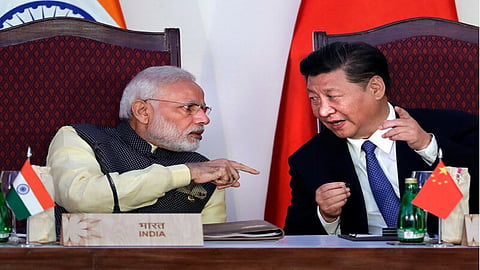
In August, Prime Minister Narendra Modi and President Xi Jinping met at Tianjin under the shadows of US President Donald Trump's tariff threats that set a clear direction for the relations between the two Asian giants.
Modi and Xi reaffirmed that the two countries were development partners and not rivals, and that their differences should not turn into disputes.
They emphasised the importance of “a stable relationship and cooperation” based on “mutual respect, mutual interest and mutual sensitivity” which is necessary for the growth and development of the two countries, as well as for a multipolar world and a multi-polar Asia.
As Trump doubled down on China and India with tariff hikes, Modi underlined that “India and China both pursue strategic autonomy and their relations should not be seen through a third country lens”.
Xi might visit India in 2026 to take part in the BRICS summit, which was expected to further speed up the pace of normalisation.
The normalisation process began with the resumption of Indian pilgrims' visit to Kailash and Mansarovar in Tibet.
It was followed by the ease of visa procedures by both countries and the resumption of flights connecting various cities after over five years.
But impediments remained. China's active military support to Pakistan during the Operation Sindoor in May was a sharp reminder of the negative impact of China-Pakistan close ties on Beijing's relations with New Delhi.
For its part, China, whose arms exports amount to over 81 per cent of Pakistan's military hardware, sought to downplay India's Deputy Chief of Army Staff Lt General Rahul R Singh's assertion that Beijing used the conflict as a “live lab”, but declined to directly answer his charge.
Gen Singh said China's strategy during Operation Sindoor was based on its ancient military strategy of "36 stratagems" and killing the adversary with a "borrowed knife" to buttress the point that Beijing extended all possible support to Pakistan to cause pain to India.
Also, the treatment meted out to Indian national Prema Thongdok from Arunachal Pradesh by the Chinese immigration officials at Shanghai airport while she was on transit to Japan evoked anger and dismay in India, especially at a time when the ties were on the mend.
Thongdok alleged that Chinese immigration detained her for 18 hours on November 21 during a transit halt after refusing to recognise her Indian passport, as her birthplace is Arunachal Pradesh.
New Delhi lodged a strong protest with China following the incident.New Delhi also said that it expects the Chinese authorities to provide assurance that Indian citizens transiting through Chinese airports will not be "selectively targeted and harassed".
China denied any ill-treatment while reiterating its claim on Arunachal Pradesh, which Delhi emphatically rejected, saying that the state remains an inalienable part of India.
The bilateral relations faced another major challenge when China blocked the export of key rare-earth metals to India, besides the US and the EU.
After several months of a squeeze on rare-earth metals over which China holds a monopoly, Beijing began clearing selective export licenses to the US following an agreement with Washington to lift curbs on semiconductor chips.
The Chinese curbs affected the manufacturing of Indian automobiles and other industries. Officials say China partially lifted curbs on India but not yet fully.
Notwithstanding the recurring bilateral tensions, India-China continues to engage in dialogue and exchanges to resolve the differences.
China is also actively pushing for the revival of the Russia, India and China (RIC) mechanism to jointly face unilateral policies being pursued by Trump to undermine globalisation.
The bilateral trade, which skewed heavily in favour of China over the years, showed signs of marginal course correction with India's exports registering an increase as Beijing showed an inclination to open up to Indian goods amid Trump's 50 per cent hike on Indian exports to the US.
Chinese Ambassador to India Xu Feihong in October said India's exports to China surged 22 per cent in the first half of FY 2025-26 vs last year.
Indian officials say the increase is very marginal and Beijing needs to open up more.In the first six months of this year, China's exports to India touched USD 70 billion, an increase of 18.5 per cent compared to the same period last year.
Significantly, Indian exports to China grew by 22 per cent in the first half of the Indian financial year to USD 8.41 billion year-on-year.The year-end data is awaited to know the bilateral trade trend.
Officials from both sides say that despite existing differences and obstacles, relations are maintaining a positive trajectory, considering the limitations imposed by their strategic rivalry.

