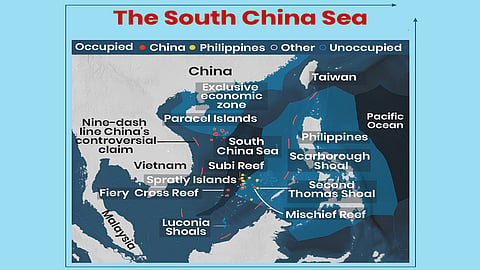

Manila | China and Southeast Asian leaders will commit to avoid actions that can escalate disputes in the South China Sea in annual talks in the Philippine capital on Monday, aiming to foster a conducive atmosphere for negotiations on a non-aggression pact in the contested waters.
The territorial conflicts are high on the agenda in the summit meeting between leaders of the Association of Southeast Asian Nations and China's premier, Li Qiang.
China, Taiwan and four ASEAN states - Brunei, Malaysia, the Philippines and Vietnam - have been involved in the decades-long territorial standoffs in the busy waterway, a key global trade route. Confrontations have particularly escalated in recent years between Chinese and Philippine coast guard and naval forces in disputed shoals.
Li expressed hope for the early conclusion of a "code of conduct," which can help foster peace and stability in the South China Sea, according to China's Xinhua news agency.
Philippine President Ferdinand Marcos Jr., who holds ASEAN's rotational chairmanship, praised the progress made so far in the negotiations this year for the regional agreement.
The sides did not immediately issue a joint statement with more details of the talks. But a draft of the statement seen by The Associated Press has the Chinese and ASEAN leaders pledging "to exercise self-restraint in the conduct of activities that would complicate or escalate disputes and affect peace and stability" in the disputed waters.
They will welcome the "positive momentum and significant progress" which have been achieved so far in the negotiations and "emphasise the need to maintain and promote an environment conducive to the negotiations," according to the statement.
There had been an agreement to conclude the negotiations this year after more than 21 years of talks and consultations. Philippine Foreign Secretary Theresa Lazaro said on Sunday that both sides have agreed on about 80 per cent of the total number of paragraphs, but three contentious issues remain unresolved and negotiations will continue next year when Singapore takes over ASEAN's leadership.
The last major sticking points are the geographic scope to be covered by the agreement, the definition of sensitive terms and whether the accord should be legally binding or not, according to Southeast Asian diplomats.
The South China Sea conflicts are a flashpoint in Asia which many fear could draw in the United States if a major conflict erupts. The US lays no claims in the waters but has warned that it's obligated to defend the Philippines, a longtime treaty ally in Asia, if Filipino forces come under an armed attack.
