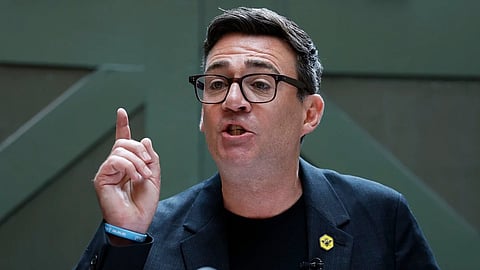

London | Andy Burnham looks set for a so-called coronation as the next British Prime Minister as the process to elect a new Labour Party leader formally opened on Thursday.
The former Mayor of Greater Manchester and new member of Parliament for Makerfield remains the sole candidate in the race to succeed Keir Starmer, who announced his resignation last month and set the clock ticking for a new leader.
Under the timetable set by Labour’s National Executive Committee (NEC), candidates have until July 15 to gather the backing of a minimum of 81 Members of Parliament to throw their hat in the ring - a process seen as a formality with Burnham as the sole contender. As a result, he is likely to be in place as the new Labour Party leader and Prime Minister by July 20.
“As prime minister, my priority will be protecting the UK by boosting defence spending, reviving local industry and strengthening our alliances,” said Burnham, setting out a vision statement as the future leader in an article published in ‘The Times’.
“I see our strength at home and our strength in the world as indivisible. Through No. 10 North, and the devolution of power to all parts of the UK, we will take a new approach to regenerating and re-industrialising the country, and thereby strengthening its resilience.
“That same approach will consider foreign policy, economic policy, security, social cohesion and British values as inextricably linked elements of the same strategic question," he stated.
The 56-year-old Labour MP has previously set out his plans for “No. 10 North” as symbolic of his efforts to devolve power to the regions of England beyond the centralised control at No. 10 Downing Street in London.
“Doing politics differently means levelling with the public, engaging them in decisions and ensuring more social value in return for increased government spending," he said.
Under NEC rules, July 13 is earmarked for candidates to take part in a parliamentary hustings where they answer questions from fellow Labour MPs.
If Burnham secures 323 nominations, it would be mathematically impossible for a rival to hit the 81-MP threshold needed to challenge him.
As it is looking increasingly likely, Burnham being the only candidate in the race would hold a solo hustings to field questions from his party colleagues.
The shape of his top team and Cabinet is unlikely to become clear before the formal process closes. While Burnham could be elected the new Labour leader unopposed by July 17, he would not become Prime Minister until days later because Starmer would need to formally tender his resignation to King Charles III at Buckingham Palace.
The monarch would then invite Burnham to form a new government and July 20 would then mark his first official working day as PM.
However, if another candidate does emerge within the timetable, the Labour leadership election will be conducted over Parliament's summer recess from July 16 onwards. In such a scenario, Starmer would remain caretaker PM until the new Parliament session opens on September 1.
However, as things stand, Burnham is looking set to become the seventh British prime minister in 10 years, and yet another leader to take charge at 10 Downing Street mid-term following a general election.
Burnham has indicated his commitment to the manifesto that won the Starmer-led Labour Party a landslide in July 2024, with the next general election expected in 2029.

