
New Delhi | From next month, Delhiites buying electric cars priced up to Rs 30 lakh will not have to pay road tax or registration fees, as the Delhi government on Monday approved a new EV policy aimed at reducing vehicular pollution and accelerating the transition to cleaner transport in the national capital.
The Electric Vehicle Policy proposes that 30 per cent of all school buses in Delhi be converted to electric by the end of March 2030. It seeks to transform Delhi into a pollution-free capital through zero-emission transport and will remain in force till March 31, 2030.
Around 30,000 EV charging points will be set up across the city to expand charging infrastructure, and the government is committing over Rs 7,000 crore over the next four years to drive this transition.
However, there is no incentive for hybrid vehicles. A dedicated online portal will be developed to enable applicants to apply for EV-related incentives under the policy.
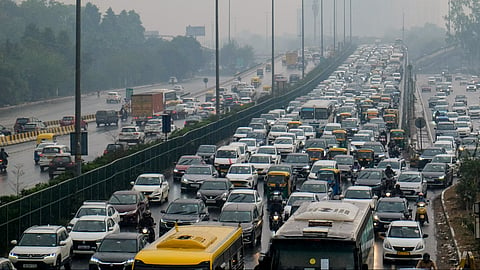
Transport and vehicular emissions remain the single largest contributor to Delhi's local PM 2.5 burden, accounting for nearly half of the pollution load.
During last year's peak winter pollution period, vehicles contributed about 46 per cent to 53 per cent of the city's local PM2.5 levels, according to a report by the Centre for Science and Environment released on December 31 last year.
Under the policy, a 100 per cent waiver of road tax and registration fees will be provided for all pure electric four-wheelers with an ex-showroom price of up to Rs 30 lakh.
Addressing a press conference, Chief Minister Rekha Gupta said benefits worth around Rs 15,000 crore, including government investment, tax exemptions and EV infrastructure development, will be provided under the policy over the next four years to promote electric mobility and reduce vehicular pollution in the national capital.
The policy, approved by the Delhi Cabinet, will come into effect from July 1 after the approval of the Lieutenant Governor, Gupta said, describing it as a major step towards making Delhi a pollution-free city by March 31, 2030.
It lays special emphasis on the transport sector and provides a roadmap for the phased transition from conventional fuel-powered vehicles to electric vehicles.
To encourage the adoption of electric vehicles, the government has announced purchase incentives for buyers.
Under the policy, people buying electric two-wheelers will get a subsidy of Rs 30,000 in the first year, Rs 20,000 in the second year and Rs 10,000 in the third year.
Similarly, buyers of electric three-wheelers, including e-autos, will be eligible for incentives of Rs 50,000, Rs 40,000 and Rs 30,000 in the first, second and third years, respectively.
Buyers of N1 category electric trucks will receive a purchase incentive of up to Rs 1 lakh, according to an official.
As part of the policy, only electric autorickshaws will be registered in Delhi from January 1, 2027, while registration of new petrol and CNG two-wheelers will be phased out, with only electric two-wheelers to be registered from April 1, 2028.
The policy also provides a scrapping incentive of Rs 1 lakh for owners of BS-IV or older four-wheelers who scrap their vehicles and switch to electric vehicles.
She said the policy also envisages expansion of charging infrastructure, vehicle scrapping facilities and other measures to accelerate the transition to electric mobility across the city.
Sunil Dahiya, founder and lead analyst at EnviroCatalyst, had earlier said the Delhi EV Policy 2026-2030 anchors the right to clean air directly to the constitutional right to life.
"By addressing vehicular emissions, a primary pollution source, the government is finally ensuring the transport sector takes ownership of its responsibility to provide a livable environment," Dahiya had told PTI.
Total vehicle registrations in Delhi rose by 17.9 per cent to 8.50 lakh units in FY 2025-26, up from about 7.21 lakh units in 2024-25. Between the financial years 2019-20 and 2025-26, more than 4.07 lakh EVs were registered in the city.
An analysis of data from the Vahan dashboard of the Ministry of Road Transport and Highways by EnviroCatalysts, an independent research body, showed that EV registrations increased from 83,512 in 2024 25 to 1.07 lakh in 2025 26. Hybrid electric vehicle registrations also rose during the same period from 6,796 to 8,476.
New Delhi | The new EV policy, approved by the Delhi government on Monday, focuses on charging infrastructure expansion and aims to set up 30,000 charging points over the next four years.
The policy, approved by the state Cabinet headed by Chief Minister Rekha Gupta, is likely to be implemented from July 1 this year for four years till March 31, 2030.
The chief minister said that a robust charging network would be the foundation of the policy's success.
"Accordingly, more than 30,000 EV charging points will be installed across Delhi during the policy period. The required land has already been identified, and charging infrastructure will be developed across the city on a large scale in the coming months," she said in a statement.
Transport Minister Pankaj Singh stated that charging infrastructure is crucial for achieving faster adoption of electric vehicles in the city, and as such, the policy envisages installation of more than 30,000 EV charging points across Delhi.
"It also lays down a phased roadmap for electrification of commercial transport, passenger vehicles, goods carriers and school bus fleets," Singh added.
The issue of expanding charging infrastructure was discussed in detail in a recent meeting chaired by Delhi Chief Secretary, in which a target of setting up 32,000 by 2030 was finalised, officials said.
The officers reviewed preparedness for charging infrastructure expansion, including at the Delhi Transport Corporation (DTC) depots, for the upcoming induction of e-buses under the National Electric Bus Program (NEBP) and PM E-Drive scheme, in the meeting.
The transport department is the overall coordinator, and Delhi Transco Limited (DTL) is the nodal agency to closely monitor and ensure compliance regarding the setting up of EV charging infrastructure.
The power department earlier recommended the incorporation of specific targets in the Delhi EV Policy 2026 for charging infrastructure. The Transport department had recommended setting up 32,000 charging points by 2030, as was communicated by it to the Commission for Air Quality Management (CAQM) and the Supreme Court.
Officials said Delhi witnessed "record" expansion of charging infra in the last one year, with the total number of charging points rising to over 10,000, of which more than 3,000 were added in the past few months.
The three major power discoms in the city-BRPL, BYPL and TPDDL-have led the initiative.
In 2025-26, BRPL and BYPL installed over 1,600 EV charging points and battery swapping stations across 1,241 locations-the highest ever in a single year, discom officials said.
Tata Power Delhi Distribution Limited (TPDDL) energised 3,783 EV connections, out of which 1,641 EV connections got charged in 2025-26.

