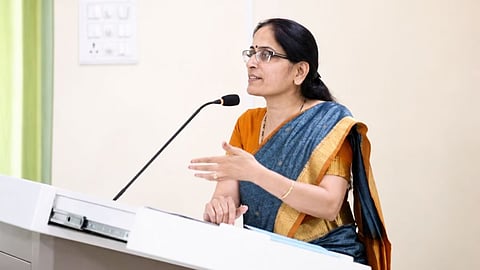

New Delhi | Senior advocate Venkita Subramani Mohana, who was appointed a judge in the Supreme Court on Monday, has become only the second woman in the country to be directly elevated to the apex court from the Bar after Justice Indu Malhotra in 2018.
Mohana will be one of the two serving women judges in the Supreme Court alongside Justice B V Nagarathna, who has been a judge in the top court since August 31, 2021.
Justice Nagarathna will also become the Chief Justice of India for more than a month in 2027.
Mohana, 59, graduated from the Coimbatore Law College in 1988 and has been practising since then. The Supreme Court designated her as a senior advocate in 2015.
She has appeared in several high-profile cases, including matters related to permanent commission for women officers in the armed forces, senior citizens' property rights, and the Karnataka hijab ban case.
Mohana will be the 12th woman judge in the history of the Supreme Court, and the second to be elevated directly from the Bar. She will retire in June 2031.
Justice M Fathima Beevi was the first woman appointed to the Supreme Court in 1989. She was elevated after serving as a high court judge.
At one point, when Justice Indu Malhotra was a judge, the Supreme Court had three women judges, with Justice R Banumathi and Justice Indira Banerjee being the other two.
Malhotra was sworn in as a top court judge directly from the Bar on April 27, 2018. She retired in March 2021.
There are presently two other judges in the top court who have been elevated directly from the Bar – Justices P S Narasimha and K V Viswanathan.
Mohana's appointment is significant from a gender-representation perspective.

Once the five new judges appointed to the top court on Monday take oath and assume charge, the Supreme Court will formally have 37 judges.
Alongside Mohana, Justice Shree Chandrashekhar, Chief Justice of the Bombay High Court; Justice Sheel Nagu, Chief Justice of the Punjab and Haryana High Court; Justice Sanjeev Sachdeva, Chief Justice of the Madhya Pradesh High Court; and Justice Arun Palli, Chief Justice of the Jammu and Kashmir and Ladakh High Court, were elevated as top court judges on Monday.
Last month, the government promulgated an ordinance amending a law to increase the sanctioned strength of the apex court from 34 to 38, including the Chief Justice of India.
While there were already two vacancies, after the sanctioned strength was increased, a total of six posts became vacant in the apex court.
With the five appointments made on Monday, the Supreme Court now has one vacancy.
On May 27, the Supreme Court Collegium had recommended the five names.
