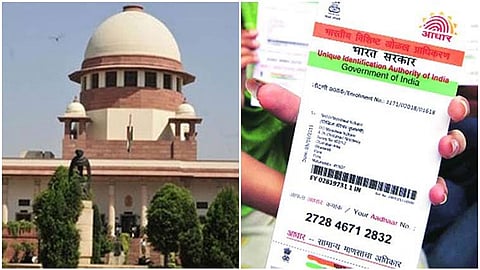

New Delhi | The Supreme Court on Monday said the issuance of new Aadhaar cards only to citizens up to the age of six years require legislative intervention and appropriate amendments in the existing legal framework.
A bench of Chief Justice Surya Kant and Justice Joymalya Bagchi was hearing a public interest litigation (PIL) seeking direction to the Unique Identification Authority of India (UIDAI) to issue new Aadhaar cards only to citizens up to the age of six years.
The bench said the appropriate recourse for the petitioner would be to bring all these issues to the notice of the State and other stakeholders to enable them to take cognisance of them.
It disposed of the petition with a direction that it be treated as a representation on behalf of the petitioner.
The plea filed by lawyer Ashwini Upadhyay had also sought a direction to frame stringent guidelines for issuance of Aadhaar to adolescents and adults to stop infiltrators from masquerading as Indian citizens.
It had sought a direction to the authorities to install display boards at common service centres stating that the 12-digit unique identification number was only a "proof of identity" and not a proof of citizenship, address or date of birth.
"As may be seen from the nature of reliefs, most of these require legislative intervention and appropriate amendments in the existing legal framework," the bench said.
Upadhyay told the bench that the UIDAI has issued 144 crore Aadhaar and almost 99 per cent Indians have been enrolled.
"Point out these issues to the Parliament and the government. They will take care of them," the bench observed.
The petitioner said it was not an adversarial litigation and the plea was for preventing infiltrators from getting Aadhaar.
He referred to the issue of fake documents and said anyone with a rent agreement can get an Aadhaar.
"You raise your grievances to the Union government. They will take appropriate steps," the bench said.
The bench, without expressing any opinion on the merits, disposed of the petition with a direction that it be treated as a representation on behalf of the petitioner.
Besides all the states and Union Territories, the plea had made the UIDAI -- which is the authority that issues Aadhaar -- and the Union ministries of home, law and justice, and electronics and information technology as parties.
The plea, filed through advocate Ashwani Dubey, said Aadhaar, originally intended as a proof of identity, has increasingly become a "foundational document" enabling individuals to obtain other identification documents, such as ration cards, domicile certificates and voter identity cards.
"The UIDAI has issued 144 crore Aadhaar and 99 per cent Indians have been enrolled. Therefore, the petitioner is filing this writ petition as a PIL under Article 32, seeking a direction to UIDAI to issue new Aadhaar to children only and frame new stringent guidelines for adolescents and adults, so as to stop infiltrators from getting it and masquerading as Indian citizens," the plea said.
It said the need to file the plea arose when the petitioner came to know the manner in which infiltrators are able to procure Aadhaar through a verification process that is weak and can be easily manipulated.
"Foreigners apply for Aadhaar under the 'foreign' category. But infiltrators apply for Aadhaar under the 'Indian citizen' category and get it easily made. Thereafter, they obtain a ration card, birth and domicile certificate, driving licence, et cetera, essentially becoming indistinguishable from Indian citizens...," it said.
Besides seeking other directions, the plea raised legal questions, including whether the Aadhaar Act 2016 has become "temporally unreasonable" for failing to keep up with the legislative intent of distinguishing foreigners from Indian citizens.
It said the alleged misuse of Aadhaar undermines targeted welfare delivery and leads to diversion of public resources.

