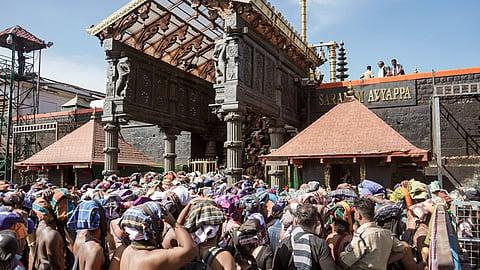

New Delhi | The Supreme Court on Thursday said the power of judicial review is a constitutional duty and it can't give up its responsibility in matters of social reform and welfare.
The observation of a nine-judge constitution bench headed by Chief Justice Surya Kant came while hearing petitions related to discrimination against women at religious places, including the Sabarimala temple in Kerala, and on the ambit of religious freedom practised by multiple faiths, including Dawoodi Bohras.
Justices B V Nagarathna, M M Sundresh, Ahsanuddin Amanullah, Aravind Kumar, Augustine George Masih, Prasanna B Varale, R Mahadevan and Joymalya Bagchi are also part of the nine-judge bench.
Senior advocate K Parmeshwar, who is amicus curiae in the matter, submitted that the primary responsibility for social welfare and reform lies with the Legislature, which is a constitutional mandate, but that does not mean the court is not empowered in certain circumstances.
Parmeshwar argued that the judicial role is not that of an overzealous reformer or a passive onlooker.
Agreeing with his submission, the CJI said, "You are absolutely right that constitutional court can't give up its responsibility, that we can't surrender that. It's not a question of power. It's a constitutional duty of a constitutional court."
Parameshwar contended that the validity of religious rights should not be judged based on factors such as rationality.
"There is a huge difference between faith and rationality. The moment you bring in rationality, Articles 25 and 26 goes out of the Constitution, with all due respect," he said adding that the courts can interfere with religious practices if such intervention is necessary to preserve the liberty or integrity of people.
The amicus requested the apex court to give a broad meaning to the term religious denomination saying, "we have inherited an Irish term, it is up to your Lordship to Indianise it."
As the hearing commenced, senior advocate Mukul Rohatgi, appearing for one of the interveners, submitted that the 1986 writ petition challenging the Syedna judgment has effectively abated due to the demise of the original petitioners and the lack of a registered body to prosecute it.
Rohatgi told the court that that there has been no instance of excommunication in 75 years and dismissed the idea of an arbitrary authority.
The top court reserved the verdict after hearing the parties for 16 days in the matter and asked them to file comprehensive written submissions by May 29.
In September 2018, a five-judge constitution bench, by a 4:1 majority verdict, had lifted the ban that prevented women between the age of 10 and 50 from entering the Ayyappa shrine at Sabarimala and held that the centuries-old Hindu religious practice was illegal and unconstitutional.
Later, on November 14, 2019, another five-judge bench headed by the then CJI Ranjan Gogoi, by a majority of 3:2, referred the issue of discrimination against women at various places of worship to a larger bench.
The bench had then framed broad issues on freedom across religions, saying they cannot be decided without any facts of the particular case.
Besides the Sabarimala case, the verdict also referred to the larger bench the issues of Muslim women's entry into mosques and dargahs, and the entry of Parsi women, married to non-Parsi men, to the holy fire place of an Agiary.
On May 11, 2020, another bench held that its five-judge bench had the power to refer the questions of law to a larger bench for adjudication while exercising its limited power under review jurisdiction in the Sabarimala temple entry case.
Earlier, the top court read out seven questions it had framed on the scope of religious freedom.
Asserting that it was open to addition and deletion of issues framed, the bench had said it would consider "what is the scope and ambit of right to freedom of religion under Article 25 of the Constitution of India?"
About the second issue, it said, "What is the inter-play between the rights of persons under Article 25 of the Constitution of India and rights of religious denomination under Article 26?"
The third question is whether the rights of a religious denomination under Article 26 are subject to other fundamental rights apart from public order, morality and health.
"What is the scope and extent of the word 'morality' under Articles 25 and 26 of the Constitution, and whether it is meant to include Constitutional morality," read the fourth question.
The bench had said it would also examine the "scope and extent of judicial review," concerning a religious practice as referred under Article 25.
"What is the meaning of the expression "sections of Hindus" occurring in Article 25 (2) (b) of the Constitution of India," read the sixth issue.
The top court had said it would examine, as the seventh question, whether a person not belonging to a religious denomination or religious group can question a practice of that "religious denomination or religious group" by filing a public interest litigation.
It had said the larger bench would have to evolve a judicial policy to do "substantial and complete justice" in matters of freedom of religion, such as restrictions on the entry of Muslim and Parsi women into their places of worship.

