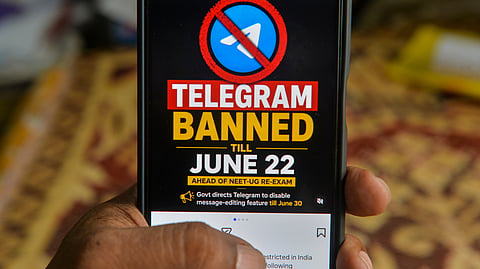

New Delhi | The Delhi High Court on Thursday questioned the Centre’s decision to temporarily restrict access to Telegram ahead of the June 21 NEET-UG 2026 re-examination, saying how the rights of 150 million users of the messaging app can be curtailed just because a few of them are taking up the test.
The observations were made by a vacation bench of Justice Tejas Karia before reserving the verdict on the plea of Telegram against the temporary ban on the ground that the app may be misused ahead of the NEET-UG retest.
On May 12, the National Testing Agency (NTA) had cancelled the National Eligibility-cum-Entrance Test (Undergraduate), or NEET-UG, held on May 3 for medical admissions amid allegations of paper leak. The matter is currently under investigation by the CBI.
In a bid to ensure smooth conduct of the controversy-ridden exam, the government imposed the temporary ban on the messaging app till June 22.
On Thursday, the Centre vehemently argued before the high court that Telegram has all the potential of getting misused by miscreants.
Justice Karia reserved the verdict after hearing extensive arguments from senior advocate Dhruv Mehta, appearing for the app, and Attorney General R Venkataramani and Solicitor General Tushar Mehta who represented the Centre.
The solicitor general referred to the technical aspects of the messaging app and said that a single Telegram account can create up to 40 bots.
“I will just give an example. In Telegram, one account user can create 40 bots. While in case of WhatsApp, it's one bot per user. They have multiplicity encouraging architecture and then the bots can further multiply,” he said.
"Bots are machines; they can further multiply. As per the report, Telegram can offer bot infrastructure which can disseminate information in bulk. This feature is unique as it permits creation of sophisticated networks with minimal human oversight," the law officer said.
Justifying the decision, he said the government does not have this problem with other intermediaries.
"This platform operates through the cloud. Even if they block it and someone does mischief, law enforcement agencies cannot reach the actual user," he said.
Mehta also mentioned that the report indicated that Telegram is frequently used for terrorist activities and that law enforcement agencies face challenges due to this architectural design in various jurisdictions.
“The scale at which it can multiply is only available on Telegram. Also, suppose if they remove one bot, other bots can be created under different names and identifiers and therefore, measures against bots only have a temporary relief.
"We do not have this problem with other intermediaries like Facebook or WhatsApp. This platform operates through the cloud, even if we block something and someone does mischief, the law enforcement agency can't reach the person,” he said.
“How can we stop the rights of 150 million people just because one set of citizens are appearing in examinations,” the bench asked.
The law officer said there are a large number of groups and channels operating on this platform and such kinds of facilities are unheard of on other platforms.
“The question is can you block somebody else's rights to protect someone else's rights. The law has been laid down in the Anuradha Bhasin case (judgement),” the bench asked.
The law officer said that the apex court judgement in the Anuradha Bhasin case does not prohibit blocking.
While reserving the verdict, the judge asked the counsel for both parties to file their written submissions, if any, by 7 pm during the day.
When the law officer spoke about the paper leak and the app’s probable role in it, Justice Karia further said, “We are all alive to the situation (of paper leak). There are so many students who were affected. But the aspect on the curb...can you ban the whole app? Let us focus on that. There is a power. That power can be exercised. To what extent can it be exercised?”
“The question here is, can you block someone else’s right to protect somebody else,” the bench asked.
The bench also asked if once the paper is leaked, and becomes viral, how can you deal with it on a real-time basis and once a complaint is received, and by the time action is taken, damage is done.
“What real-time surveillance is there on your platform,” the bench asked.
The potential harm was huge and the app had been restricted under the powers to pass such a direction, and so the court could not interfere at the present stage, the solicitor general said.
“The goal is that the exam be conducted on June 21. And the goal is legitimate. I have shown that we have employed less restrictive measures,” the law officer said.
The attorney general said that the restrictive order “is complete and applies its mind".
He said that the app was someone who could not discharge its duty, and so it could not seek proportionality. “This platform, because of its unique architecture, I would say, is a Frankenstein.”
On Wednesday, the high court asked the Centre to file its reply on Telegram's plea.
The Ministry of Electronics and Information Technology (MeitY), acting on recommendations of the NTA, issued a direction under Section 69A of the Information Technology Act, 2000, restricting access to the Telegram platform in India till June 22, covering the day of the NEET (UG) 2026 re-examination and its immediate aftermath.
New Delhi | The Centre on Thursday informed the Delhi High Court that the Telegram messaging app was being exploited for illegal activities ranging from cybercrime and financial frauds to terrorism and circulation of leaked examination papers.
This was stated in an affidavit filed by scientist Mayank working with the Ministry of Electronics and Information Technology seeking dismissal of the plea by Telegram against the Centre’s action to temporarily restrict access to the app ahead of June 21 NEET-UG re-examination.
Citing a report of the Indian Cyber Crime Coordination Centre (I4C), the affidavit said that the app had become a preferred platform for cybercriminals, who use fake accounts, concealed identities, channels and groups to carry out unlawful activities, including financial frauds, malware distribution, data breaches and circulation of leaked papers.
“Telegram is being exploited for illegal activities including drug trafficking, cybercrime, extremism, terrorism, child exploitation, and cyber scams and frauds, primarily due to privacy features,” the affidavit said.
A vacation bench of Justice Tejas Karia was hearing the Telegram app's plea against the decision to restrict its access prior to the NEET-UG retest.
On May 12, the National Testing Agency (NTA) had cancelled the National Eligibility-cum-Entrance Test (Undergraduate), or NEET-UG, held on May 3 for medical admissions amid allegations of paper leak. The matter is currently under investigation by the CBI.
“Telegram has become the new dark web, linking threat actors. Criminals have rapidly adopted Telegram to post links on channels that connect to dark web forums through deep web links, making it hard for authorities to track and attribute criminals,” the affidavit said.
The government also informed the court that the fraud complaints linked to the app on the National Cyber Crime Reporting Portal rose sharply in recent years, with over 2.75 lakh complaints involving alleged fraud of Rs 3,086 crore reported in 2025 alone.
“Telegram channels with unlimited number of subscribers are designed to broadcast messages to large audiences. The subscribers’ identities are hidden from each other and channel's creator or selected admins can post messages, while subscribers can only view the content,” the Centre said.
The government also referred to regulatory and enforcement actions taken against Telegram in several countries, including China, Iran, France, Russia, Germany and Brazil, over issues such as non-compliance with local laws, content moderation failures and law-enforcement concerns.
However, the Centre said blocking the entire platform would be disproportionate and contrary to the statutory framework under the Information Technology Act and the IT Rules, 2021, which envisage targeted action against specific unlawful content.
It informed the court that Telegram had been complying with notices issued through the Sahyog portal and had removed or disabled access to all 404 URLs flagged by authorities, including channels linked to alleged NEET paper leaks and examination-related fraud.
The high court has reserved its verdict on the plea after hearing arguments from senior advocate Dhruv Mehta, appearing for Telegram, and Attorney General R Venkataramani and Solicitor, Jun 18 (PTI) General Tushar Mehta who represented the Centre.
The court asked both the parties to submit written submissions by 7 pm.

