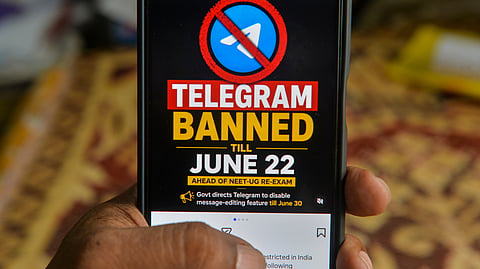


New Delhi | The Delhi High Court on Friday upheld the Centre's move to temporarily restrict access to the Telegram messaging app ahead of the June 21 NEET-UG re-exam, holding the order was "not disproportionate".
Orally pronouncing the substantive portions of the verdict, a vacation bench of Tejas Karia said, "After considering all the arguments, we find that given the emergency nature, the reasons supplied are sufficient and the government has followed the procedure in Section 69A." Section 69A of the Indian Information Technology (IT) Act, 2000, empowers the Centre to block public access to any online information, websites, or applications to protect national security, public order, and sovereignty.
The judge said Telegram's plea claiming non-supply of reasons cannot be held to be true.
He said the Centre's orders are "well-founded and supported by reasons," and that the orders do not suffer from non-application of mind.
"Respondent 1 (Centre) was empowered under Section 69A to direct the blocking of access to Telegram. The test of proportionality is satisfied. The government's measures are the least restrictive. It cannot be held that the order is disproportionate," Justice Karia said.
Telegram had moved the court, citing discriminatory treatment and a breach of Article 14 for being singled out among social media intermediaries. It also claimed to have taken down more than 900 links related to unlawful NEET content and deployed artificial intelligence, machine learning tools and manual moderation to identify violations.
It claimed to have held multiple meetings with government agencies from May onwards and submitted detailed responses outlining both proactive and reactive moderation measures.
After receiving specific URLs from authorities on June 9, it removed the flagged content within an hour, Telegram claimed.
During the arguments on Thursday, the court had posed a question to the Solicitor General about the correctness of curtailing the rights of over 150 million Telegram users because a set of students were going to appear in the re-exam.
"How can we stop the rights of other users just because one set of citizens is appearing in the exam?" the court had said.
On May 12, the National Testing Agency (NTA) had cancelled the National Eligibility-cum-Entrance Test (Undergraduate), or NEET-UG, held on May 3 for medical admissions amid allegations of paper leak.
The matter is currently under investigation by the CBI and a re-test is scheduled on June 21.
The Ministry of Electronics and Information Technology (MeitY), acting on recommendations of the NTA, issued a direction on June 16 under Section 69A of the Information Technology Act, 2000, restricting access to the Telegram platform in India till June 22, covering the day of the NEET (UG) 2026 re-examination and its immediate aftermath.
A separate direction requires Telegram to disable in India the message-editing feature for already-posted messages till June 30, 2026, addressing the specific structural feature through which the platform has been used to fabricate after-the-event "paper leak" evidence in respect of national examinations. P
