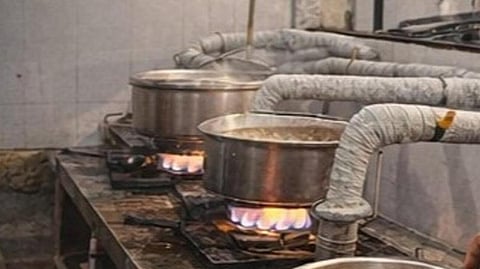

Mumbai | The Indian Institute of Technology (IIT) Bombay has been using a patented biomass gasification technology to convert dry leaf waste into cooking fuel, a significant innovation considering the concerns over LPG supply pushing people into panic buying mode at present.
The city-based premier institute has been using this technology since the last decade, reducing LPG usage on campus by 30 to 40 per cent, it said on its social media handle.
In 2014, Prof Sanjay Mahajani from the Department of Chemical Engineering at IIT Bombay proposed biomass gasification to convert campus waste into cooking fuel.
The early trials proved challenging as Indian biomass formed clinkers clogging and damaging conventional systems and creating 30 minutes or more of smoke.
However, the team persisted and by 2016, a patented gasifier achieved a 100-fold reduction in clinker formation.
The biomass gasification process involves collection, shredding and processing of dry leaves into pellets. These pellets are then heated in a low-oxygen chamber, where they undergo pyrolysis and gasification, releasing a fuel-rich gas mixture.
This gas burns cleanly, generating a steady flame suitable for cooking.
Prof Sandeep Kumar from the Department of Energy Science and Engineering joined the experiment in 2017 to design a breakthrough burner and secure a patent for the technology.
At present, the IIT Bombay staff canteen runs on 30 to 40 per cent less LPG, achieving 60 per cent thermal efficiency with emissions under 20 ppm (parts per million).
Licensed to Infixen Energy, this technology developed by IIT Bombay is moving to large hostels which could save Rs 50 lakh annually, replace 90 tonnes of LPG, and reduce 300 tonnes of carbon dioxide.

