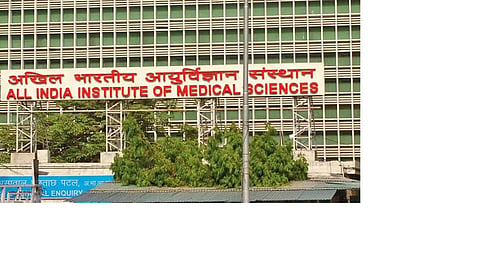

New Delhi | The country's premier institute, AIIMS-Delhi, has performed its second dual kidney transplant using organs from a marginal donor, a 70-year-old woman who was declared brain dead, for a single recipient, doctors said.
The surgery underscores efforts to expand the deceased-donor pool and provide kidney transplantation to more patients with end-stage kidney disease.
The successful transplant was performed on July 28 by the Department of Surgical Disciplines in collaboration with the departments of Nephrology, Anaesthesia, Transplant Immunology and the Organ Retrieval Banking Organisation (ORBO), AIIMS, Delhi.
The donor, a septuagenarian woman from Command Hospital, Chandimandir, Chandigarh, was considered a marginal donor due to her advanced age. Kidneys from marginal donors, also called expanded criteria donors, come from individuals with higher medical risks or those who are over 60 years of age.
"In view of the advanced age and marginal donor characteristics, both kidneys were utilised for transplantation in a single recipient as a carefully planned strategy to maximise the use of available donor organs," Dr Asuri Krishna, professor in the department of Surgery at AIIMS-Delhi, said.
The kidneys were transported from Chandigarh to Delhi by an Army helicopter, enabling their rapid transfer.
Despite a cold ischaemia time of around 12 hours, both kidneys started functioning immediately after transplantation, Dr Krishna said.
The recipient, a 56-year-old woman, underwent implantation of both kidneys on the right side.
She had an uneventful recovery and was discharged after 10 days with normal kidney function, according to the doctors.
The organ retrieval and transplantation were facilitated by coordinated efforts involving the Army Research and Referral Hospital, Delhi, and various teams at AIIMS.
AIIMS Director Dr Nikhil Tandon provided support and guidance for the procedure, while Balram, transplant coordinator at ORBO, played a key role in coordinating the logistics, communication, organ retrieval and transportation, Dr Krishna said.
The transplant surgery was led by Dr Krishna, along with Dr Sushant, Dr Aditya Baksi, Dr Brijesh Kumar Singh and Dr Mohit Sangade of the Department of Surgical Disciplines.
The nephrology team was involved in recipient assessment, perioperative management and post-transplant care.
Dual kidney transplantation from carefully selected marginal donors is a strategy to increase utilisation of deceased-donor organs. In selected cases, both kidneys from a donor may be transplanted into a single recipient to provide adequate renal function and utilise organs that might otherwise be declined because of donor age or other marginal characteristics, Dr Krishna said.
The latest procedure was AIIMS -Delhi's second such dual kidney transplant from a marginal donor and underscores efforts to expand the deceased-donor pool and provide kidney transplantation to more patients with end-stage kidney disease, he said.
"The immediate functioning of both kidneys despite around 12 hours of cold ischaemia and the recipient's discharge with normal kidney function after 10 days marked an encouraging early outcome," he said.
Cold ischemia is the preservation phase of a donor organ to slow metabolism before transplantation.

