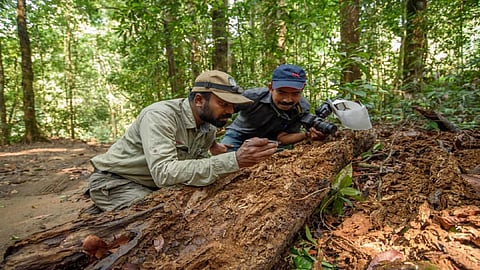


# Ajayan | The medical doctor groom-to-be goes out with his parents and relatives to buy clothes for his wedding. That is when a flutter near a textile shop catches the eye of Dr Kalesh Sadasivan. It was the butterfly Western Striped Albatross. While his parents busied themselves with fabrics and finery collection, Dr Kalesh was quietly preoccupied collecting the larvae of that winged miracle.
A birdwatcher, a butterfly enthusiast who has documented over a hundred species, a keen identifier of spiders and cicadas, and now this silent pilgrim has his lens turned towards the republic of ants. This is Dr Kalesh, whose profession bears no relation to these pursuits. He shapes flesh and restores form as the Head of Plastic and Reconstructive Surgery at Thrissur Government Medical College. But by instinct, he still belongs to the wild.
Asked how a demanding medical career coexists with a seemingly distant passion, he answers with quiet clarity, one evident in the very-recently published Entomon, the quarterly journal of the Association for Advancement of Entomology, where he led a research team that compiled a checklist of 328 species of butterflies in Kerala drawn from forests, wetlands, and highlands.
He traces this clarity to his childhood in Mannar, on the Alappuzha border, where his grandparents farmed vast lands. “Fields, cattle, birds, rivers, fishing - these shaped my sense of nature,” he recalls. “Even after I was moved, at the age of five, to the heart of Thiruvananthapuram, that foundation stayed with me. It still works within me, even while I remain a medicinal practioner now.”
During a vacation after Grade VII, his bureaucrat father placed a few books in his hands - antidotes to boredom and quiet seeds of a reading habit. One of them, Sixty Indian Birds by Dharmakumarsinghji, proved decisive. Until then, he had never known that birds bore common names like magpie or roller. Suddenly, the world around him became legible. Spotting and identifying birds came easily, guided by the pages he had read. A classmate and close friend Satya soon joined him as a willing accomplice, and by the time his school life ended, the two had grown into committed birdwatchers.
Yet, after a point, the thrill dulled; the challenge he sought was missing. That was when he chanced upon Common Butterflies of India by Isaac Kehimkar, Thomas Gay, and JC Punetha at an exhibition. “Birdwatching demands travel,” he says, “but butterflies are everywhere.” And so, he and his friend moved from birds to butterflies. Their efforts led them to the Butterflies of India by Wynter-Blyth. True to form, he began at the end—studying the chapter on the difficult skippers, the small, moth-like butterflies with a darting flight. Though one had joined medical college and the other engineering in 2001, mornings were reserved for butterfly trails. The two would gather and on their bike make it to Akkulam or Ponmudi. By evening, just before classes ended, they would slip back to campus, returning home as though they had spent the day entirely in lecture halls.
Here too, challenge beckoned, and was answered with imagination. Cameras were beyond reach, so art stepped in. Equally gifted with pen, pencil and brush, the two sketched larvae and traced their slow alchemy into bursts of colour. More than seventy species of skippers were identified and carefully chronicled in a book. Their journeys reached beyond wings alone: they mapped nectar plants as well, like the sprawling Jamaican Blue Spike at Akkulam Boat Club, which attracted butterflies in multitudes.
A small stroke of fortune followed when Satya, Dr Kalesh’s friend, received a film-roll camera from his grandfather. Life became a little easier, though decidedly more expensive, as every stage from egg to butterfly could now be captured. “We weren’t merely recording butterflies,” recalls a jubilant Dr Kalesh. “We began with the larvae, traced their life cycles, learned their peculiarities, and because nectar drew them in, came to know the plants as well. It was a complete, enriching journey - plants, eggs and larvae and finally the butterfly in full bloom.”
After college, the two friends spent a brief while with an NGO, only to realise it offered little room to grow. The pull of academia grew stronger. Then life took an unexpected, gentler turn. On the cusp of his final year, Dr Kalesh proposed to a classmate; and she wholeheartedly said yes. They married while still house surgeons in 2006, and together resolved to pursue post-graduation, settling down to prepare for the entrance examinations - life, love and ambition neatly converging.
Their terrace became a classroom as preparations for the PG entrance began. While his wife read, he listened; but under the open, star-strewn sky his mind often strayed. One such night, his gaze caught a butterfly on a coconut palm, unfamiliar and arresting. Camera in hand, by then a hard-won possession, he captured it just as it prepared to lay an egg, and carefully collected the larvae for rearing.
Photographs were shared, emails flew to experts abroad, and the mystery was finally named: the Plain Palm Dart, a skipper. Further study confirmed what his instincts had sensed. The butterfly’s entire life unfolded on the coconut palm - eggs laid on its leaves, nectar drawn from its flowers. With no reason to descend, it remained largely unseen, living its quiet, elevated life above the human gaze.
Amid all this, he cleared the entrance with flying colours and chose surgery, defying his father’s wish for a different path in postgraduate studies. He went further, into plastic surgery, guided by a clarity that mirrored his life outside medicine. If surgery is about cutting away and stitching back what nature provides, plastic surgery is art - redesign, imagination and creative repair. Since completing his specialization, Dr Kalesh has served as a professor at Thiruvananthapuram Medical College and now heads the Department of Plastic and Reconstructive Surgery at Thrissur Government Medical College. His wife, meanwhile, has carved her own path as a gynaecologist. He is also among the founders of the Travancore Natural History Society, dedicated to the study of nature and its intimate links with everyday life.
Two of his butterfly studies were published by the BNHS. One began during his days as a house surgeon, when a larva he was rearing finally emerged after a long duty shift - as a triangular, blue-tinted butterfly he had never seen before. With photographs and the full life cycle documented, he was guided to wildlife photographer and chronicler Suresh Elamon, who had earlier rediscovered the Travancore Evening Brown in the Periyar Tiger Reserve, a species long thought extinct. Suresh shared his field notes, became his mentor, and the resulting papers on the Travancore Evening Brown and the Western Striped Albatross were published in 2011.
Along the way, Dr Kalesh has identified new species of cicadas, spiders, wasps, mantises and ants, with several studies completed and others awaiting deeper inquiry. He now hopes to advance the identification of cicadas through their acoustic signatures. In recognition of his work, a digger wasp discovered by a Zoological Survey of India scientist was named Miscophus kaleshi in his honour in 2004. With a formidable body of research acknowledged worldwide, he stands apart for his rare ability to carve time for both scalpel and specimen; an ease of balance that explains why Suresh Elamon calls him “an astoundingly amazing guy”.
