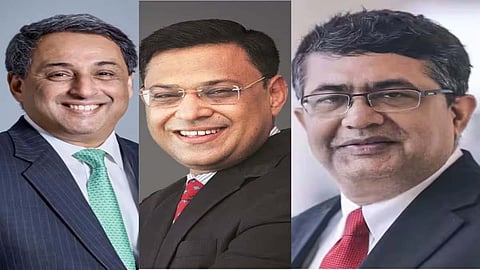

New Delhi | Tata Sons, the holding company of the USD 275-billion-plus Tata conglomerate, has narrowed its search for a successor to Chairman N Chandrasekaran to three prominent corporate leaders -- Tata Steel CEO and MD T V Narendran, Tata Sons Executive Director and Group CFO Saurabh Agrawal, and NSE MD and CEO Ashish Chauhan, people familiar with the matter said.
While Narendran has emerged as the frontrunner among internal candidates, Agrawal is also in the reckoning with his investment-banking and capital-allocation experience, while Chauhan, a veteran of India's capital markets and one of the founding executives of the National Stock Exchange, could turn out to be the dark horse, the people said.
The selection process is still underway, and no final decision has been taken. The Tata Sons board and the trusts that control the holding company are expected to play a key role in choosing the next chairman.
Sources said Tata Trusts Chairman Noel Tata has flagged the shortlisted candidates to top government leaders and a decision is likely once the names are thoroughly debated.
Tata Trusts and Tata Sons did not immediately respond to emailed requests for comment.
Chandrasekaran, who took over as Tata Sons chairman in 2017 and is currently serving his second five-year term, announced last month that he would not seek reappointment when his tenure ends on February 20, 2027.
While a formal process to find his successor has been set in motion, no shortlist has been officially confirmed. Other names that have surfaced include Noel Tata himself, who could serve as interim chairman if the committee cannot conclude the process in time; Tata Sons' Group Chief Digital Officer Aarthi Subramanian; Tata Motors CEO Shailesh Chandra; and Tata Power CEO Praveer Sinha.
CHAUHAN: THE DARK HORSE
According to people familiar with the discussions, Chauhan could be the surprise choice.
Narendran brings Tata pedigree and is considered the natural internal contender for the top job, but his career has been almost entirely within Tata Steel, and he has relatively less experience at the holding-company level and in capital allocation.
Chauhan, on the other hand, brings a markedly different profile.
The NSE chief has deep experience in technology, capital markets, financial services and institution building. He was among the executives who helped establish the NSE in the 1990s and later served as MD and CEO of the Bombay Stock Exchange before returning to NSE as its chief in 2022.
An IIT Bombay graduate with a postgraduate management degree from IIM Calcutta, Chauhan has also worked at Reliance Industries and IDBI Bank. He is presently steering a Rs 30,000-crore initial public offering (IPO) of NSE - the largest in Indian history so far that will value the stock exchange at about Rs 5 lakh crore and place it among the 10 most valuable Indian companies by market capitalisation.
His candidature could offer the Tata Group an external-looking choice without bringing in a completely unknown face, people familiar with his profile said. Chauhan understands capital markets and the technology-driven transformation of large institutions, while his experience straddles corporate management, finance and technology.
He is also familiar with India's regulatory and policy environment, an attribute that could be useful as the group expands across highly regulated sectors, the people said.
People familiar with Chauhan's career describe him as a corporate troubleshooter who tends to work quietly and methodically, handling difficult situations without taking an aggressive public posture. He is credited with steering NSE through a difficult period and preparing the exchange for a potential listing, while at BSE he transformed a broker-run, broker-operated exchange into a professionally managed corporate institution.
His supporters point to his ability to handle pressure, take teams along and execute over long periods, as well as his understanding of technology, finance, telecom and the broader political economy.
The Tata Sons chairmanship, however, is a particularly demanding role. Chauhan would have to move from the specialised and highly regulated world of capital markets to overseeing a conglomerate spanning more than 30 businesses and more than a million employees.
NARENDRAN: THE TATA INSIDER
Narendran has emerged as the name most consistently mentioned in early discussions and remains the strongest internal operating candidate.
A Tata Steel veteran since 1988, Narendran has spent more than three decades with the group and has led the steelmaker as CEO and MD for more than a decade.
He has steered Tata Steel through volatile global commodity cycles, heavy capital expenditure and the difficult European operations that have been a challenge for successive Tata Sons chairmen.
Narendran has overseen the company's organic and inorganic expansion and has held several prominent industry and institutional positions, including chairman of the World Steel Association and president of the Confederation of Indian Industry.
He is reported to be one of the two operating CEOs -- the other being Tata Power's Praveer Sinha -- whom Noel Tata regularly consults.
For Narendran, the challenge would be to translate his experience of running a large Tata operating company into managing a sprawling portfolio ranging from IT and automobiles to aviation, consumer businesses and new-age manufacturing.
AGRAWAL: THE FINANCE OPTION
Agrawal represents a distinctly finance- and strategy-oriented internal option.
He joined Tata Sons in 2017 as Group CFO under Chandrasekaran and currently serves as Executive Director and Group CFO. His responsibilities extend beyond those of a conventional CFO, including capital allocation, investment-management decisions and portfolio optimisation across the group.
An IIT Roorkee graduate with a postgraduate management degree from IIM Calcutta, Agrawal began his career in finance and investment banking in 1995.
He went on to head investment banking at DSP Merrill Lynch, served as head of corporate finance for India and South Asia at Standard Chartered and held a senior strategy role at the Aditya Birla Group before joining Tata Sons.
Agrawal had also advised major Indian groups, including the Tatas, on transactions before joining the conglomerate, giving him a combination of external financial-market experience and intimate knowledge of the Tata Group's investment architecture.
He has held board positions across the group, including Tata Steel, Voltas and Tata Digital, and chairs businesses including Tata Capital, Tata Play, Tata AIA Life Insurance, Tata AIG General Insurance, Tata Power Renewable Energy, Tata 1mg and BigBasket.
His candidacy becomes particularly relevant as Tata Sons faces a period of heavy capital requirements and increasingly complex decisions over where to deploy capital across its businesses.
WHY THE CHOICE MATTERS
Chandrasekaran's departure comes at a critical juncture for the Tata Group, which is in the middle of one of its biggest investment cycles, including the expansion of Air India, semiconductor and electronics manufacturing projects, electric mobility and digital businesses.
The next chairman will inherit a group with roughly Rs 16.24 lakh crore in revenue and will have to navigate several strategic flashpoints.
TCS, the group's largest listed company and biggest contributor to Tata Sons' market value, is entering a period of rapid technological change. Air India, which Chandrasekaran also chairs, needs substantial investment as Tata seeks to build a global-scale airline. Tata Digital's loss-making operations will require sharper strategic decisions.
The new chairman will also have to address the long-pending question of a public listing of Tata Sons, alongside broader boardroom governance issues and the financial pressures faced by the Shapoorji Pallonji Group, a minority shareholder.
Air India could prove one of the biggest tests. The airline is being rebuilt after its acquisition from the government and has ambitions to expand rapidly as India's aviation market grows. But raising the capital needed for aircraft purchases and securing confidence among aircraft lessors remain key challenges.
The succession process also comes amid questions over the Tata Group's traditional leadership pipeline. Narendran, notably, is not a Tata Administrative Services officer and has spent his Tata career entirely at Tata Steel.
Noel Tata, chairman of Tata Trusts and a non-executive director on the Tata Sons board, has emerged as a key figure in the succession process following the death of Ratan Tata in 2024. His influence is expected to be significant as the group seeks to balance commercial expansion with the governance and philanthropic ethos associated with the Tata name.
The final choice could therefore signal the direction Tata Sons wants to take in the next decade.
Sources said Narendran offers continuity and deep operating experience within the Tata Group. Agrawal brings capital-markets expertise and intimate knowledge of the holding company's investment decisions. Chauhan offers a broader combination of technology, finance, institutional building and regulatory experience.
For now, Narendran remains the stronger internal candidate, with Agrawal providing a finance-focused alternative. But Chauhan's unusual combination of technology, financial-market expertise and institutional leadership makes him the dark horse who could upset the expected order in the succession race, they said.
The selection committee is expected to advance the process in the coming months, with the new chairman required to take charge after Chandrasekaran's term ends in February 2027.

