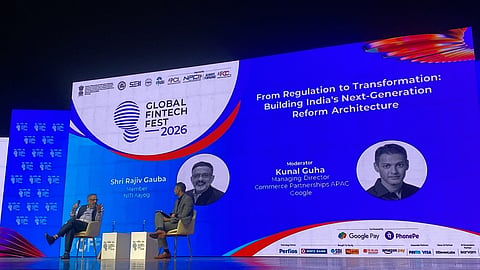

Moderator: Kunal Guha, Google
Speaker: Rajiv Gauba, Member NITI Aayog
Good morning once again and welcome to the third day of the Global FinTech Fest 2026. (0:27) We actually hope that you had a great day yesterday as well, you know, insightful conversations, (0:32) most importantly, some meaningful connections that you have built over the time over here (0:36) and of course, a lot of fresh perspectives to take home with. I am Ramya R. Chawla and I'm very, (0:43) very delighted to be here at the Grand Theatre NMACC for GFF 2026.
With that, let's get the day (0:49) of GFF 2026 underway. GFF 2026 is organized by Payments Council of India, the National (0:57) Payments Corporation of India and the FinTech Convergence Council. The festival is supported (1:02) by Ministry of Electronics and Information Technology, Department of Financial Services, (1:06) Ministry of Finance, Department of Economic Affairs, Ministry of Finance, New Emerging and (1:10) Strategic Technology Division, Ministry of External Affairs, NITI.IO, Reserve Bank of India, (1:15) Securities and Exchange Board of India, International Financial Services Centers (1:19) Authority, Pension Fund Regulatory and Development Authority.
And most importantly, I think it's (1:25) always great to thank all of our partners for helping, you know, us put together this event (1:29) of such scale and such size. So with that, GFF 2026 is co-powered by Google Pay, Phone Pay, (1:37) our technology partners, Perfuros. It's brought to you by HDFC, State Bank of India, Punjab (1:42) National Bank, Bank of Baroda and Amazon Pay.
Our associate partners, Paytm, Visa, our voice AI (1:48) partner, 11 Labs, AI ecosystem partner, Serum AI and payment enabler is Lyra Network. So with that, (2:00) I think we're going to begin with the fireside chat that we're all set for. And the topic is (2:05) truly, truly interesting.
We're going to talk about regulation to transformation, where we're (2:09) building India's next generation reform architecture. So for that, I would first invite (2:15) on stage, the moderator for the session, ladies and gentlemen, could we have a round of applause (2:19) as I invite Mr. Kunal Guha, Managing Director Commerce Partnerships, APAC, Google.
Hello, everyone. How's everyone holding up on day two? (0:06) All right. Good.
A lot of energy. Excellent. (0:09) It's my first GFF.
I'm calling this the Mahakumbela of FinTech. (0:13) I'm very overwhelmed, but in a good way. (0:17) By way of introduction, my name is Kunal Guha.
(0:21) I'm responsible for the portfolio at Google that is building (0:25) the new frontier technologies of agentic commerce, (0:29) financial inclusion, digital identity across Asia Pacific. (0:36) And for me, as I come to India and sit down and see all of the innovation (0:41) that is happening across the past decade, it truly has been built (0:45) on an incredible, incredible belief that India can lead. (0:50) So today's topic is about Niti Aayog, 2047, (0:55) and how do we get to what will become an Indian $30 trillion economy, (1:02) a true developed state, and what do we need to be able to achieve that? (1:07) And it is a pleasure for me to introduce to the gentleman (1:11) who is the chief architect of Niti Aayog, (1:15) Sri Rajiv Gauba.
Please come on stage. (1:19) By way of introduction... (1:32) By way of introduction, and very humbly, Sri Gauba's entire career (1:40) as a civil servant has been so inspirational. (1:43) He has played pivotal roles in both policy formulation (1:48) and deep, deep execution across the heartlands of India.
(1:53) As a member of Niti Aayog, he heads very high-level committees (1:59) that are responsible for both regulatory reform, (2:03) as well as thinking about how can we achieve this Vixit Bharat goal (2:09) and true vision, and what would it take across the board. (2:13) To start off, Sri Rajivji, before we get into the macroeconomic policy (2:19) of what we're trying to achieve together as a nation, (2:22) you were the architect of India's governance (2:27) that allowed for us to move away from physical currency into UPI. (2:33) So, do you still hold currency in your wallet? (2:37) Of course.
(2:50) So, in my wallet, right? (2:54) I have one 200-rupee note, another 500-rupee note, (3:01) and these are the notes which I have been carrying for maybe, (3:04) I don't know, since when. (3:06) I don't need to carry them. (3:08) They are there in my wallet only because my wife insists.
(3:16) You know, agar kahi your credit card doesn't work, so you should. (3:23) But, frankly speaking, I don't need them. (3:26) I don't do, you know, shopping mostly is done by folks at home, (3:32) and I think it has become so convenient that there is excessive shopping now.
(3:37) Food is ordered online. (3:39) I personally, I pay my yoga teacher every month using Google Pay. (3:45) Thank you, thank you.
(3:48) Thank you for that. (3:50) I pay, you know, some of the clubs of which I remember, (3:57) again using my credit card. (4:02) So, and the only time, you know, we use currency notes (4:10) is when we, not very frequently, when we go out to some restaurant, (4:17) to, you know, although there is service charge and all that, (4:21) we are not sure whether that is passed on to the, you know, servers.
(4:27) So we pay them by cash. (4:30) Otherwise, you don't need to use cash at all. (4:33) Amazing transformation which has happened in this country, (4:37) thanks both to government and private sector.
(4:40) Government created the underlying digital infrastructure, (4:46) and start-ups and other players, they have created the superstructure. (4:51) So that's where we are. (4:53) You know, when you think about things like data rates, (4:56) which is the lowest in the world, (4:58) when you think about the permeance of access, (5:00) which is growing significantly more and more, (5:03) we are also working on solving for the last mile, (5:05) which is in areas where there is no technology, (5:08) how can people still use UPI? (5:10) How people can still use real-time payments? (5:12) We will get that together through government and industry.
(5:16) So my first question to you is, (5:18) you have been this chief architect of so much of the reform over the last decade, (5:22) and now we are moving towards Vision 2047, (5:26) which is incredibly ambitious, right? (5:29) And it requires us to get to 8% year-on-year annual growth in GDP (5:34) across through a lot of structural reforms. (5:37) What, in your view, should define this next-generation reform architecture? (5:43) So, in one word, deregulation. (5:48) The next-generation reform architecture has to be defined by deregulation.
(5:56) Because, you know, if you look at the last 10-12 years, (6:01) a lot of big-ticket stuff has already happened. (6:06) Prime Minister Modi has had a single-minded focus on reform. (6:13) He was here for the inauguration, (6:15) and he said that the Reform Express will continue.
(6:20) So I can tell you, having had a ringside view when I was there, (6:25) I was Secretary of State at the time when COVID started unfolding, (6:29) that even during COVID, which was once in a century kind of a crisis, (6:37) or even when faced with serious supply disruptions (6:40) caused by the ongoing conflicts, Russia-Ukraine, and the West Asia, (6:47) he has been determined that we turn crisis into opportunity through reforms. (6:57) Now, I can mention some. (7:00) A whole lot of reforms have happened.
(7:02) The GST has created a unified national market. (7:05) We didn't have any framework for insolvency resolution earlier. (7:11) So capital, land, assets, they continue to remain locked up.
(7:17) Ideally. (7:18) And now, it has changed. (7:22) Capital can be redeployed.
(7:25) FDI regime has seen tremendous liberalization across sectors. (7:32) FDI caps have been removed altogether or raised up to 74%, (7:38) and mostly on automatic. (7:40) No government approval.
(7:42) Even in areas which were once considered totally off-limits for the private sector. (7:49) You know, defense, space, and now nuclear energy. (7:53) They have been opened up.
(7:56) And last year, you had the four new labor force. (7:59) I think one of the last big arcs of the industry. (8:04) Making it easier now for industry to reap the advantages of economies of scale and formalization.
(8:12) And of course, better security for the workforce, the labor force. (8:18) So, there's a lot of big stuff having happened. (8:23) Of course, there can never be a full stop.
(8:25) What is left now? (8:27) Since you asked me, next generation. (8:29) I think what is left now is making the everyday task of doing business in India simpler and easy. (8:40) You know, we abolished industry licensing in 1991.
(8:43) But, License Raj did not go. (8:49) Inspector Raj has survived and flourished. (8:54) Licenses have appeared in many different avatars.
(8:58) As permission, approval, mandatory registration, which is not automatic. (9:05) Frequent renewal requirements. (9:09) Across a multitude of laws and rules.
(9:13) Of central and state government ministries, departments, and of the city government. (9:21) Therefore, the next generation reform has to be to liberate the industry and citizens at large. (9:29) From this stifling chokehold of rules, regulations, permissions.
(9:37) So, our task is cut out. (9:39) To scrutinize the maze of laws, regulations, rules, processes with a fine form. (9:44) And test them against the touchstone of trust-based governance.
(9:53) Which the Prime Minister has called Jan Vishwa. (9:59) That is the new philosophy of governance which he has articulated. (10:04) Now, this is granular work.
(10:07) It may be unglamorous. (10:10) It is not the headline grabbing stuff. (10:13) It is what I call nuts and bolts.
(10:16) So, this is the next generation reform. (10:21) And the committee that you talked about. (10:25) It is not a very high level.
(10:27) Just a high level committee. (10:29) So, that committee was set up on 19th August, 2025. (10:36) For regulatory reform.
(10:38) Along with another committee on Bixi Bharat goals. (10:41) So, we are working in this direction. (10:44) And what we have done is that we have developed a framework.
(10:47) First of all, there has to be a framework. (10:49) Based on these principles of trusting the citizens, the businesses, the industry. (10:55) Essentially, what have we said? (10:59) That licenses should be required only for reasons of national security.
(11:04) Or for activities which pose serious risk to human health. (11:09) Or environment. (11:10) Otherwise, you should have registration which is automatic.
(11:14) Not subject to yes or no. (11:17) Licenses where they are necessary. (11:20) Some will be required.
(11:22) They should have perpetual validity. (11:25) Or long term, 10 year validity. (11:28) Inspections should not be random.
(11:30) They should be risk based. (11:32) So, this is a paradigm shift which we are trying to bring about. (11:35) Moving to, as has been described, permitted unless prohibited.
(11:43) Rather than prohibited unless permitted. (11:47) Another thing, you know, that changes in regulations should not be introduced at random. (11:54) But only they should follow a fixed cycle, calendar.
(11:59) And all existing and future regulations should be subjected to regulatory impact assessment. (12:06) And assessment of the cost of improvement. (12:09) So, this framework, these principles need to be applied to all laws and regulations.
(12:16) Existing and new. (12:18) And at all levels, central, state and city. (12:21) So, this, you know, has to be the direction of reform for the next few years.
(12:29) And so, you know, just right before this, we were having this delightful conversation about (12:33) how, as policies defined at the national level, the real benefits happen at the rural, all the way down to the city level. (12:42) And through all of your experiences, you've been foundational at driving that. (12:45) What allows for everything that you're doing within the TIO, all of the fundamentals that we're defining at the center, (12:53) how does that permeate deep, deep into, like, small Tier 2, Tier 3, as well as rural towns in India? (13:02) That's a very good question.
(13:04) We have not just two levels, we have three levels of government. (13:10) We are a federal country. (13:13) We have, you know, central, union list, state list of this.
(13:19) And we have a concurrent list. (13:20) And then there is city government. (13:23) So, there's a lot of vital reforms which fall squarely in the domain of the states.
(13:30) And municipal governments. (13:32) Land use changes, building permits. (13:34) You know, consent to establish and consent to operate, which are given by the state pollution control boards.
(13:43) You know, various kinds of licenses, legal licenses and all that for hotels, legal metrology, so on. (13:52) So, in some areas, centers and states have to work together for deregulation to become a reality. (13:59) So, this committee, we are going through the central regulations.
(14:06) And a lot of work has already been done in the last one year. (14:10) This committee has been at work. (14:12) The environmental regulations have been streamlined, eased.
(14:16) A lot of compliances have been removed altogether. (14:19) The quality control regime has been simplified. (14:23) A lot of compliances have been reduced or removed altogether for the MSMEs.
(14:31) For corporates in general, under the company law. (14:35) Then, you know, we have a deregulation task force. (14:39) Distinct from this committee.
(14:41) Which is working with the states. (14:45) To apply the trust-based framework to state and city level compliances. (14:53) And, for example, you know, we have gotten the Ministry of Environment, Forest and Climate Change.
(15:03) To make consent to operate permanently at the state level through the state pollution control boards. (15:10) The food business operator licenses have been made permanent. (15:14) And the requirement of licenses for annual turnover up to 1.5 crore has been dispensed altogether.
(15:21) Now the deregulation task force steps in. (15:25) To get identical changes implemented at the state level. (15:31) Now a very good example of this, you know, where both centre and states will work together.
(15:35) Is a national building code. (15:39) Now this code is published by the Bureau of Indian Standards. (15:43) Which is a central body under the Ministry of Consumer Affairs.
(15:49) Over the years, this code, although it is supposedly voluntary. (15:55) But it has become overly prescriptive, restrictive. (15:58) And most state governments and ministry bodies simply, you know, (16:04) Adopted lock, stock and barrel into their regulations.
(16:09) So what we have done is, working with the Department of Consumer Affairs and BIS. (16:15) That the chapters on construction practices, landscape, facility management, sustainability. (16:24) Which are not central to structural safety, etc.
(16:28) Have been removed altogether. (16:31) We have changed the name to National Building Construction Standards. (16:35) Making its voluntary character totally explicit.
(16:42) Now, next action lies on part of the state governments and municipal governments. (16:50) They can allow now and some of them are already doing it. (16:52) Taking advantage of this ...requirements for setback, for ground coverage, for parking requirements. So, five to six (0:07) times more built-up area, land will be unlocked, allowing, for example, hospitals (0:15) to construct more floors, hotels to construct more rooms. Why, you know, our tourism industry can benefit much more.
(0:22) Our rooms are far more expensive than in competing destinations. So, we expect, you (0:28) know, that this will unlock land supply, and hotel room tariff will come down by 35%. (0:35) Affordable housing, you know, will become more accessible to people.
Then again, you know, in talking of tourism, tour operators today, they need various state-level (0:47) permits, even though they possess so-called All India Tourist Permit. Hotels need (0:53) multiple health, trade, and liquor licenses for different venues and for (0:57) different locations. So, our committee has recommended sweeping reforms in these areas, (1:04) and we are now nudging the states through this deregulation task force to (1:09) implement.
So, the real estate sector, tourism, hospitality, health, all with large (1:15) contribution to economy and jobs. So, therefore, I mean, in a nutshell, to sum up, I would say (1:22) that the role of central, state, and municipal authorities is, you know, distinct, defined, they work together. Central's role is to promote model regulations in some areas, (1:35) share templates and best practices, and create incentives for implementation through, (1:43) by linking, you know, transfers of funds or fiscal transfers under various central (1:50) missions to implementation of these reform ideas.
The capital expenditure (1:56) soft loans, which the Central Committee is now providing to the states under the (2:03) Special Assistance Scheme for capital investment, and then the Urban Challenge (2:10) Fund, which was launched last year. These are examples of large fund dispersions (2:16) linked to these kind of reforms and projects being selected on challenge (2:21) boards. So, this is cooperative federalism in practice with a competitive edge.
I (2:32) think we have to understand, you know, that we are a country of continental size. Many of our (2:37) states and even districts are bigger than many, many countries, hundreds of (2:41) countries. There cannot be a Vixit Bharat without Vixit states.
So, states need to (2:49) think and plan like that, and that is beginning to happen as a result of, you (2:54) know, the Prime Minister's exhortation for Vixit Bharat. They are preparing their (2:59) own state visions, and they have realized now that reform is the only way to get (3:06) investment, accelerate growth, and create jobs. So, I think this is what, you know, (3:14) will sustain the reform moment.
And a big part of this reform moment is also the (3:21) speed with which innovation and change is also driving this forward. Fintech as an (3:26) industry as a whole is building at such a breakneck speed, and a key part of (3:31) regulation and reform is also how can we ensure that citizens are protected. It is (3:35) built on trust, and it's built on rules, and equal parts allow for innovation, (3:40) allow for sandbox environments, allow for experimentation, sometimes even failure.
(3:47) Fintech, I think, is a shining example. You also mentioned what all has been (3:52) accomplished. We can be proud of the fintech sector.
Many players who are present here, I don't want to name anyone, (4:01) they've all contributed to this success story. Growth has been, I think, a sort of (4:08) phenomenon. In a relatively short time span, I think we now have, we are home to over (4:13) 10,000 fintech firms with nearly 40 billion US dollars in investments over (4:21) the last 10 years.
But I think much more, much more important than the numbers is (4:28) the fact that our fintech ecosystem, it has truly democratized access and (4:40) financial inclusion. Payments have been revolutionized. They have democratized (4:47) insurance.
They made it possible for ordinary Indians to participate in stock (4:54) market like never before. And so we have to salute the capability, the innovative (5:03) spirit, the genius of our youngsters, the startups. But we also have to (5:12) acknowledge the role of the government by creating the underlying robust (5:18) digital public infrastructure.
And secondly, policies of the government which made it (5:26) possible for literally everyone to have mobile phones and data. We have the (5:32) cheapest data in the world. And we don't need, you know, confirmation or approval (5:43) from global papers or journals.
But I would like to, you know, mention, I think this week or (5:53) last week's Economist, some of you may have read, you know, it raves about India's (5:59) UPI. It says, you know, that purchases ranging from vegetable worth rupees 10 to (6:06) five phones costing more than a lakh, all are being made using UPI. I mentioned, you know, you asked me a personal question in the beginning.
So I'm just quoting from that article. (6:23) It sits at the top coconuts on Mumbai beach carts and alongside samosas in Delhi snack shops. (6:31) It is displayed on rickshaw drivers' seat backs, utility companies' bills and (6:37) Amazon's checkout page.
It can be scanned to buy ten rupees worth of peanuts or one (6:43) lakh rupee iPhones. So ubiquitous has the QR code become and so quotidian its use. (6:50) That is easy to forget just how recent an addition it is to the Indian landscape.
(7:00) So all this is done. But I think there is a lot more to do. I think access to credit can (7:08) certainly be, you know, made more democratic, universal to the small (7:15) shopkeeper, MSMEs.
I think insurance needs much greater penetration. We need (7:23) to go the way of digital bank. There has been a lot of discussion about digital banks and I think the (7:33) power of AI should be leveraged by the fintechs to, you know, strengthen our (7:43) systems against fraud and to make decisions, whether by shopkeepers or by lenders or individuals, (7:53) you know, more kind of nuanced and customized.
So a lot of work which needs to happen going (8:02) forward. So here I think we have to strike a right approach to regulation. Over-regulation (8:11) will push innovation offshore.
This is the lesson which, for example, in many areas EU is (8:24) that they have lost out in competitiveness to the US because of the over-regulation by the Brussels (8:35) bureaucracy. On the other hand, under-regulation can produce, you know, a crisis and the loss (8:45) of confidence. And then we end up responsible.
We have to strike a right balance which is not (8:52) static but dynamic. Secondly, regulation has to be principle-based, technology neutral, (9:01) and scaled with risk rather than being applied uniformly, which, for example, (9:06) our digital competition, which is under consideration, plans to do, seeks to do, (9:12) by placing obligations only on the systemically significant enterprises and not, you know, (9:21) treating every player the same way. Similarly, RBI has a similar regulatory structure, (9:28) the NBFCs, four layers based on size, activity, and perceived risk areas.
Thirdly, I think regulation (9:38) should promote competition. New entrants should be able to come in and exit without any friction, (9:47) so that the threat of competition in itself disciplines the incumbents, and obviating the (9:56) need for a regulator to step in. Fourth, non-discriminatory access to underlying infrastructure, (10:04) which has been the case so far, physical, digital, and financial.
And then information (10:10) symmetry, so that consumers and regulators both have timely, reliable, and open access to data. (10:20) I think we also can have better coordination, greater coordination amongst different regulators, (10:33) you know, to improve predictability and remove, you know, requirements like duplicate, (10:39) differing KYC requirements. This is something which we are working on to improve interoperability.
(10:46) So I think all of this simplifying and digitizing the regulatory processes should be a, (10:53) has to be a continuing exercise. And a big part of this, Sridharji, is also the breakneck speed (11:02) with which innovation, AI, agentic is like the biggest topic that everyone's been speaking about (11:07) during GFF, and it only will accelerate more. How can we also make sure that a lot of the (11:12) knowledge of this technology permeates across the governments as well? And how can, (11:20) we can allow for these technological evolutions, help drive the economy, and then helps allow us (11:28) to be able to coordinate better.
And, you know, the UPI example was such a good one, and EPI is (11:33) such a good one, where government and industry work hand in hand to be able to think about where (11:37) technology could go, what potential could come. Well, three things also. Working more closely (11:46) with the private sector, which has been done in the past also.
Number two, capacity building (11:53) in the government, and having a system where we can induct professionals laterally into the (12:03) government. More kind of open door, revolving door, two-way policy. I think the scale and speed (12:12) of technology adoption in India by the government is not fully appreciated.
EY, EDI, you know, (12:24) more than 17,000 crore authentications, transactions have been done so far. (12:29) Government e-marketplace, which many people are not aware, it has revolutionized the way (12:33) government departments procure goods and services. (12:40) There are so many examples of technology having been leveraged to transform (12:45) governance and public service delivery, you know, passports, e-visa, direct benefit transfer, (12:53) COVID platform during COVID.
(12:58) Within the government also, internal working of the government is now mostly, you know, (13:02) E-5 system. And within the government, you know, for last many years now, more than a decade, (13:14) many entrants, most of the entrants into government have very strong technology. (13:21) So, there is no dearth of capacity or talent.
Yes, but this is an area where knowledge and (13:26) skills get dated very fast. So, that is why we have to, you know, adopt this model, which we (13:35) have done in the past also, that we partner with the private sector to get the state of art (13:41) expertise and deliver the quality of services. Essentially, you can say PPP in governance, (13:51) not just projects.
So, that is how we should, you know, do improve in future. (13:59) Number two, capacity building and upskilling of civil service. Again, this is something which (14:06) government is already doing in a big way.
Not many people are aware because it's something (14:11) internal to the government. You know, I got Karmayogi platform. There is a platform called (14:17) I got Karmayogi, which is entirely an initiative, conceptualized, steered by the Prime Minister (14:25) Modi, where, you know, a lot of content, generic and specialized, is available online (14:38) to all employees across the government, state governments also, (14:43) and for upgrading their, you know, technical and behavioral skills also.
(14:49) And it is mandatory. It has been made part of the performance appraisal (14:55) for officials at all levels, from, you know, section officers to the secretaries of government. (15:03) So, that is capacity building.
And thirdly, as, you know, laterally, which has (15:10) commenced, which is now is already there, but it needs to be scaled up and institutionalized so (15:18) that contemporary ideas and skills can be infused in the government at different levels. (15:29) And Rajivji, our wonderful hosts are telling me very politely that we're running out of time. (15:35) So, I'll come to our last question, which is, this audience here and everyone at GFF, (15:42) they're going to play such a critical role and a crucial role in for us to be able to drive (15:48) India's progress together.
So, what is the key ask that you would have of this audience? (15:54) As we build towards this Mixed Bharat 2047 vision, (15:58) what would you like this audience to be accountable responsible for? (16:02) See, Mixed Bharat is not a government of India mission. (16:06) It is a national enterprise. And each one of us, irrespective of our area of work, (16:14) our field of activity has an important role to play.
Government, industry, citizens, (16:20) all of us have to act with that kind of a spirit and understand that this is once in a lifetime (16:27) opportunity. We are at an inflection point and we must make the most of this opportunity. (16:35) And Srirajivji, the scale requires such a bold, forward-looking and technology-enabled architecture.
(16:43) Ladies and gentlemen, this is a masterclass at how you think about a vision for what will make (16:49) India a developed nation. A huge round of applause for Srirajiv Gopal. Thank you very (16:53) much, everyone.
Thank you, sir. Thank you. Thank you so much, sir.
I think those are wonderful (16:59) insights for each and every one of us here. I would now request Mr. Kunal Goa to kindly present (17:04) a token of appreciation to Srirajiv, sir.

