
Washington | The US on Thursday unveiled PaxPass, a platform to streamline the movement of critical AI goods and a Foundry School with Stanford University to develop a workforce for the growth of emerging technologies across member states of the Pax Silica initiative.
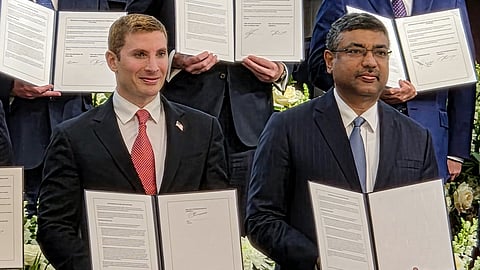
Nearly 20 members of the Pax Silica Initiative, including India, also signed the AI Opportunity Declaration at the second Summit that got underway at the Donald J Trump Institute of Peace in Washington.
“The Declaration reflects a simple but important idea. Governments should not approach AI primarily through the lens of prescription. We should approach it through the lens of opportunity,” Jacob Helberg, US Under Secretary of State for Economic Affairs, who is driving the Pax Silica Initiative, said, delivering the inaugural address at the Summit.
He also announced the launch of PaxPass, an ambitious new platform that has the potential to transform how trusted partners use critical goods that power the AI economy by combining cargo verification, AI-powered risk assessment, and pre-approved expedited processing for trusted shipments.
“PaxPass will reduce friction, strengthen supply chain resilience and accelerate trusted trade. To support this effort, the United States is committing USD 50 million in foreign assistance funding dedicated to the development and deployment of PaxPass,” he said.
Helberg said the US was putting resources behind its vision and demonstrating that a trusted partnership is backed by real investment.
He also announced plans to launch Foundry School, a workforce development initiative in partnership with Stanford, to equip entrepreneurs, engineers and advanced manufacturing leaders across the Pax Silica economies.
“In parallel, Stanford and the State Department will develop a first-of-its-kind curriculum for institutions across Pax Silica economies to adopt and teach advanced manufacturing, which is not yet well established. It is a stand-alone field of study,” Helberg said.
“FoundrySchool will give the next generation of technologists, industrial leaders, the shared foundation and the capabilities that underwrite prosperity in this field,” he said.
Helberg said the US recently announced the first-of-its-kind economic security zone and a model designed to attract investment, expand trusted manufacturing capacity, and create innovation from the environment that generates long-term growth.
“Our hope is that this is only the first of a handful of such zones across the Pax Silica network, creating a connected ecosystem where investment, innovation, and trusted production reinforce one another across different countries,” he said.
“These aren't isolated projects. They're profitable, replicable pilots designed to help countries solve a lot of challenges together, and they're designed to set the model that will scale the economy,” Helberg said.
Addressing the gathering, US Deputy Secretary of State Christopher Landau said the technologies that define this century – advanced chips, AI infrastructure, abundant energy, and the minerals that make up our world – are too consequential and too vulnerable to coercive policies and markets.
“Pax Silica exists to keep these technologies and the future growth of all of us in trusted hands. Governments didn't build the frontier of technology. Our companies did it,” he said.
“When the United States unleashes its private sector and partners with nations that do the same, no state-directed rivalry takes place. No single nation holds everything that these technologies supply chains. That is our strength, not our weakness,” Landau said.
“Our combined capabilities are something no command economy can compete with,” he said, adding that nine new countries have signed the Pax Silica declarations.
Argentina, Germany, the Netherlands, Chile, Costa Rica, Greece, Kazakhstan, Panama, and the European Union joined the Pax Silica initiative on the sidelines of the Summit.
“Our premise here is simple. Align public purpose with private capability. Strip away the friction that has held us back and let free enterprise do what no government has ever done. That's the purpose of the AI opportunity,” Landau said.

