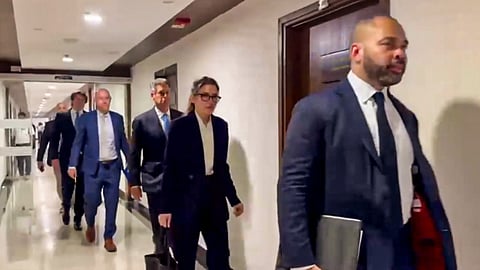

New Delhi | Meta executives faced a second straight day of questioning by Indian government officials on Thursday over issues including Instagram's content recommendation algorithms and the social media giant's compliance with local laws, government sources said, adding that the company said it was working to tackle deepfakes, child sexual abuse material (CSAM) and bot accounts.
The government will push the company to take continuous measures to address its various concerns, sources told PTI after the hour-long meeting concluded.
Meta on Thursday faced Centre's questions on whether it is adhering to Indian laws, algorithmic issues, as well as guardrails to meet constitutional and legal requirements, government sources said and pointed out that the company has assured that it is serious and "working hard" to address deepfakes, CSAM, and bots, government sources said.
The company's global team, including Meta global affairs head Joel Kaplan, met IT Minister Ashwini Vaishnaw for the second straight day on Thursday following the government's summons over the temporary restriction of Prime Minister Narendra Modi's Facebook post recently.
The series of meetings will go on for 3-4 days in all, and the next round will see Meta's technical team engaging in discussions with the government.
Government sources said that Meta admitted that there are serious issues, and that it is working "very hard" to address concerns around deepfakes, child sexual abuse material (CSAM), bots and synthetic content.
Meta executives assured the government that the company will continue with actions and improvements, the sources added.
"We will push them hard, and technical discussions will continue," a source said.
Asked about discussions on the fairness of algorithms, sources said that Meta informed them that it has mechanisms in place to deal with the issue.
Kaplan, who served in the administration of George W Bush -- including as White House Deputy Chief of Staff for Policy -- before joining Meta (then Facebook) in 2011, did not reply to questions from the media after the meeting.
Meta was questioned on their algorithms, whether the compliance mechanism has sufficient checks and balances, and guardrails to meet constitutional and legal requirements, government sources said.
This is the second round of questioning of Meta's global team by the government, after the Prime Minister's July 23 Facebook post -- addressing students and youth and promising stringent action against examination paper leaks -- was restricted for about five hours on the platform, raising issues around intermediary accountability.
Meta's global team was immediately summoned by the government to explain why PM's Facebook post was temporarily restricted.
On Wednesday, Kaplan and his team met IT Secretary S Krishnan, and then the IT Minister.
After the Wednesday meeting, government sources had said that Meta apologised for the temporary removal of Modi's post as well as for failures ranging from child sexual abuse content to deepfakes and boosting certain content on being paid "a lot of money".
While Kaplan, who flew in for meetings with Indian officials, said in a written statement on Wednesday, that he "apologised to the minister on behalf of Meta for the error restricting PM Modi's post", government sources, who did not wish to be identified, said the apology came from company chief executive Mark Zuckerberg.
A Parliamentary Standing Committee, too, sought an apology from Zuckerberg over the removal of Modi's Facebook post, warning in a letter that protection and immunity available could be withdrawn if no apology was forthcoming within three days.
Modi had first posted the selfie video on Instagram. The video was later shared on Facebook, which was restricted by the social media platform. Meta later restored the post, attributing its removal to an error by AI-powered automated content filters, and apologised.
According to government sources, Vaishnaw had asked Meta point-blank on Wednesday whether the company accepted payments to promote content that could trigger public disorder.
The government read out provisions of Section 79 of the Information Technology Act to Meta officials, making it clear that non-compliance in discharging intermediary obligations jeopardises the company's safe harbour protection (immunity as a platform).
After the meeting, government sources had said Meta executives admitted to failures involving child sexual abuse content and deepfakes and admitted that "a lot of money was paid for boosting a certain type of content".
Vaishnaw, it is learnt, also asked Meta if it is doing enough to prevent illegal content on their platform.
"They admitted that their systems are not fully geared up for so much of the content which is illegal... They admitted that they are not able to control all of it," government sources said.
Neither Kaplan nor any other Meta official acknowledged the claims or offered any comments on Wednesday.
The government last month served a notice on Meta over alleged child sexual abuse material in paid advertisements on Instagram, and the meetings this week have seen the US giant being grilled on issues such as child sexual abuse material, deepfakes, safeguards for verified and prominent accounts, algorithmic bias, and compliance with Indian laws.
New Delhi | The government has slashed the online content takedown time for sensitive matters to 2 hours from the earlier 24 hours given to social media platforms, an official statement said on Thursday.
According to the statement, amendments were made on February 10, 2026, in the IT Rules 2021 to strengthen the regulatory framework to address harms arising from synthetically generated information (SGI), including deepfakes and AI-generated content.
"Strengthening of timelines for compliance, including reduced timelines for removal of unlawful information upon actual knowledge upon valid reasoned intimation from the Appropriate Government or court orders (timeline reduced from 36 hours to 3 hours) and for grievance redressal (including special categories such as nudity/impersonation etc) (timeline reduced from 72 hours to 36 hours and 24 hours to 2 hours for sensitive matters, respectively)," the statement said.
IT Rules mandates the significant social media intermediaries (SSMIs), platforms with over 50 lakh user base in India, to take reasonable efforts to deploy appropriate technical measures, including automated tools or other suitable mechanisms, to proactively identify information that depicts any act or simulation in any form depicting rape, child sexual abuse or conduct or any information which is similar in content to information that has previously been removed.
"In case of failure of the intermediaries to observe the legal obligations as provided in the IT Rules, they lose their exemption from third party information provided under section 79 of the IT Act. They are liable for consequential action or prosecution as provided under any extant law," the statement said.

