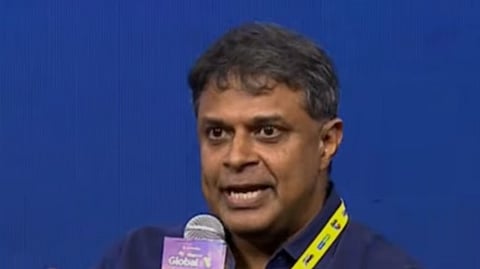

New Delhi | Sovereign AI can grow to the next level if it is used at a large scale, however, free services by global companies are a challenge, domestic AI firm Sarvam's Founder Vivek Raghavan said on Tuesday.
Sovereign AI is an AI platform developed indigenously from scratch using own datasets, which enables nations to reduce reliance on foreign technology firms and protects their national interests.
Notably, OpenAI is offering access to ChatGPT for free while Reliance Jio in partnership with Google is offering free access to AI platform Gemini.
Speaking at a session in AI Impact Summit here, Raghavan said, "We are going to put some models out there which are world-class in their category. We have been doing that over the past few weeks and we hope to do some more. But I think the important thing is that these models can actually reach the next level only when there is usage at a large scale".
He observed that one of the challenges is that Sarvam AI was looking at competing with free models.
"In the real world nothing is free so if all the frontier models are available for free in any other industry it will probably be called dumping but here .. that is something that we have to figure out," Raghavan said.
He said the US and China are far ahead of India and that is a fact "we have to accept."
The Sarvam AI Founder said India needs to decide whether it wants to become a digital colony or come in the nations that own AI technology.
He emphasized the importance of making sure that Indian models are used at a large scale.
New Delhi | The Adani Group on Tuesday unveiled a USD 100-billion investment to develop renewable-energy-powered, hyperscale AI-ready data centres by 2035 -- one of the world's largest integrated energy-compute commitments.
The initiative is expected to catalyse an additional USD 150 billion across server manufacturing, cloud platforms, and supporting industries, creating a projected USD 250 billion AI infrastructure ecosystem in India, Adani Enterprises, the group's flagship firm, said in a statement.
"The world is entering an intelligence revolution more profound than any previous industrial revolution," said Gautam Adani, Chairman of the Adani Group.
"Nations that master the symmetry between energy and compute will shape the next decade."
India, he said, is uniquely positioned to lead.
"At Adani, we are building on our foundation in data centres and green energy to expand into the complete five-layer AI stack focused on India's technological sovereignty. India will not be a mere consumer in the AI age. We will be the creators, the builders and the exporters of intelligence, and we are proud to be able to participate in that future," he said.
The roadmap builds on AdaniConneX's 2 GW national data centre platform, expanding towards a 5 GW target. The more than doubling of the data centre capacity is anchored on recently struck partnerships with Google for setting up the nation's largest gigawatt-scale AI data centre campus in Visakhapatnam, and with Microsoft for similar facilities in Hyderabad and Pune.
"The Adani Group is in discussion with other major players seeking to establish large-scale campuses across India," the statement said without giving details.
The conglomerate is also deepening collaboration with Flipkart to develop a second AI data centre to support high-performance AI workloads and next-generation digital commerce.
The Adani Group will invest USD 55 billion to expand renewable energy, including one of the world's largest battery energy storage systems, and co-invest in domestic manufacturing of critical infrastructure components to strengthen India’s self-reliance in AI infrastructure.
"The 5 GW deployment will create the world's largest integrated data centre platform, combining renewable power generation, transmission infrastructure and hyperscale AI compute within a single coordinated architecture.
"Unlike conventional data centre expansions, the programme is designed as a unified energy-and-compute ecosystem, where generation, grid resilience and high-density processing capacity are developed in parallel," the statement said.
Facilities will be optimised for large high-density compute clusters and next-generation AI workloads, supported by advanced liquid cooling systems and high-efficiency power architecture.
Dedicated compute capacity will support Indian Large Language Models (LLMs) and national data initiatives, ensuring long-term data sovereignty. Reliable transmission networks and advanced grid systems will underpin the platform, ensuring stability, scalability and uptime at hyperscale.
As global AI workloads become increasingly energy-intensive, the Adani Group is uniquely positioned to provide the competitively priced, carbon-neutral power essential for this transition.
"Central to this strategy is Adani Green Energy's 30 GW Khavda project, of which over 10 GW is already operational. In addition, the Group is committed to investing another USD 55 billion to expand its renewable energy portfolio, which will include one of the world's largest battery energy storage systems (BESS)," it said.
Strategic connectivity through cable landing stations, including at Adani's network of ports, will ensure low-latency global integration with the Americas, Europe, Africa and Asia.
To reduce exposure to global supply-chain volatility, the Adani Group will also co-invest in domestic manufacturing partnerships of critical infrastructure components, including high-capacity transformers, advanced power electronics, grid systems, inverters and industrial thermal management solutions.
"This approach positions India not only as a data hub, but as a producer and exporter of next-generation intelligence and compute infrastructure," the statement added.
Bengaluru | Infosys on Tuesday unveiled its AI First Value Framework, positioning itself to capture an estimated USD 300-400 billion incremental AI services opportunity by 2030, as global enterprises accelerate adoption of generative and agentic AI.
The company, in a statement, said the framework, powered by its Infosys Topaz suite, will help enterprises unlock AI value at scale and move from experimentation to enterprise-wide AI operating models.
Citing a Nasscom-McKinsey report, Infosys described the shift as opening a new frontier in IT services.
Infosys' AI strategy rests on two pillars: capturing new demand across six AI value pools and embedding AI across its existing services to expand wallet share.
The six value pools include AI Strategy & Engineering, Data for AI, Process AI, Agentic Legacy Modernization, Physical AI, and AI Trust - spanning enterprise architecture design, AI-ready data platforms, workflow transformation, modernization of legacy estates, intelligent product engineering, and governance frameworks for responsible AI deployment.
Infosys said it is collaborating with 90 per cent of its top 200 clients on AI initiatives, with more than 4,600 AI projects currently underway and over 30 new AI service offerings developed across the six value pools.
Nandan Nilekani, co-founder and chairman, Infosys, said IT services companies will play an even more critical role in the AI era. While AI agents can automate tasks and enhance productivity, enterprises still require deep systems integration, governance, trust frameworks, and large-scale transformation capabilities to fundamentally re-engineer their businesses.
As an AI-first company with over four decades of experience in guiding clients through technology shifts, Infosys is uniquely positioned to orchestrate AI across complex ecosystems and unlock significant value from the expanding global AI services opportunity, he said.
CEO and MD Salil Parekh added AI is a powerful enabler for the services industry and the AI First value framework uniquely positions Infosys to capture market share across these six value pools.
Infosys said it is leveraging its composable agentic services suite, Infosys Topaz Fabric, and partnerships with AI disruptors to deliver both AI-augmented and AI-first services globally.
