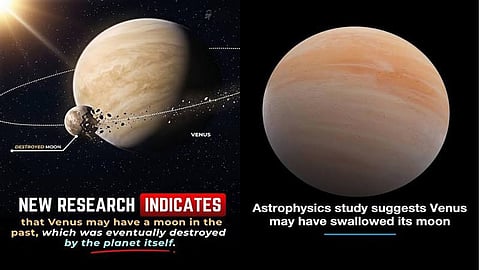

New Delhi | Venus's moon may have crashed into it because of the planet's gravity and slow spin rate, which is probably why Earth's twin does not have a moon, according to new research.
Various theories have long suggested that Venus may once have had a moon that was destroyed by a massive impact, while others argue that the planet never underwent a collision to form a moon in the first place.
Stephen Kane, an astrophysicist at University of California-Riverside and lead author of the research published in the The Astrophysical Journal, said that the study shows Venus "didn't require a catastrophe to arrive at what we can see today".
"It turns out the gravity of the planet itself combined with the rate at which it spins naturally caused the moon to collapse on top of it," Kane said.
Due to Earth's "relatively fast" rotation of 24 hours, energy from the spinning gets transferred to the moon, causing the moon to distance from the Earth, the researchers said.
However, they said, Venus is in the opposite situation, where due to a slow rotation -- taking 243 Earth days for one spin -- and the planet's gravity, the moon might spiral inward towards a collision.
Kane tested the idea by modelling the physics of how planetary bodies interact through gravity, reproducing first the evolution of Earth and its moon to ensure the model accurately represented a known system.
The researcher then varied Venus' rotation rate and the size of its hypothetical moons, testing moons with masses ranging from half to ten times the mass of Earth's moon.
In most simulations, the result was found to be the same -- the moon crashed into Venus. And the more massive the moon, the faster it crashed.
While the finding does not prove Venus once had a moon, Kane believes it may have. However, whether a moon ever formed remains an open question.
The study shows that if Venus had a moon, it could not have continued existing indefinitely, the researchers said.
"Slowly rotating terrestrial planets in the inner regions of planetary systems are unlikely to retain large satellites, with important implications for their obliquity stability and long-term habitability," the authors wrote.
"When people think about Earth twins around other stars, one question they ask is, 'Does it have a moon?'. My study shows a disturbing scenario for many of those cases. If these planets don't rotate fast enough, the moon will crash to the surface, and that would change the course of history for those planets," Kane said.

