
AI generated summary, newsroom reviewed
Safeena Wani
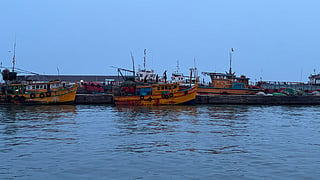
Over the last 40 years, from rowing a wooden boat to fishing in a fibreglass vessel along the Kakinada fishing harbour on India's eastern coast, ageing fisherman Presingi Adinarayana has seen it all. He knows this stretch of the Bay of Bengal intimately, feeling the shore sand sink beneath his feet every day.
For decades, Adinarayana, who also serves as president of the Fishermen Welfare Association in Kakinada, has harvested various gastropod and bivalve species—such as sea snails, conchs, clams, oysters, and cockles—to feed his family and sell to wholesalers supplying local markets and restaurants. Kakinada is also home to India's second-largest mangrove forest after the Sundarbans, a region renowned for both rice cultivation and seafood exports.
Now, the waters of the Bay of Bengal are changing. Rapid industrial expansion in and around the Kakinada fishing harbour, which forms part of the Kakinada Port complex, has led to contaminants pouring into the sea, often leaving a toxic sheen or rainbow film on the water's surface. This marine pollution has severely impacted fish catches. 'There are many oil-drilling companies, fertiliser, pharmaceutical, and other factories in the area that have polluted the sea over the decades and added emissions into the air,' says Adinarayana.
Adding to these concerns is India's largest green ammonia project—AM Green—coming up in Kakinada with a $10 billion investment. Designed to produce 1.5 million tonnes per annum (MTPA) of green hydrogen and green ammonia, the facility is primarily geared toward decarbonisation and exports.
'This will further pollute our waters, and the government continues to remain in deep slumber over this pressing concern of ours. We cannot go from one office to another to present our grievances. No public consultation was held for the project where we could have raised and submitted our concerns,' says Adinarayana, adding that both fishermen and the marine ecosystem are now staring at their 'worst battle of survival.'

The project establishes a direct clean-energy supply chain to Europe, as India prepares to export green ammonia and green hydrogen from the port town. The plant spans 495 acres acquired from the existing 1,127-acre site of Nagarjuna Fertilizers and Chemicals Limited (NFCL), which previously produced grey hydrogen. AM Green has allocated 2.97 acres for its electrolyser assembly unit, while the remaining 492.03 acres are earmarked for the existing ammonia-urea complex and the proposed green ammonia facility.
The Human Rights Forum, Andhra Pradesh, has written to the Expert Appraisal Committee of the Union Ministry of Environment, Forest and Climate Change (MoEF&CC) urging it to decline environmental clearance for AM Green, calling instead for a comprehensive revision of the Environment Impact Assessment (EIA) and an immediate public hearing.
Experts note that while standalone green ammonia plants powered by renewable electricity and electrolysis may be exempt from prior environmental clearance, AM Green's Kakinada project falls under the clearance framework because it involves modernising and altering an existing ammonia-urea complex.
Prime Minister Narendra Modi announced the Green Hydrogen Mission on Independence Day in 2021, leading to the formal launch of the National Green Hydrogen Mission (NGHM) in 2023. The government aims to position India as a global hub for green hydrogen production, targeting at least 5 million metric tonnes per annum (MMTPA) by 2030—with the potential to scale up to 10 MMTPA as export markets expand. Alongside domestic decarbonisation, the policy seeks to make India a leading exporter of green hydrogen and its derivatives, particularly green ammonia.
Under the mission's Strategic Interventions for Green Hydrogen Transition (SIGHT) scheme, India plans to support the production of 724,000 metric tonnes of green ammonia annually.
Germany had unveiled its national hydrogen strategy earlier, in 2020. According to a report by the US-based Institute for Energy Economics and Financial Analysis (IEEFA), Germany expects to meet around 70 percent of its hydrogen demand through imports—a reliance that intensified after 2023 as domestic developers flagged high production costs and stringent European Union sustainability rules. It is precisely this European import market that India aims to capture.
Currently, green hydrogen costs an average of around $7.63 per kg in Europe, compared to $4 to $5 per kg in India. However, grey hydrogen—priced between $2 and $3 per kg—continues to dominate the Indian market, despite a $1.6 billion direct production incentive rolled out by the Government of India for green hydrogen and its derivatives between 2026 and 2030.
A joint report by Bain & Company, the Confederation of Indian Industry (CII), and the Rocky Mountain Institute (RMI) noted that India's commissioned pilot capacity for green hydrogen in 2024 remained below 0.01 MMT due to elevated production costs.
'Hard-to-abate sectors like steel and cement are difficult to decarbonise. In the steel industry, green hydrogen not only provides clean energy but also acts as a reducing agent,' says Dr Soumya Dutta, co-convener of the South Asian People's Action on Climate Crisis (SAPACC), trustee of the Movement for Advancing Understanding of Sustainability and Mutuality (MAUSAM), and executive member of Friends of the Earth India.
However, Dr Dutta points out that producing green hydrogen is highly energy-intensive, requiring roughly 50 to 55 kilowatt-hours (around 180 to 200 megajoules) of renewable electricity per kilogram of hydrogen.
'If India plans to decarbonise its own industrial sectors rather than exporting green hydrogen, we are moving in the right direction. But in the current scenario of exporting green hydrogen and its derivatives, we are placing immense pressure on our land and water resources just to supply Europe. That amounts to the exploitation of our resources and our own people,' he adds.
India and the European Union are set to sign a landmark Free Trade Agreement (FTA) in December 2026—a deal first initiated in 2007, stalled in 2013, revived in 2022, and concluded in January 2026 to deepen bilateral trade, investment, and strategic ties.
Ahead of the pact, AM Green in Kakinada signed a Memorandum of Understanding (MoU) with German chemical giant BASF to export 10,000 tonnes of green ammonia compliant with EU standards. The company has also signed two additional MoUs with Germany's Uniper and the Port of Rotterdam, with commercial operations scheduled to begin in 2027 to supply green hydrogen and green ammonia to Germany and other EU nations.
Indian analysts remain divided on the long-term benefits of the India–Germany clean-energy trade. 'For India, energy trade with Germany and Europe serves two purposes: reducing fossil fuel dependence while avoiding over-reliance on any single country or supply chain for transition technologies, and positioning India as a clean-energy exporter. The EU-India FTA can advance both, with India supplying energy and Europe acting as a technology partner,' says international trade expert Parul Bakshi.
Geopolitical factors also underpin Europe's pivot toward India. 'Europe is wary of China, which dominates the entire renewable energy ecosystem—holding a majority share in critical minerals, leading global battery supply chains, and owning proprietary technologies. Unlike India, China does not depend on Europe for technology or capital,' says Dr Mohd Saqib, a political science researcher at the University of Kashmir. 'Europe recognises that Chinese control over supply chains poses a risk to European energy security, which is why it is engaging with India as a counterweight.'
Meeting India's 2030 target of 5 MMTPA of green hydrogen requires 15 GW of electrolyser capacity and 125 GW of dedicated renewable energy. Generating 125 GW through solar photovoltaic installations alone would require roughly 625,000 acres of land.
Dr Dutta argues that European nations should instead invest in green hydrogen projects in countries like the United States, which possess vast tracts of land and access to the Pacific Ocean. 'Cheap renewable power and low labour costs in India are attracting European buyers. Yet we must remember that India is a land-constrained, densely populated nation,' he says. 'Producing green hydrogen and ammonia demands massive amounts of renewable energy and land, which risks displacing large populations.'
According to data from Land Conflict Watch, nearly 36,003 hectares of land across India are already embroiled in conflicts linked to renewable energy projects. Meanwhile, a 2026 survey by the Federation of European Businesses in India found that 71 percent of European firms still face hurdles in securing regulatory approvals in the country.
To accelerate the sector, the central government has eased environmental clearance norms under the EIA framework for standalone green energy projects and waived inter-state transmission charges for green hydrogen producers.
Experts also highlight the logistical challenges of hydrogen transport: because shipping hydrogen in gaseous form is hazardous and complex, exporters convert it into liquid green ammonia for maritime transport, which can later be reconverted into gas at the destination.
'Producing hydrogen through electrolysis using renewable power does not automatically make the process entirely green,' cautions E.A.S. Sarma, former Union Power Secretary and a prominent environmental activist in Andhra Pradesh. 'If a plant runs on solar or wind power, how does it operate at night? Battery storage capacity in India remains insufficient, meaning facilities inevitably draw backup power from the national grid—which is still largely powered by coal-fired plants.'
Back along the Kakinada coast, Adinarayana sits writing down the names of fishermen who have ventured into deep waters and are yet to return—a daily log kept to ensure every crew member makes it safely back to shore after days at sea.
'These are not just numbers; they are human beings spending over a week at sea to earn a catch and feed their families,' he says. 'All they ask is to be allowed to continue their livelihood in peace, just as they have for centuries.'
This story was produced as part of the In-Dialogue: India–Germany Fellowship Programme by taz Panter Stiftung, Germany.